


Costs of Caregiving: Weight Loss in Captive Adult Male Cotton-Top Tamarins (Saguinus oedipus) Following the Birth of Infants
- PMID: 16804560
- PMCID: PMC1483063
- DOI: 10.1023/A:1013210226793
Costs of Caregiving: Weight Loss in Captive Adult Male Cotton-Top Tamarins (Saguinus oedipus) Following the Birth of Infants
Abstract
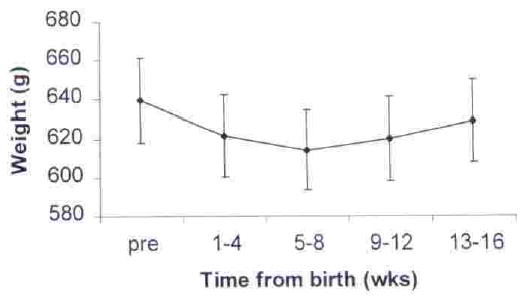
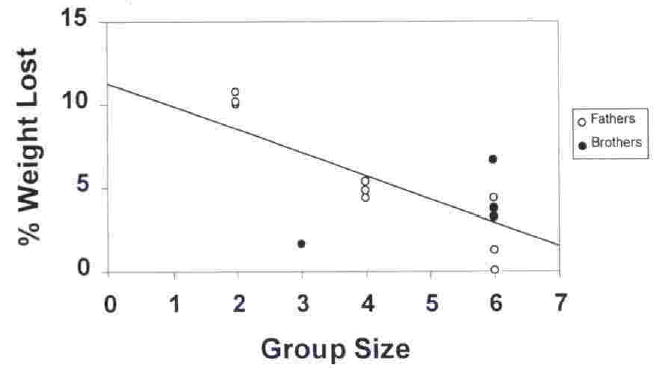
We examined changes in weight for 10 captive adult male cotton-top tamarins (Saguinus oedipus) from before the birth of infants through the first 16 weeks of infant life. Compared to before birth, males weighed significantly less in Weeks 1-4, 5-8, and 9-12 following the birth. Weights in Weeks 13-16 did not differ significantly from prebirth weights. Maximum weight loss for individual males ranged from 1.3 to 10.8% of prebirth body weight. Males in groups with fewer helpers lost significantly more weight than ones in groups with more helpers. For the 3 males that had no helper other than their mates, weight loss was particularly striking, ranging from 10.0 to 10.8% of their prebirth body weight. These results suggest that caring for infants is energetically costly, and that in this cooperatively breeding species, the presence of more individuals to share the burden of infant carrying reduces the cost to individual caregivers.
Figures
References
-
- Achenbach GG, Snowdon CT. Responses to sibling birth in juvenile cotton-top tamarins (Saguinus oedipus) Behaviour. 1998;135:845–862.
-
- Baker AJ, Dietz JM, Kleiman DG. Behavioural evidence for monopolization of paternity in multi-male groups of golden lion tamarins. Anim Behav. 1993;46:1091–1103.
-
- Caine NG. Visual scanning by tamarins. Folia Primatol. 1984;43:59–67.
-
- Caine, N. G. (1993). Flexibility and co-operation as unifying themes in Saguinus social organization and behaviour: The role of predation pressures. In Rylands, A. B. (ed.). Marmosets and Tarmarins: Systematics. Behaviour and Ecology Oxford University Press. Oxford, pp. 200–219
-
- Cleveland J, Snowdon CT. Social development during the first twenty weeks in the cotton-top tamarin (Saguinus oedipus) Anim Behav. 1984;32:432–444.
Grants and funding
LinkOut - more resources
Full Text Sources