


Monomethylarsonous acid induces transformation of human bladder cells
- PMID: 16806342
- PMCID: PMC2851136
- DOI: 10.1016/j.taap.2006.04.011
Monomethylarsonous acid induces transformation of human bladder cells
Abstract
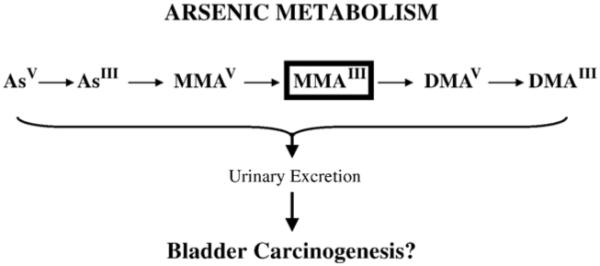
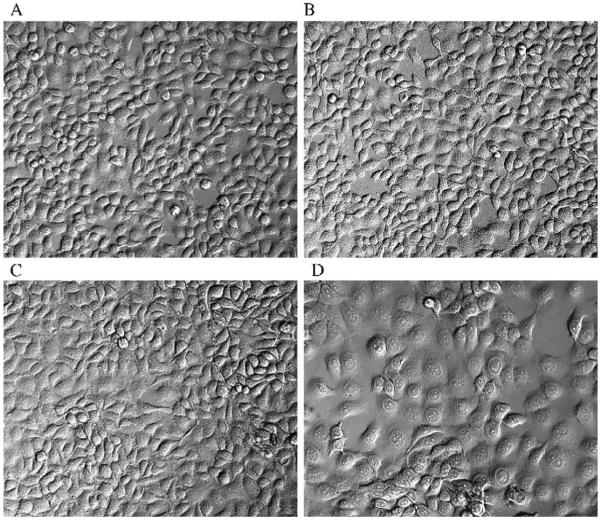
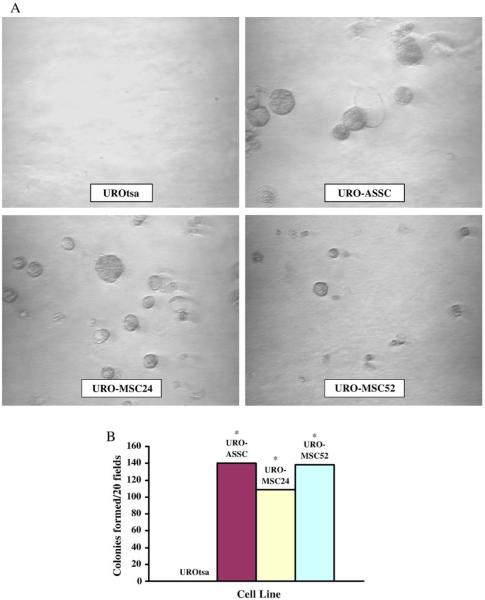
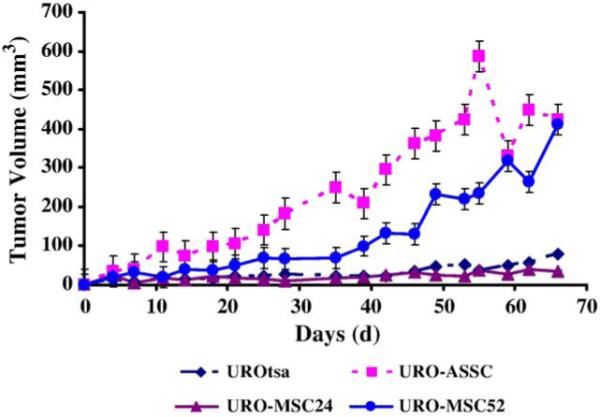
Arsenic is a human bladder carcinogen. Arsenic is methylated to both monomethyl and dimethyl metabolites which have been detected in human urine. The trivalent methylated arsenicals are more toxic than inorganic arsenic. It is unknown if these trivalent methylated metabolites can directly cause malignant transformation in human cells. The goal of this study is determine if monomethylarsonous acid (MMA(III)) can induce malignant transformation in a human bladder urothelial cell line. To address this goal, a non-tumorigenic human urothelial cell line (UROtsa) was continuously exposed to 0.05 muM MMA(III) for 52 weeks. Hyperproliferation was the first phenotypic change observed in exposed UROtsa (URO-MSC). After 12 weeks of exposure, doubling time had decreased from 42 h in unexposed control cells to 27 h in URO-MSC. Hyperproliferation continued to be a quality possessed by the URO-MSC cells after both 24 and 52 weeks of exposure to MMA(III), which had a 40-50% reduction in doubling time. Throughout the 52-week exposure, URO-MSC cells retained an epithelial morphology with subtle morphological differences from control cells. 24 weeks of MMA(III) exposure was required to induce anchorage-independent growth as detected by colony formation in soft agar, a characteristic not found in UROtsa cells. To further substantiate that malignant transformation had occurred, URO-MSC cells were tested after 24 and 52 weeks of exposure to MMA(III) for the ability to form tumors in SCID mice. Enhanced tumorigenicity in SCID mouse xenografts was observed after 52 weeks of treatment with MMA(III). These observations are the first demonstration of MMA(III)-induced malignant transformation in a human bladder urothelial cell line and provide important evidence that MMA(III) may be carcinogenic in human tissues.
Figures
References
-
- Ahmad S, Kitchin KT, Cullen WR. Plasmid DNA damage caused by methylated arsenicals, ascorbic acid and human liver ferritin. Toxicol. Lett. 2002;133:47–57. - PubMed
-
- Aposhian HV. Enzymatic methylation of arsenic species and other new approaches to arsenic toxicity. Annu. Rev. Pharmacol. Toxicol. 1997;37:397–419. - PubMed
-
- Aposhian HV, Gurzau ES, Le XC, Gurzau A, Healy SM, Lu X, Ma M, Yip Li., Zakharyan RA, Maiorina RM, Dart RC, Tircus MG, Gonzalez-Ramirez D, Morgan DL, Avram D, Aposhian MM. Occurrence of monomethylarsonous acid in urine of humans exposed to norganic arsenic. Chem. Res. Toxicol. 2000a;13:693–697. - PubMed
-
- Aposhian HV, Zheng B, Aposhian MM, Le XC, Cebrian ME, Cullen W, Zakharyan RA, Ma M, Dart RC, Cheng Z, Andrews P, Yip Li., ’Malley GF, Maiorino RM, Van Voorhies W, Healy SM, Titcomb A. DMPA-arsenic challenge test. II. Modulation of arsenic species, including monomethylarsonous acid (MMA(III)), excreted in human urine. Toxicol. Appl. Pharmacol. 2000b;165:74–83. - PubMed
-
- Basu A, Mahata J, Gupta S, Giri AK. Genetic toxicology of a paradoxical human carcinogen, arsenic: a review. Mutat. Res. 2001;488:171–194. - PubMed
Publication types
MeSH terms
Substances
Grants and funding
LinkOut - more resources
Full Text Sources
Other Literature Sources
