. 2006 Jun 28;26(26):7121-6.
doi: 10.1523/JNEUROSCI.0943-06.2006.

Actions and consequences in bimanual interaction are represented in different coordinate systems

Affiliations

Actions and consequences in bimanual interaction are represented in different coordinate systems

Paul M Bays et al. J Neurosci. .

Abstract

Moving one part of the body can generate interaction forces that tend to destabilize other parts of the body. However, stability is maintained by mechanisms that predict and actively oppose these interaction forces. When our body or environment changes, these anticipatory mechanisms adapt so as to continue to produce accurate predictions. In this study, we examine the acquisition of a novel predictive coordination between the arms, in a situation in which a force is produced on one hand as a consequence of the action of the other hand. Specifically, a force was applied to the left hand that depended on the velocity of the right hand. With practice, subjects learned to stabilize the perturbed left arm during right-arm movements by predicting and actively opposing the externally applied forces. After adaptation, we examined how learning generalized to a new joint configuration of the right or left arm to investigate the coordinate systems in which the internal transformation from movement to force is represented. This revealed a dissociation between the representation of the action of the right arm and the representation of its consequence, that is the force on the left arm. The movement is represented in extrinsic coordinates related to the velocity of the hand, whereas the force resulting from the movement is represented in a joint-based intrinsic coordinate system.


Figures
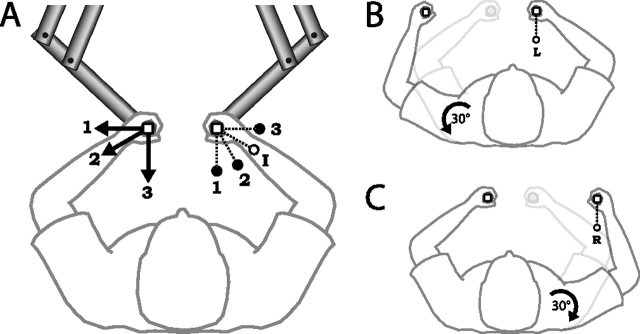
Figure 1.
Figure 1.
Apparatus and task. A, Posture during the training session. Each trial began with the hands positioned in home positions (white squares) 43 cm in front and 8 cm to either side of the subject’s midline. Subjects made an out-and-back movement of their right hand to one of three target locations (1–3, filled circles). Forces were applied to the left hand determined by the motion of the right hand. Arrows illustrate the direction of force generated during a straight-line outward movement to each target. On intermediate target trials, subjects made right-hand movements to a fourth target location (I, open circle). B, Posture and target location (L, open circle) on left-arm rotation trials. C, Posture and target location (R, open circle) on right-arm rotation trials.
Figure 2.
Figure 2.
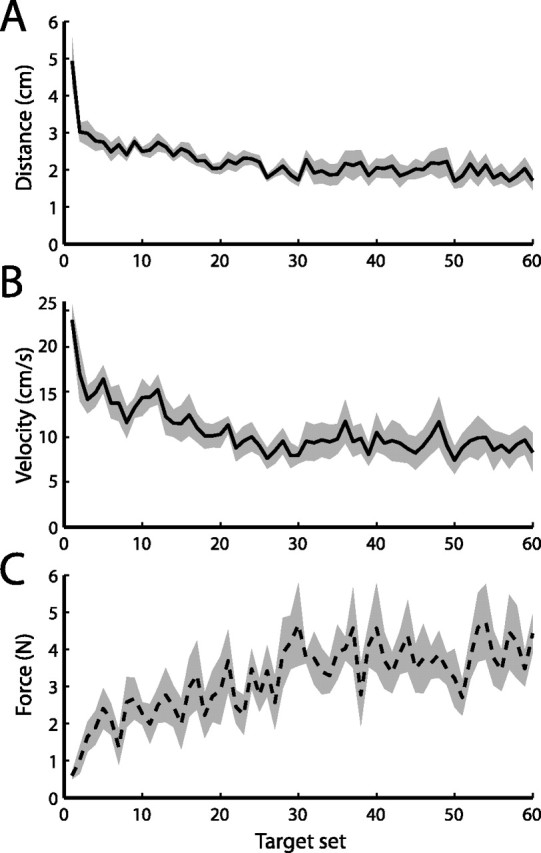
Adaptation over the training session. A, Peak distance of left hand from home position. Mean across each set of six trials; height of shaded area indicates ±1 SE across subjects. B, Magnitude of left-hand velocity at peak right-hand velocity toward target. Mean across each set of six trials; shaded area indicates ±1 SE. C, Mean magnitude of force generated by left hand on catch trials at peak right-hand velocity toward target. Shaded area indicates ±1 SE.
Figure 3.
Figure 3.
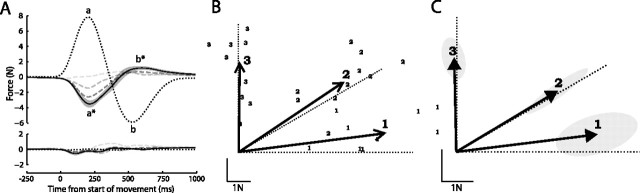
Time course and direction of left-hand forces during the training session. A, Mean left-hand force perpendicular (top) and parallel (bottom) to the right-hand target direction as a function of time from right-hand movement onset. The dotted line shows mean force applied by the manipulandum on field trials. Mean forces generated by subjects are plotted for the first catch trial (light gray dashed line) and averaged across catch trials 1–10 (mid-gray dashed line), 11–30 (dark gray dashed line), and 31–60 (solid line; shaded area represents ±1 SE across subjects). B, C, Arrows indicate mean force vectors generated on catch trials 31–60 for each training target, for a typical subject (B; small digits indicate data points from individual trials) and averaged across all subjects (C; with 95% confidence ellipses). Dotted lines indicate direction of mean force vectors generated by the manipulandum on field trials for each target.
Figure 4.
Figure 4.
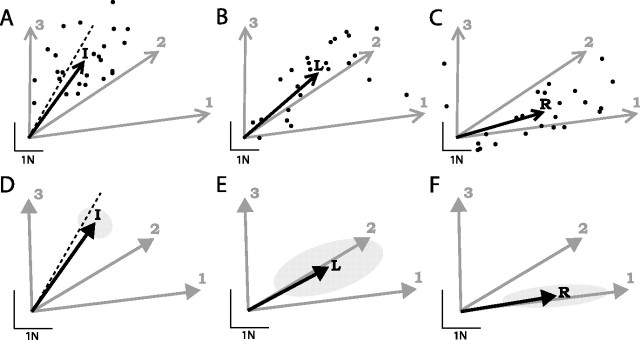
Generalization of learning. Mean force vectors (black arrows) generated on generalization trials, for a typical subject (A–C; with data points from individual trials) and averaged across all subjects (D–F; with 95% confidence ellipses). Training target forces are replotted for comparison (gray arrows). A, D, Intermediate target trials. Dashed line indicates 30°. B, E, Left-arm rotation trials. C, F, Right arm rotation trials.

References

    1. Bagesteiro LB, Sainburg RL (2002). Handedness: dominant arm advantages in control of limb dynamics. J Neurophysiol 88:2408–2421. - PMC - PubMed
    1. Bagesteiro LB, Sainburg RL (2003). Nondominant arm advantages in load compensation during rapid elbow joint movements. J Neurophysiol 90:1503–1513. - PMC - PubMed
    1. Baraduc P, Wolpert DM (2002). Adaptation to a visuomotor shift depends on the starting posture. J Neurophysiol 88:973–981. - PubMed
    1. Blakemore SJ, Goodbody SJ, Wolpert DM (1998). Predicting the consequences of our own actions: the role of sensorimotor context estimation. J Neurosci 18:7511–7518. - PMC - PubMed
    1. Brashers-Krug T, Shadmehr R, Bizzi E (1996). Consolidation in human motor memory. Nature 382:252–255. - PubMed

Publication types