


Disclosure of medical errors: what factors influence how patients respond?
- PMID: 16808770
- PMCID: PMC1924693
- DOI: 10.1111/j.1525-1497.2006.00465.x
Disclosure of medical errors: what factors influence how patients respond?
Abstract
Background: Disclosure of medical errors is encouraged, but research on how patients respond to specific practices is limited.
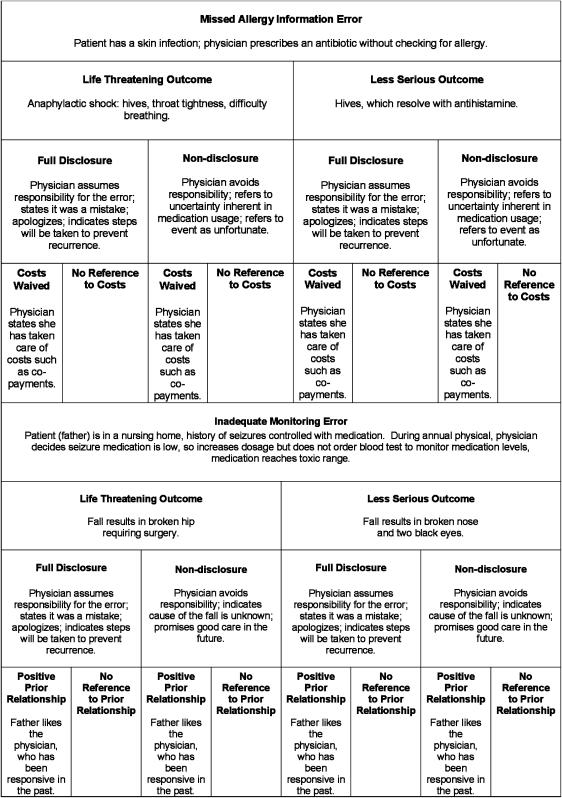
Objective: This study sought to determine whether full disclosure, an existing positive physician-patient relationship, an offer to waive associated costs, and the severity of the clinical outcome influenced patients' responses to medical errors.
Participants: Four hundred and seven health plan members participated in a randomized experiment in which they viewed video depictions of medical error and disclosure.
Design: Subjects were randomly assigned to experimental condition. Conditions varied in type of medication error, level of disclosure, reference to a prior positive physician-patient relationship, an offer to waive costs, and clinical outcome.
Measures: Self-reported likelihood of changing physicians and of seeking legal advice; satisfaction, trust, and emotional response.
Results: Nondisclosure increased the likelihood of changing physicians, and reduced satisfaction and trust in both error conditions. Nondisclosure increased the likelihood of seeking legal advice and was associated with a more negative emotional response in the missed allergy error condition, but did not have a statistically significant impact on seeking legal advice or emotional response in the monitoring error condition. Neither the existence of a positive relationship nor an offer to waive costs had a statistically significant impact.
Conclusions: This study provides evidence that full disclosure is likely to have a positive effect or no effect on how patients respond to medical errors. The clinical outcome also influences patients' responses. The impact of an existing positive physician-patient relationship, or of waiving costs associated with the error remains uncertain.
References
-
- Kohn LT, Corrigan JM, Donaldson M. To Err is Human: Building a Safer Health System. Washington, DC: National Academy Press; 2000. - PubMed
-
- Mazor KM, Simon SR, Yood RA, et al. Health plan members' views about disclosure of medical errors. Ann Intern Med. 2004;140:409–18. - PubMed
-
- Gallagher TH, Waterman AD, Ebers AG, Fraser VJ, Levinson W. Patients and physicians attitudes regarding the disclosure of medical errors. JAMA. 2003;289:1001–7. - PubMed
-
- Blendon R, DesRoches CM, Brodie M, et al. Views of practicing physicians and the public on medical errors. N Engl J Med. 2002;347:1933–40. - PubMed
-
- Hobgood C, Peck CR, Gilbert B, Chappell K, Zou B. Medical errors–what and when: what do patients want to know? Acad Emerg Med. 2002;9:1156–61. - PubMed
Publication types
MeSH terms
LinkOut - more resources
Full Text Sources
Other Literature Sources
Medical