


Dihydroxythiophenes are novel potent inhibitors of human immunodeficiency virus integrase with a diketo acid-like pharmacophore
- PMID: 16809294
- PMCID: PMC1489040
- DOI: 10.1128/JVI.00306-06
Dihydroxythiophenes are novel potent inhibitors of human immunodeficiency virus integrase with a diketo acid-like pharmacophore
Abstract
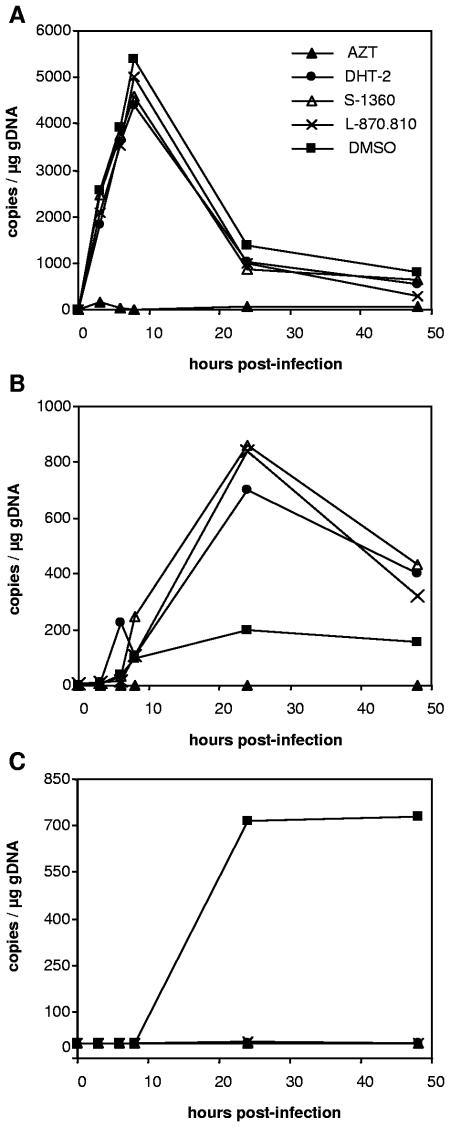
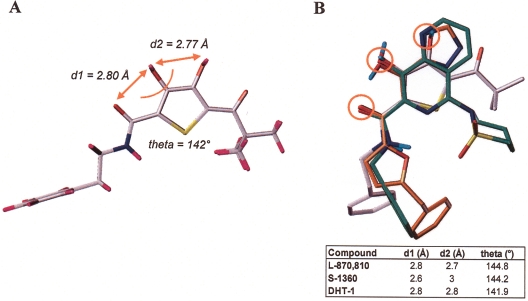
We have identified dihydroxythiophenes (DHT) as a novel series of human immunodeficiency virus type 1 (HIV-1) integrase inhibitors with broad antiviral activities against different HIV isolates in vitro. DHT were discovered in a biochemical integrase high-throughput screen searching for inhibitors of the strand transfer reaction of HIV-1 integrase. DHT are selective inhibitors of integrase that do not interfere with virus entry, as shown by the inhibition of a vesicular stomatitis virus G-pseudotyped retroviral system. Moreover, in quantitative real-time PCR experiments, no effect on the synthesis of viral cDNA could be detected but rather an increase in the accumulation of 2-long-terminal-repeat cycles was detected. This suggests that the integration of viral cDNA is blocked. Molecular modeling and the structure activity relationship of DHT demonstrate that our compound fits into a two-metal-binding motif that has been suggested as the essential pharmacophore for diketo acid (DKA)-like strand transfer inhibitors (Grobler et al., Proc. Natl. Acad. Sci. USA 99:6661-6666, 2002.). This notion is supported by the profiling of DHT on retroviral vectors carrying published resistance mutations for DKA-like inhibitors where DHT showed partial cross-resistance. This suggests that DHT bind to a common site in the catalytic center of integrase, albeit with an altered binding mode. Taken together, our findings indicate that DHT are novel selective strand transfer inhibitors of integrase with a pharmacophore homologous to DKA-like inhibitors.
Figures
References
-
- Adam, B. D., E. Maticka-Tyndale, and J. J. Cohen. 2003. Adherence practices among people living with HIV. AIDS Care 15:263-274. - PubMed
-
- Anthony, N. J., R. P. Gomez, S. D. Young, M. Egbertson, J. S. Wai, L. Zhuang, M. Embrey, L. Tran, J. Y. Melamed, H. M. Langford, J. P. Guare, T. E. Fisher, S. M. Jolly, M. S. Kuo, D. S. Perlow, J. J. Bennett, and T. W. Funk. 2002. Preparation of (poly)azanaphthalenylcarboxamides as HIV integrase inhibitors. PCT Int. Appl. WO 2002030930.
-
- Anthony, N. J. 2004. HIV-1 integrase: a target for new AIDS chemotherapeutics. Curr. Top. Med. Chem. 4:979-990. - PubMed
-
- Asante-Appiah, E., S. H. Seeholzer, and A. M. Skalka. 1998. Structural determinants of metal-induced conformational changes in HIV-1 integrase. J. Biol. Chem. 273:35078-35087. - PubMed
-
- Billich, A. 2003. S-1360 Shionogi-GlaxoSmithKline. Curr. Opin. Investig. Drugs 4:206-209. - PubMed
MeSH terms
Substances
LinkOut - more resources
Full Text Sources
Other Literature Sources
Medical
