


doi: 10.1126/science.1127488.
The influence of a sense of time on human development
Affiliations
- PMID: 16809530
- PMCID: PMC2790864
- DOI: 10.1126/science.1127488
Item in Clipboard
The influence of a sense of time on human development
Science.
.
Abstract
The subjective sense of future time plays an essential role in human motivation. Gradually, time left becomes a better predictor than chronological age for a range of cognitive, emotional, and motivational variables. Socioemotional selectivity theory maintains that constraints on time horizons shift motivational priorities in such a way that the regulation of emotional states becomes more important than other types of goals. This motivational shift occurs with age but also appears in other contexts (for example, geographical relocations, illnesses, and war) that limit subjective future time.
Figures

An example of one pair of advertisements used to study age differences in preferences and memory for products. In each pair, the advertisements were identical except for the slogan. One slogan was related to gaining knowledge. The second promised an emotionally meaningful reward (14).
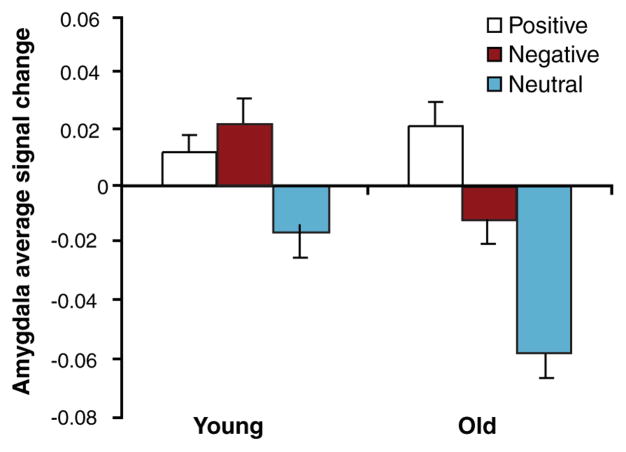
The percentage of signal change in amygdala activation in response to emotionally positive, emotionally neutral, and emotionally negative images. Younger people show significantly increased activation in response to positive and negative images. Older people show increased activation only in response to positive images (20). [Adapted from Mather et al. (2004)]
References
-
- Baltes PB, Mayer KU. The Berlin Aging Study: Aging from 70 to 100. Cambridge Univ. Press; New York: 2001.
-
- Salthouse TA, Davis HP. Dev Rev. 2006;26:31.
-
- Lindenberger U, Marsiske M, Baltes PB. Psychol Aging. 2000;15:417. - PubMed
-
- Baltes PB. Dev Psychol. 1987;23:611.
Publication types
MeSH terms
Grants and funding
LinkOut - more resources
Full Text Sources
Medical
