Effects of job strain on blood pressure: a prospective study of male and female white-collar workers
- PMID: 16809603
- PMCID: PMC1522116
- DOI: 10.2105/AJPH.2004.057679
Effects of job strain on blood pressure: a prospective study of male and female white-collar workers
Abstract
Objectives: We evaluated whether cumulative exposure to job strain increases blood pressure.
Methods: A prospective study of 8395 white-collar workers was initiated during 1991 to 1993. At follow-up, 7.5 years later, 84% of the participants were reassessed to estimate cumulative exposure to job strain.
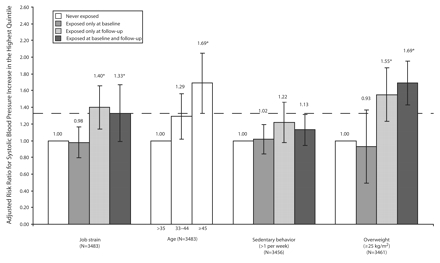
Results: Compared with men who had never been exposed, men with cumulative exposure and those who became exposed during follow-up showed significant systolic blood pressure increments of 1.8 mm Hg (95% confidence interval [CI]=0.1, 3.5) and 1.5 mm Hg (95% CI=0.2, 2.8), respectively, and relative risks of blood pressure increases in the highest quintile group of 1.33 (95% CI = 1.01, 1.76) and 1.40 (95% CI = 1.14, 1.73). Effect magnitudes were smaller among women. Effects tended to be more pronounced among men and women with low levels of social support at work.
Conclusions: Among these white-collar workers, exposure to cumulative job strain had a modest but significant effect on systolic blood pressure among men. The risk was of comparable magnitude to that observed for age and sedentary behavior. Men and women with low levels of social support at work appeared to be at higher risk for increases in blood pressure.
Figures
References
-
- Kannel WB. Risk factors in hypertension. J Cardiovasc Pharmacol. 1989;13(suppl 1):S4–S10. - PubMed
-
- Pickering TG. Short-term variability of blood pressure, and the effects of physical and mental activity. In: Ambulatory Monitoring and Blood Pressure Variability. London, England: Science Press Ltd; 1990.
-
- Kaplan NM. Clinical Hypertension. 5th ed. Balti-more, Md: Williams & Wilkins; 1990.
-
- MacMahon S, Peto R, Cutler J, et al. Blood pressure, stroke, and coronary heart disease, part 1. Prolonged differences in blood pressure: prospective observational studies corrected for the regression dilution bias. Lancet. 1990;335:765–774. - PubMed
-
- Whelton SP, Chin A, Xin X, He J. Effect of aerobic exercise on blood pressure: a meta-analysis of randomized, controlled trials. Ann Intern Med. 2002;136: 493–503. - PubMed
Publication types
MeSH terms
LinkOut - more resources
Full Text Sources
Medical