Review
doi: 10.1037/0033-2909.132.4.582.
Aging and self-regulated language processing
Affiliations
- PMID: 16822168
- PMCID: PMC2246038
- DOI: 10.1037/0033-2909.132.4.582
Item in Clipboard
Review
Aging and self-regulated language processing
Psychol Bull.
2006 Jul.
Abstract
An adult developmental model of self-regulated language processing (SRLP) is introduced, in which the allocation policy with which a reader engages text is driven by declines in processing capacity, growth in knowledge-based processes, and age-related shifts in reading goals. Evidence is presented to show that the individual reader's allocation policy is consistent across time and across different types of text, can serve a compensatory function in relation to abilities, and is predictive of subsequent memory performance. As such, it is an important facet of language understanding and learning from text through the adult life span.
Copyright (c) 2006 APA, all rights reserved.
Figures
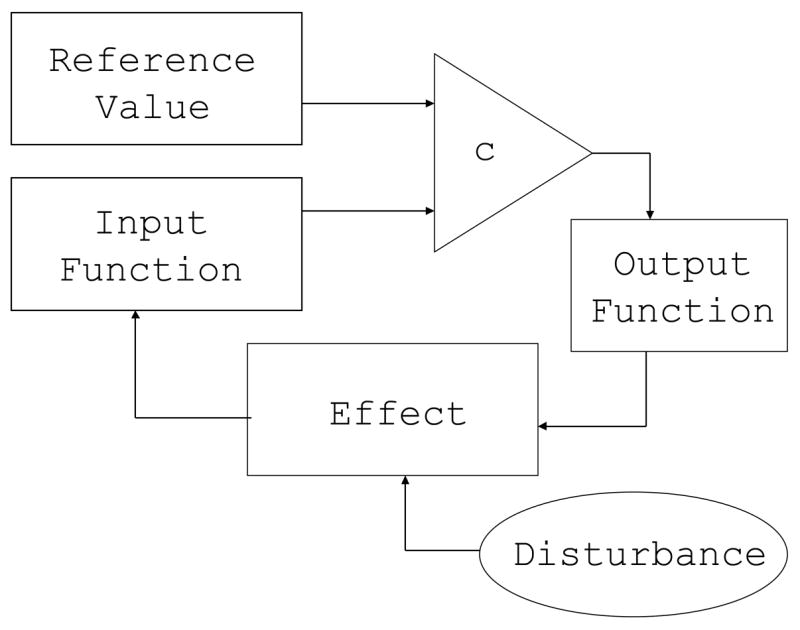
A negative feedback loop.
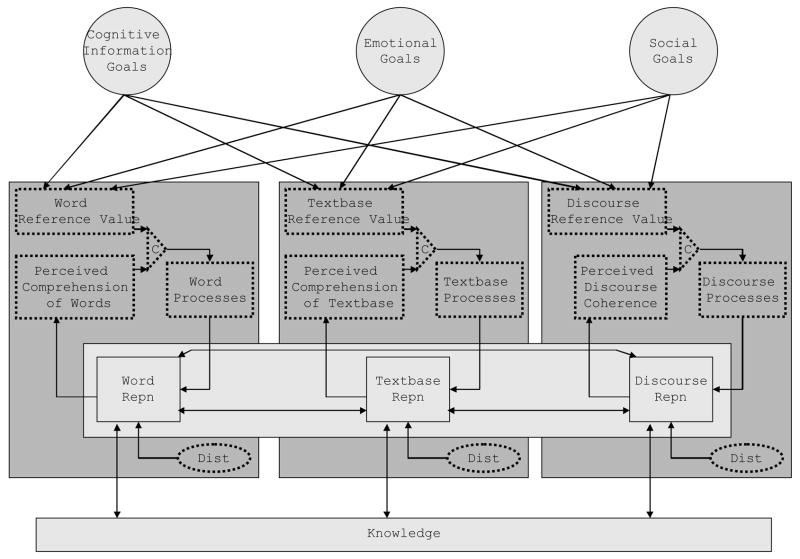
Model of self-regulated discourse understanding.
References
-
- Aaronson D, Ferres S. The word-by-word reading paradigm: An experimental and theoretical approach. In: Kieras DE, Just MA, editors. New methods in reading comprehension research. Hillsdale, N.J.: Erlbaum; 1984. pp. 31–68.
-
- Aaronson D, Scarborough HS. Performance theories for sentence coding: Some qualitative evidence. Journal of Experimental Psychology: Human Perception and Performance. 1976;2:56–70.
-
- Aaronson D, Scarborough HS. Performance theories for sentence coding: Some quantitative models. Journal of Verbal Learning and Verbal Behavior. 1977;16:277–303.
-
- Ackerman PL. Adult intelligence: Sketch of a theory and applications to learning and education. In: Smith MC, Pourchot T, editors. Adult learning and development. Mahwah, NJ: Erlbaum; 1998. pp. 145–158.
-
- Ackerman PL, Rolfhus EL. The locus of adult intelligence: Knowledge, abilities, and nonability traits. Psychology and Aging. 1999;14:314–330. - PubMed
Publication types
MeSH terms
Grants and funding
LinkOut - more resources
Full Text Sources
Medical
Research Materials