


Relationship between resident workload and self-perceived learning on inpatient medicine wards: a longitudinal study
- PMID: 16824224
- PMCID: PMC1550230
- DOI: 10.1186/1472-6920-6-35
Relationship between resident workload and self-perceived learning on inpatient medicine wards: a longitudinal study
Abstract
Background: Despite recent residency workload and hour limitations, little research on the relationship between workload and learning has been done. We sought to define residents' perceptions of the optimal patient workload for learning, and to determine how certain variables contribute to those perceptions. Our hypothesis was that the relationship between perceived workload and learning has a maximum point (forming a parabolic curve): that either too many or too few patients results in sub-optimal learning.
Methods: Residents on inpatient services at two academic teaching hospitals reported their team and individual patient censuses, and rated their perception of their learning; the patient acuity; case variety; and how challenged they felt. To estimate maximum learning scores, linear regression models with quadratic terms were fit on learning score.
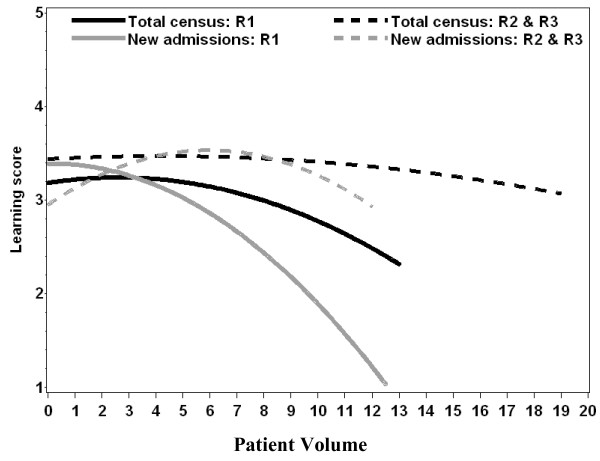
Results: Resident self-perceived learning correlated with higher acuity and greater heterogeneity of case variety. The equation of census versus learning score, adjusted for perception of acuity and case mix scores, showed a parabolic curve in some cases but not in others.
Conclusion: These data suggest that perceived resident workload is complex, and impacted by additional variables including patient acuity and heterogeneity of case variety. Parabolic curves exist for interns with regard to overall census and for senior residents with regard to new admissions on long call days.
Figures

References
-
- ACGME Report of the ACGME Work Group on Resident Duty Hours: Accreditation Council for Graduate Medical Education (ACGME) p. 9.
-
- Wartman SA, O'Sullivan PS, Cyr MG. The Service/Education Conflict in Residency Programs. Journal of General Internal Medicine. 1990;5:S59–S69. - PubMed
MeSH terms
LinkOut - more resources
Full Text Sources
Miscellaneous
