


Short-term sprint interval versus traditional endurance training: similar initial adaptations in human skeletal muscle and exercise performance
- PMID: 16825308
- PMCID: PMC1995688
- DOI: 10.1113/jphysiol.2006.112094
Short-term sprint interval versus traditional endurance training: similar initial adaptations in human skeletal muscle and exercise performance
Abstract
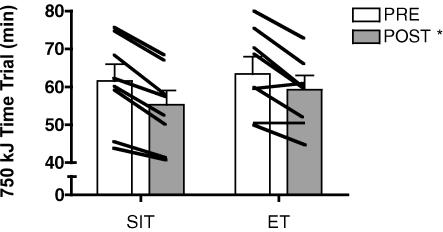
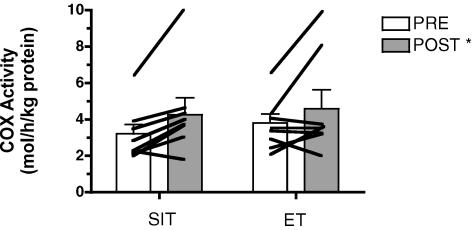
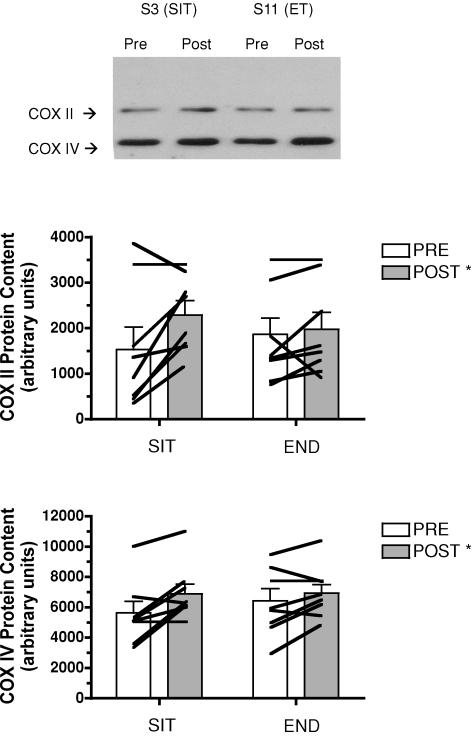
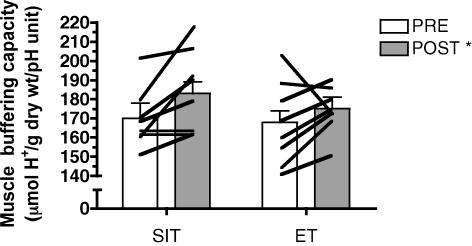
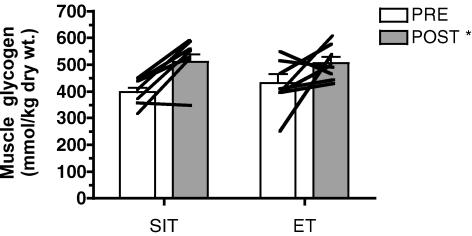
Brief, intense exercise training may induce metabolic and performance adaptations comparable to traditional endurance training. However, no study has directly compared these diverse training strategies in a standardized manner. We therefore examined changes in exercise capacity and molecular and cellular adaptations in skeletal muscle after low volume sprint-interval training (SIT) and high volume endurance training (ET). Sixteen active men (21 +/- 1 years, ) were assigned to a SIT or ET group (n = 8 each) and performed six training sessions over 14 days. Each session consisted of either four to six repeats of 30 s 'all out' cycling at approximately 250% with 4 min recovery (SIT) or 90-120 min continuous cycling at approximately 65% (ET). Training time commitment over 2 weeks was approximately 2.5 h for SIT and approximately 10.5 h for ET, and total training volume was approximately 90% lower for SIT versus ET ( approximately 630 versus approximately 6500 kJ). Training decreased the time required to complete 50 and 750 kJ cycling time trials, with no difference between groups (main effects, P </= 0.05). Biopsy samples obtained before and after training revealed similar increases in muscle oxidative capacity, as reflected by the maximal activity of cytochrome c oxidase (COX) and COX subunits II and IV protein content (main effects, P </= 0.05), but COX II and IV mRNAs were unchanged. Training-induced increases in muscle buffering capacity and glycogen content were also similar between groups (main effects, P </= 0.05). Given the large difference in training volume, these data demonstrate that SIT is a time-efficient strategy to induce rapid adaptations in skeletal muscle and exercise performance that are comparable to ET in young active men.
Figures
Comment in
-
To perform your best: work hard not long.J Physiol. 2006 Sep 15;575(Pt 3):690. doi: 10.1113/jphysiol.2006.117317. Epub 2006 Jul 27. J Physiol. 2006. PMID: 16873398 Free PMC article. No abstract available.
References
-
- Abe H. Role of histidine-related compounds as intracellular proton buffering constituents in vertebrate muscle. Biochemistry (Moscow) 2000;65:757–765. - PubMed
-
- Atherton PJ, Babraj J, Smith K, Singh J, Rennie MJ, Wackerhage H. Selective activation of AMPK-PGC-1alpha or PKB-TSC2-mTOR signaling can explain specific adaptive responses to endurance or resistance training-like electrical muscle stimulation. FASEB J. 2005;19:786–788. - PubMed
-
- Bell GJ, Wenger HA. The effect of one-legged sprint training on intramuscular pH and nonbicarbonate buffering capacity. Eur J Appl Physiol. 1988;58:158–164. - PubMed
-
- Burgomaster KA, Heigenhauser GJF, Gibala MJ. Effect of short-term sprint interval training on human skeletal muscle carbohydrate metabolism during exercise and time trial performance. J Appl Physiol. 2006;100:2041–2047. - PubMed
-
- Burgomaster KA, Hughes SC, Heigenhauser GJF, Bradwell SN, Gibala MJ. Six sessions of sprint interval training increases muscle oxidative potential and cycle endurance capacity in humans. J Appl Physiol. 2005;98:1985–1990. - PubMed
Publication types
MeSH terms
Substances
LinkOut - more resources
Full Text Sources
Other Literature Sources
Medical
