


Comparison of aerobic and photosynthetic Rhodobacter sphaeroides 2.4.1 proteomes
- PMID: 16828186
- PMCID: PMC2794424
- DOI: 10.1016/j.mimet.2006.04.021
Comparison of aerobic and photosynthetic Rhodobacter sphaeroides 2.4.1 proteomes
Abstract
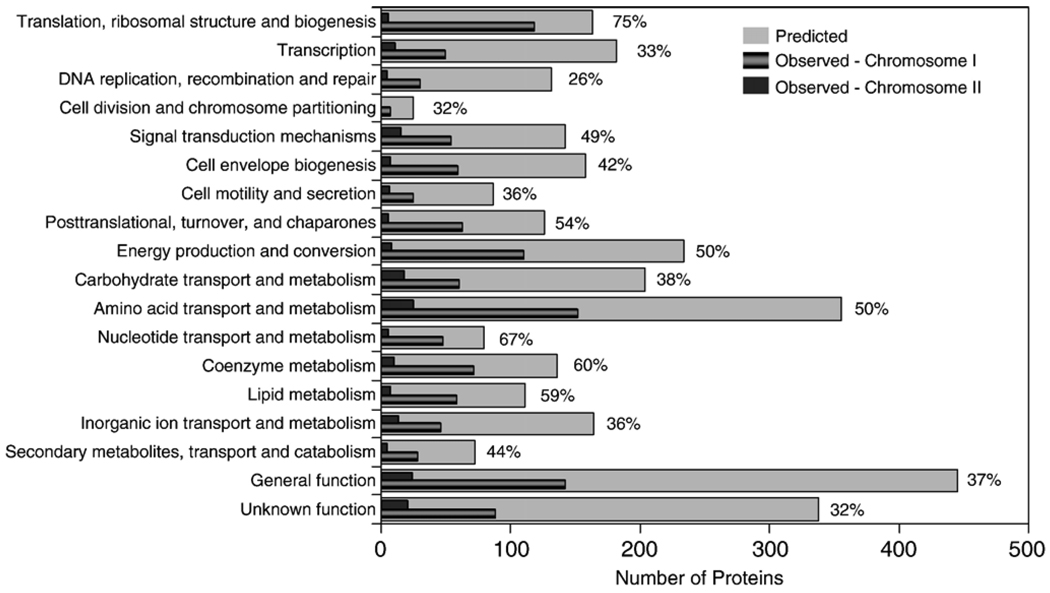
The analysis of proteomes from aerobic and photosynthetic Rhodobacter sphaeroides 2.4.1 cell cultures by liquid chromatography-mass spectrometry yielded approximately 6,500 high confidence peptides representing 1,675 gene products (39% of the predicted proteins). The identified proteins corresponded primarily to open reading frames (ORFs) contained within the two chromosomal elements of this bacterium, but a significant number were also observed from ORFs associated with 5 naturally occurring plasmids. Using the accurate mass and time (AMT) tag approach, comparative studies showed that a number of proteins were uniquely detected within the photosynthetic cell culture. The estimated abundances of proteins observed in both aerobic respiratory and photosynthetic grown cultures were compared to provide insights into bioenergetic models for both modes of growth. Additional emphasis was placed on gene products annotated as hypothetical to gain information as to their potential roles within these two growth conditions. Where possible, transcriptome and proteome data for R. sphaeroides obtained under the same culture conditions were also compared.
Figures


References
-
- Anderson KK, Monroe ME, Daly DS. Estimating probabilities of peptide assignments to LC-FTICR-MS observations. Proc of the Intern Conf METMBS. 2004:151–156.
-
- Armitage JP, Schmitt R. Bacterial chemotaxis: Rhodobacter sphaeroides and Sinorhizobium meliloti — variations on a theme? Microbiology. 1997;143:3671–3682. - PubMed
-
- Belov ME, Anderson GA, Wingerd MA, Udseth HR, Tang KQ, Prior DC, Swanson KR, Buschbach MA, Strittmatter EF, Moore RJ, Smith RD. An automated high performance capillary liquid chromatography-Fourier transform ion cyclotron resonancemass spectrometer for high-throughput proteomics. J. Am. Soc. Mass Spectrom. 2004;15:212–232. - PubMed
Publication types
MeSH terms
Substances
Grants and funding
LinkOut - more resources
Full Text Sources
