


Behaviour problems in 18- to 36-month old children of alcoholic fathers: secure mother-infant attachment as a protective factor
- PMID: 16830441
- PMCID: PMC2664663
- DOI: 10.1017/s0954579406060214
Behaviour problems in 18- to 36-month old children of alcoholic fathers: secure mother-infant attachment as a protective factor
Abstract
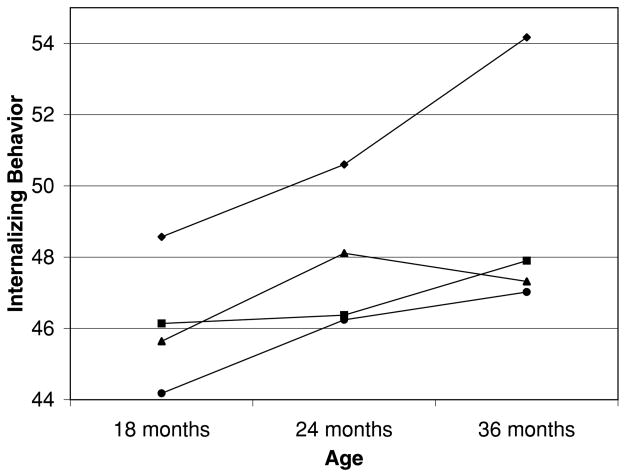
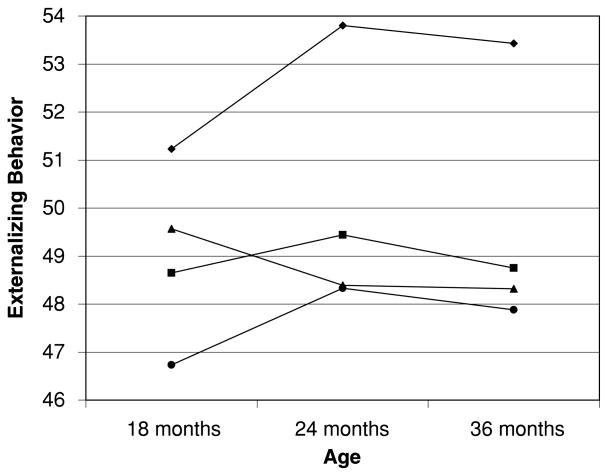
This study examined the relationship between paternal alcoholism and toddler behavior problems from 18 to 36 months of age, as well as the potential moderating effects of 12-month infant-mother attachment security on this relationship. Children with alcoholic fathers had higher levels of internalizing and externalizing behavior than children of nonalcoholic fathers. Simple effects testing of an interaction effect of child age, group, and attachment security with mothers on externalizing behaviour suggested that at 24 and 36 months of age mother-infant attachment security moderated the relationship between alcohol group status and externalizing behaviour. Namely, within the alcohol group, those children with secure relationships with their mothers had significantly lower externalizing than insecure children of alcoholics. A similar pattern was noted for internalizing behavior at 36 months of age. Implications for intervention are discussed.
Figures
Similar articles
-
Mother-infant and father-infant attachment among alcoholic families.Dev Psychopathol. 2002 Spring;14(2):253-78. doi: 10.1017/s0954579402002043. Dev Psychopathol. 2002. PMID: 12030691 Free PMC article.
-
Longitudinal links from attachment with mothers and fathers to adolescent substance use: Internalizing and externalizing pathways.Dev Sci. 2024 Nov;27(6):e13539. doi: 10.1111/desc.13539. Epub 2024 Jun 21. Dev Sci. 2024. PMID: 39031676
-
Configurations of mother-child and father-child attachment as predictors of internalizing and externalizing behavioral problems: An individual participant data (IPD) meta-analysis.New Dir Child Adolesc Dev. 2021 Nov;2021(180):67-94. doi: 10.1002/cad.20450. Epub 2022 Jan 10. New Dir Child Adolesc Dev. 2021. PMID: 35005834
-
A conceptual model for the development of externalizing behavior problems among kindergarten children of alcoholic families: role of parenting and children's self-regulation.Dev Psychol. 2007 Sep;43(5):1187-201. doi: 10.1037/0012-1649.43.5.1187. Dev Psychol. 2007. PMID: 17723044 Free PMC article.
-
Child-father attachment in early childhood and behavior problems: A meta-analysis.New Dir Child Adolesc Dev. 2021 Nov;2021(180):43-66. doi: 10.1002/cad.20434. Epub 2021 Oct 14. New Dir Child Adolesc Dev. 2021. PMID: 34651413 Review.
Cited by
-
Adverse childhood experiences and psychopathology in adolescents from northern Chile: the moderating role of the attachment style.Psicol Reflex Crit. 2023 Nov 28;36(1):37. doi: 10.1186/s41155-023-00273-z. Psicol Reflex Crit. 2023. PMID: 38015372 Free PMC article.
-
Early Childhood Risk and Protective Factors Predicting Resilience against Adolescent Substance Use.Advers Resil Sci. 2020 Jun;1(2):107-119. doi: 10.1007/s42844-020-00007-5. Epub 2020 Jun 16. Advers Resil Sci. 2020. PMID: 33768210 Free PMC article.
-
Attachment-Based Parenting Interventions and Evidence of Changes in Toddler Attachment Patterns: An Overview.Clin Child Fam Psychol Rev. 2022 Dec;25(4):737-753. doi: 10.1007/s10567-022-00405-4. Epub 2022 Aug 18. Clin Child Fam Psychol Rev. 2022. PMID: 35982272 Free PMC article. Review.
-
Mental Health Literacy Content for Children of Parents with a Mental Illness: Thematic Analysis of a Literature Review.Brain Sci. 2017 Oct 26;7(11):141. doi: 10.3390/brainsci7110141. Brain Sci. 2017. PMID: 29072587 Free PMC article.
-
Mental Health Literacy of Youth That Have a Family Member With a Mental Illness: Outcomes From a New Program and Scale.Front Psychiatry. 2019 Feb 4;10:2. doi: 10.3389/fpsyt.2019.00002. eCollection 2019. Front Psychiatry. 2019. PMID: 30778305 Free PMC article.
References
-
- Achenbach TM. Manual for the Child Behavior Checklist/2–3 and 1992 Profile. Burlington, VT: University of Vermont, Department of Psychiatry; 1992.
-
- Achenbach TM, Rescorla LA. Manual for ASEBA Preschool Forms and Profiles. Burlington, VT: University of Vermont, Research Center for Children, Youth, and Families; 2000.
-
- Ainsworth MDS, Wittig BA. Attachment and exploratory behavior of one year olds in a strange situation. In: Foss BM, editor. Determinants of infant behavior. Vol. 4. London: Methuen; 1969.
-
- Andreason NC, Rice J, Endicott J, Reich T, Coryell W. The family history approach to diagnosis. Archives of General Psychiatry. 1986;43:421–429. - PubMed
-
- Anthony JC, Warner LA, Kessler RC. Comparative epidemiology of dependence on tobacco, alcohol, controlled substances, and inhalants: Basic findings from the National Comorbidity Survey. Experimental and Clinical Psychopharmacology. 1994;2:244–268.
Publication types
MeSH terms
Grants and funding
LinkOut - more resources
Full Text Sources
Medical