


Multiple erythroid isoforms of human long-chain acyl-CoA synthetases are produced by switch of the fatty acid gate domains
- PMID: 16834775
- PMCID: PMC1543647
- DOI: 10.1186/1471-2199-7-21
Multiple erythroid isoforms of human long-chain acyl-CoA synthetases are produced by switch of the fatty acid gate domains
Abstract
Background: The formation of acyl-CoA by the action of acyl-CoA synthetases plays a crucial role in membrane lipid turnover, including the plasma membrane of erythrocytes. In human, five Acyl-CoA Synthetase Long-chain (ACSL) genes have been identified with as many as 3 different transcript variants for each.
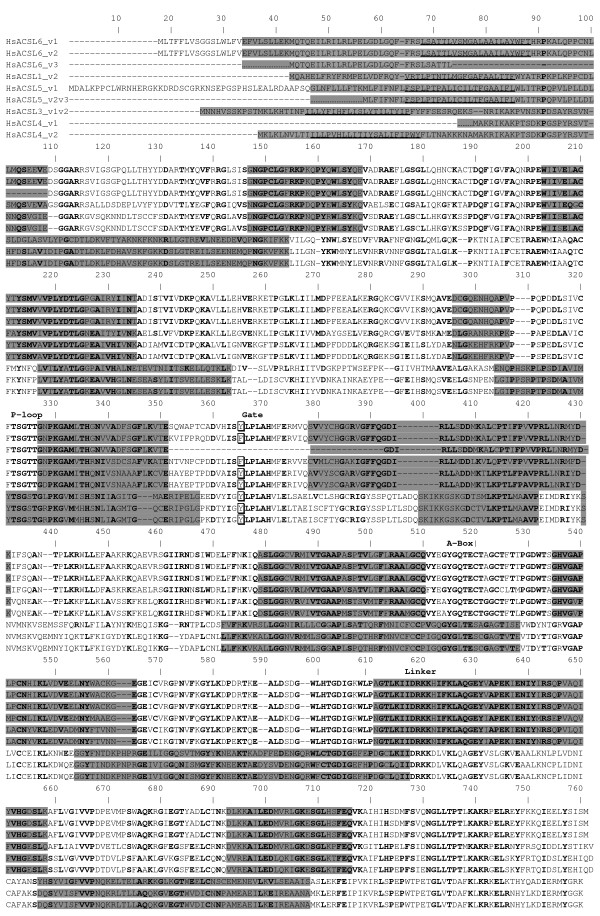
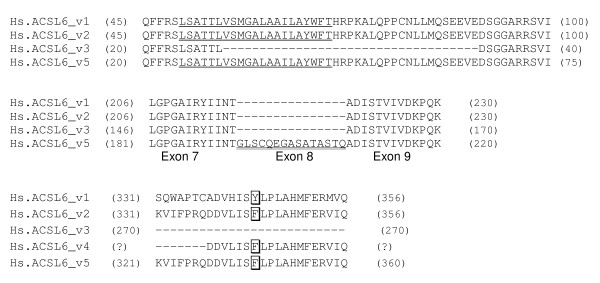
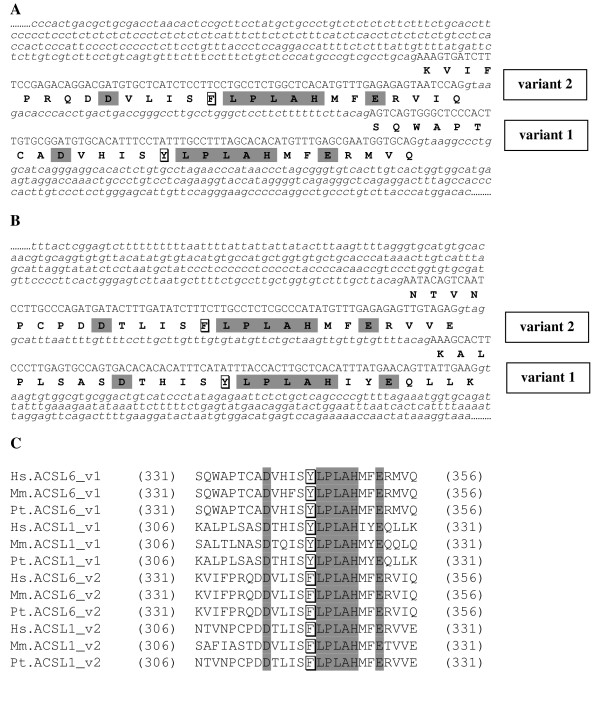
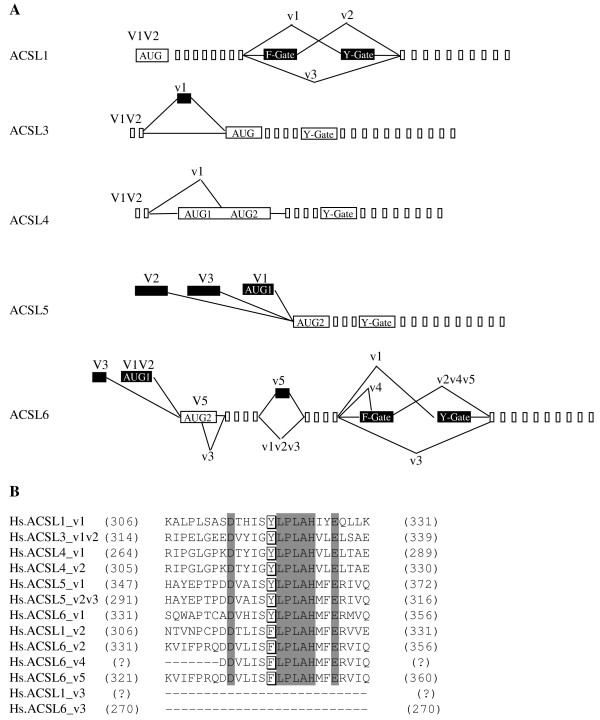
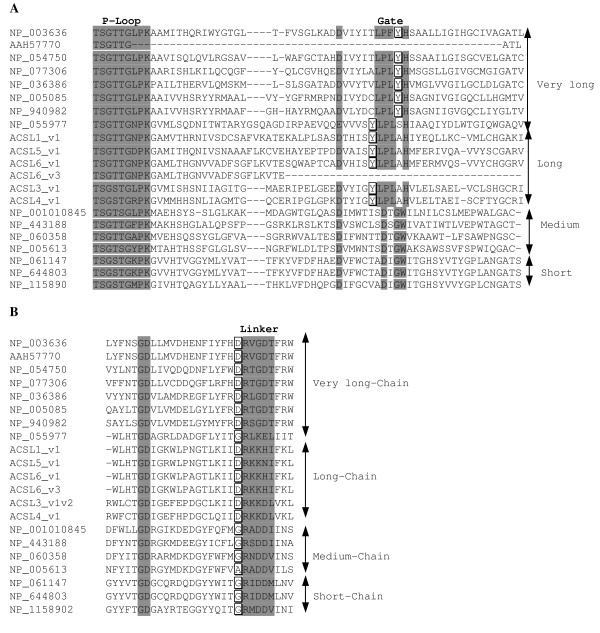
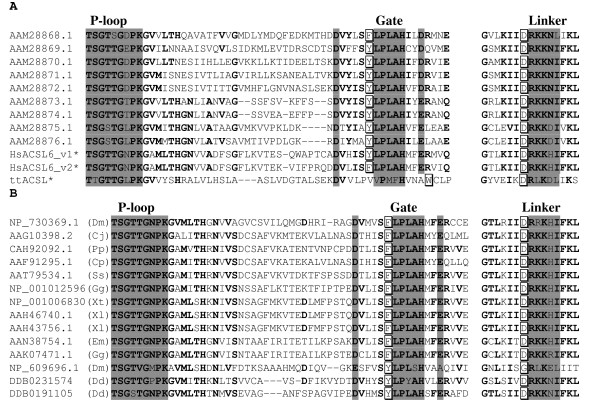
Results: Acyl-CoA Synthetase Long-chain member 6 (ACSL6) is responsible for activation of long-chain fatty acids in erythrocytes. Two additional transcript variants were also isolated from brain and testis. We report the expression in reticulocytes of two new variants and of the one isolated from brain. All three represented different spliced variants of a mutually exclusive exon pair. They encode a slightly different short motif which contains a conserved structural domain, the fatty acid Gate domain. The motifs differ in the presence of either the aromatic residue phenylalanine (Phe) or tyrosine (Tyr). Based on homology, two new isoforms for the closely related ACSL1 were predicted and characterized. One represented a switch of the Phe- to the Tyr-Gate domain motif, the other resulted from the exclusion of both. Swapping of this motif also appears to be common in all mammalian ACSL member 1 and 6 homologs.
Conclusion: We propose that a Phe to Tyr substitution or deletion of the Gate domain, is the structural reason for the conserved alternative splicing that affects these motifs. Our findings support our hypothesis that this region is structurally important to define the activity of these enzymes.
Figures
References
-
- Lands WE, Hart P. Metabolism Of Glycerolipids. Vi. Specificities Of Acyl Coenzyme A: Phospholipid Acyltransferases. J Biol Chem. 1965;240:1905–1911. - PubMed
-
- Hisanaga Y, Ago H, Nakagawa N, Hamada K, Ida K, Yamamoto M, Hori T, Arii Y, Sugahara M, Kuramitsu S, Yokoyama S, Miyano M. Structural basis of the substrate-specific two-step catalysis of long chain fatty acyl-CoA synthetase dimer. J Biol Chem. 2004;279:31717–31726. doi: 10.1074/jbc.M400100200. - DOI - PubMed
-
- Weimar JD, DiRusso CC, Delio R, Black PN. Functional role of fatty acyl-coenzyme A synthetase in the transmembrane movement and activation of exogenous long-chain fatty acids. Amino acid residues within the ATP/AMP signature motif of Escherichia coli FadD are required for enzyme activity and fatty acid transport. J Biol Chem. 2002;277:29369–29376. doi: 10.1074/jbc.M107022200. - DOI - PubMed
-
- Lewin TM, Van Horn CG, Krisans SK, Coleman RA. Rat liver acyl-CoA synthetase 4 is a peripheral-membrane protein located in two distinct subcellular organelles, peroxisomes, and mitochondrial-associated membrane. Arch Biochem Biophys. 2002;404:263–270. doi: 10.1016/S0003-9861(02)00247-3. - DOI - PubMed
Publication types
MeSH terms
Substances
Associated data
- Actions
- Actions
- Actions
- Actions
Grants and funding
LinkOut - more resources
Full Text Sources
Molecular Biology Databases
Miscellaneous
