


Historical estimation of diesel exhaust exposure in a cohort study of U.S. railroad workers and lung cancer
- PMID: 16841258
- PMCID: PMC1550353
- DOI: 10.1007/s10552-006-0027-5
Historical estimation of diesel exhaust exposure in a cohort study of U.S. railroad workers and lung cancer
Erratum in
- Cancer Causes Control. 2007 Feb;18(1):115
Abstract
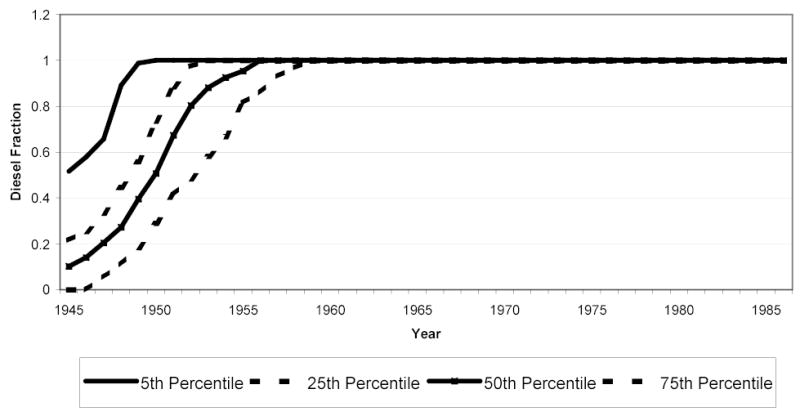
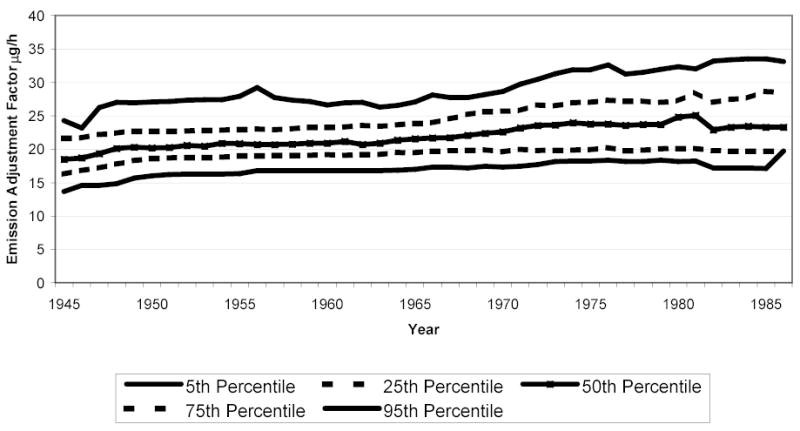
We have previously shown an elevated risk of lung cancer mortality in diesel exhaust exposed railroad workers. To reduce exposure misclassification, we obtained extensive historical information on diesel locomotives used by each railroad. Starting in 1945, we calculated the rate each railroad converted from steam to diesel, creating annual railroad-specific weighting factors for the probability of diesel exposure. We also estimated the average annual exposure intensity based on emission factors. The U.S. Railroad Retirement Board provided railroad assignment and work histories for 52,812 workers hired between 1939-1949, for whom we ascertained mortality from 1959-1996. Among workers hired after 1945, as diesel locomotives were introduced, the relative risk of lung cancer for any exposure was 1.77 (95% CI = 1.50-2.09), and there was evidence of an exposure-response relationship with exposure duration. Exposed workers hired before 1945 had a relative risk of 1.30 (95% CI = 1.19-1.43) for any exposure and there was no evidence of a dose response with duration. There was no evidence of increasing risk using estimated measures of intensity although the overall lung cancer risk remained elevated. In conclusion, although precise historical estimates of exposure are not available, weighting factors helped better define the exposure-response relationship of diesel exhaust with lung cancer mortality.
Figures
References
-
- Office of Environmental Health Hazard Assessment. Health Risk Assessment for Diesel Exhaust. Sacramento, CA: California Environmental Protection Agency; 1998.
-
- Office of Research and Development. HEALTH ASSESSMENT DOCUMENT FOR DIESEL ENGINE EXHAUST. Washington, DC: National Center for Environmental Assessment, U.S. Environmental Protection Agency; 2002 01 May 2002. Report No.: USEPA EPA/600/8–90/057F.
-
- National Toxicology Program. Report on Carcinogens, Tenth Edition: U.S. Department of Health and Human Services, Public Health Service; 2002 December 2002.
Publication types
MeSH terms
Substances
Grants and funding
LinkOut - more resources
Full Text Sources
Medical
