Review
doi: 10.1371/journal.pmed.0030242.
Epub 2006 Jul 25.
Silencing viral infection
Affiliations
- PMID: 16848617
- PMCID: PMC1518680
- DOI: 10.1371/journal.pmed.0030242
Item in Clipboard
Review
Silencing viral infection
PLoS Med.
2006 Jul.
Abstract
The authors describe recent progress and obstacles to harnessing RNA interference to prevent or treat viral infection.
Conflict of interest statement
Figures

siRNAs can be used to silence either viral mRNAs or host genes required for viral entry or replication. This figure shows some possible targets for suppressing HIV replication. Silencing
CCR5 can prevent viral entry, while any viral gene can also be silenced to interfere with viral production. siRNAs could also target the viral long term repeat or even the proviral genomic RNA prior to integration, although whether this can be done is controversial. Targeting multiple genes will enhance viral suppression and reduce the chances of viral escape by sequence mutation.
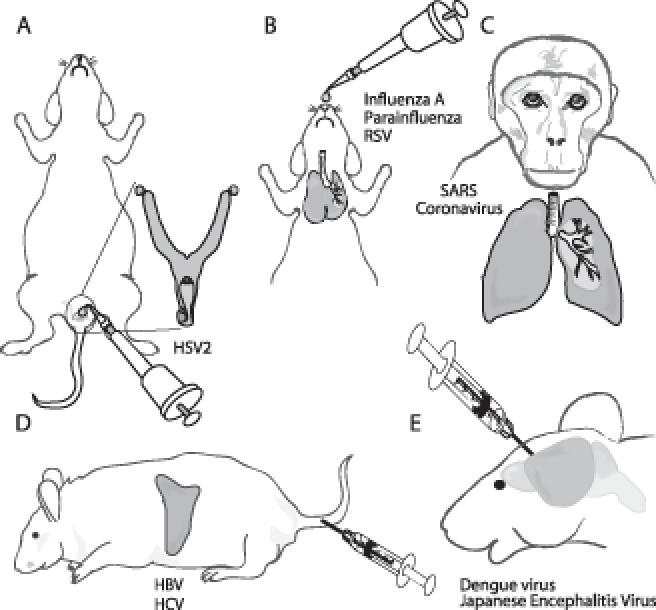
(A) Intravaginal application of siRNAs mixed with a transfection lipid inhibits sexual transmission of HSV-2 in mice [
17]. (B) Intranasal or intratracheal administration of siRNAs, either by themselves or mixed with lipids, protects against respiratory infection in mice [
12,
13,
15]. (C) Intranasal administration of siRNAs in rhesus macaques protects against SARS coronavirus infection [
16]. (D) Intravenous injection of siRNAs incorporated into specialized liposomes inhibits a hepatitis B virus replicon [
19]. (E) Intracerebral injection of siRNAs protects against flavivirus encephalitis [
10]. HSV-2, herpes simplex virus type 2; HBV, hepatitis B virus; HCV, hepatitis C virus; RSV, respiratory syncytial virus.
References
-
- Sullivan CS, Grundhoff AT, Tevethia S, Pipas JM, Ganem D. SV40-encoded microRNAs regulate viral gene expression and reduce susceptibility to cytotoxic T cells. Nature. 2005;435:682–686. - PubMed
-
- Jopling CL, Yi M, Lancaster AM, Lemon SM, Sarnow P. Modulation of hepatitis C virus RNA abundance by a liver-specific microRNA. Science. 2005;309:1577–1581. - PubMed
-
- Krutzfeldt J, Rajewsky N, Braich R, Rajeev KG, Tuschl T, et al. Silencing of microRNAs in vivo with ‘antagomirs’. Nature. 2005;438:685–689. - PubMed
-
- Gitlin L, Karelsky S, Andino R. Short interfering RNA confers intracellular antiviral immunity in human cells. Nature. 2002;418:430–434. - PubMed
Publication types
MeSH terms
Substances
Grants and funding
LinkOut - more resources
Full Text Sources
Other Literature Sources
Medical