


Unloading work of breathing during high-frequency oscillatory ventilation: a bench study
- PMID: 16848915
- PMCID: PMC1750967
- DOI: 10.1186/cc4968
Unloading work of breathing during high-frequency oscillatory ventilation: a bench study
Abstract
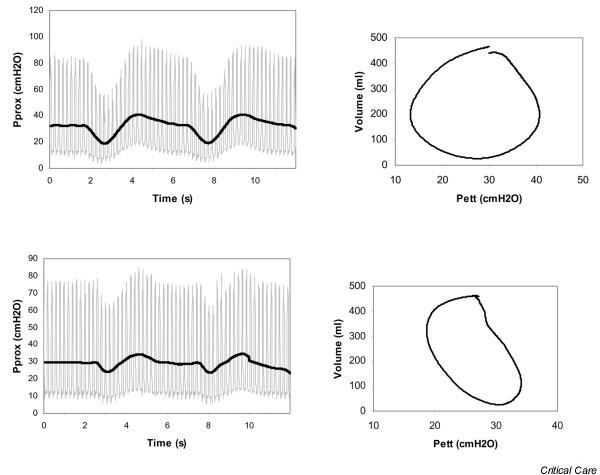
Introduction: With the 3100B high-frequency oscillatory ventilator (SensorMedics, Yorba Linda, CA, USA), patients' spontaneous breathing efforts result in a high level of imposed work of breathing (WOB). Therefore, spontaneous breathing often has to be suppressed during high-frequency oscillatory ventilation (HFOV). A demand-flow system was designed to reduce imposed WOB.
Methods: An external gas flow controller (demand-flow system) accommodates the ventilator fresh gas flow during spontaneous breathing simulation. A control algorithm detects breathing effort and regulates the demand-flow valve. The effectiveness of this system has been evaluated in a bench test. The Campbell diagram and pressure time product (PTP) are used to quantify the imposed workload.
Results: Using the demand-flow system, imposed WOB is considerably reduced. The demand-flow system reduces inspiratory imposed WOB by 30% to 56% and inspiratory imposed PTP by 38% to 59% compared to continuous fresh gas flow. Expiratory imposed WOB was decreased as well by 12% to 49%. In simulations of shallow to normal breathing for an adult, imposed WOB is 0.5 J l-1 at maximum. Fluctuations in mean airway pressure on account of spontaneous breathing are markedly reduced.
Conclusion: The use of the demand-flow system during HFOV results in a reduction of both imposed WOB and fluctuation in mean airway pressure. The level of imposed WOB was reduced to the physiological range of WOB. Potentially, this makes maintenance of spontaneous breathing during HFOV possible and easier in a clinical setting. Early initiation of HFOV seems more possible with this system and the possibility of weaning of patients directly on a high-frequency oscillatory ventilator is not excluded either.
Figures


Comment in
-
Allowing for spontaneous breathing during high-frequency oscillation: the key for final success?Crit Care. 2006;10(4):155. doi: 10.1186/cc4993. Crit Care. 2006. PMID: 16887013 Free PMC article. Review.
References
-
- Putensen C, Mutz NJ, Putensen-Himmer G, Zinserling J. Spontaneous breathing during ventilatory support improves ventilation-perfusion distributions in patients with acute respiratory distress syndrome. Am J Respir Crit Care Med. 1999;159:1241–1248. - PubMed
-
- Putensen C, Muders T, Varelmann D, Wrigge H. The impact of spontaneous breathing during mechanical ventilation. Curr Opin Crit Care. 2006;12:13–18. - PubMed
-
- Sydow M, Burchardi H, Ephraim E, Zielmann S, Crozier TA. Long-term effects of two different ventilatory modes on oxygenation in acute lung injury. Comparison of airway pressure release ventilation and volume-controlled inverse ratio ventilation. Am J Respir Crit Care Med. 1994;149:1550–1556. - PubMed
-
- Wrigge H, Zinserling J, Neumann P, Muders T, Magnusson A, Putensen C, Hedenstierna G. Spontaneous breathing with airway pressure release ventilation favors ventilation in dependent lung regions and counters cyclic alveolar collapse in oleic-acid-induced lung injury: a randomized controlled computed tomography trial. Crit Care. 2005;9:R780–R789. doi: 10.1186/cc3908. - DOI - PMC - PubMed
Publication types
MeSH terms
LinkOut - more resources
Full Text Sources
Other Literature Sources
