Underinvestigation and undertreatment of carotid disease in elderly patients with transient ischaemic attack and stroke: comparative population based study
- PMID: 16849366
- PMCID: PMC1562473
- DOI: 10.1136/bmj.38895.646898.55
Underinvestigation and undertreatment of carotid disease in elderly patients with transient ischaemic attack and stroke: comparative population based study
Abstract
Objective: To identify any underinvestigation of older patients with transient ischaemic attack (TIA) and stroke.
Design: Comparative population based studies.
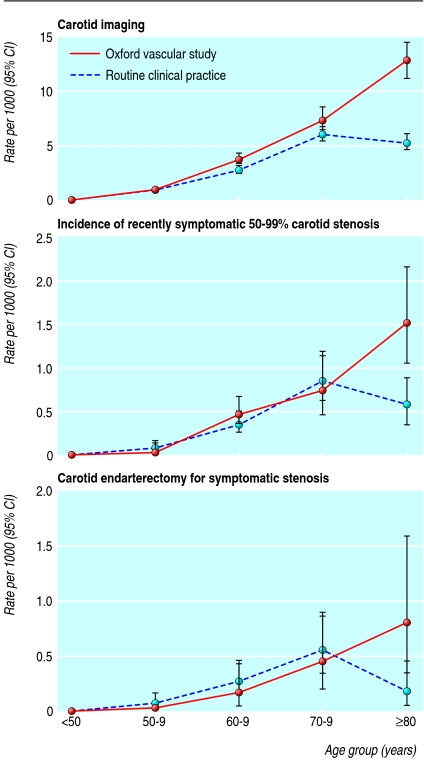
Setting: Routine clinical practice in all secondary care services in Oxfordshire and a nested population based study of incidence of transient ischaemic attack and stroke (the Oxford vascular study-OXVASC). PARTICIPANTS/POPULATION: All patients undergoing carotid imaging for ischaemic retinal or cerebral transient ischaemic attack or stroke from 1 April 2002 to 31 March 2005 in the Oxford vascular study (n = 91,105) and from 1 April 2002 to 31 March 2003 in routine clinical practice (n = 589,899).
Main outcome measures: Age specific rates of carotid imaging, diagnosed >or= 50% symptomatic carotid stenosis, and subsequent endarterectomy, in patients with recent transient ischaemic attack or stroke.
Results: Of patients with recent carotid territory transient ischaemic attack or ischaemic stroke, 575 in routine clinical practice and 402 in the Oxford vascular study had carotid imaging, with similar rates up to the age of 80. The incidence of >or= 50% symptomatic stenosis increased steeply with age, particularly in those aged >or= 80. Compared with investigations in patients in the Oxford vascular study, the rates of carotid imaging (relative rate 0.36, 95% confidence interval 0.28 to 0.46, P < 0.0001), diagnosis of >or= 50% symptomatic stenosis (0.33, 0.16 to 0.69, P = 0.004), and carotid endarterectomy (0.19, 0.06 to 0.63, P = 0.007) in this age group in routine clinical practice were all substantially lower.
Conclusions: Incidence of symptomatic carotid stenosis increases steeply with age, but, despite good evidence of major benefit from endarterectomy in elderly patients and a willingness to have surgery, there is substantial underinvestigation in routine clinical practice in patients aged >or= 80 with transient ischaemic attack or ischaemic stroke.
Figures
Comment in
-
Ageism in services for transient ischaemic attack and stroke.BMJ. 2006 Sep 9;333(7567):508-9. doi: 10.1136/bmj.38961.641400.BE. BMJ. 2006. PMID: 16960188 Free PMC article. No abstract available.
-
Ageism in services for transient ischaemic attack and stroke: clinical leadership is key in changing practice.BMJ. 2006 Sep 23;333(7569):656. doi: 10.1136/bmj.333.7569.656-a. BMJ. 2006. PMID: 16990339 Free PMC article. No abstract available.
-
Ageism in services for transient ischaemic attack and stroke: whose ageism?BMJ. 2006 Oct 7;333(7571):755; author reply 755-6. doi: 10.1136/bmj.333.7571.755-a. BMJ. 2006. PMID: 17023480 Free PMC article. No abstract available.
References
-
- Rudd AG, Lowe D, Hoffman A, Irwin P, Pearson M. Secondary prevention for stroke in the United Kingdom: results from the national sentinel audit of stroke. Age Ageing 2004;33: 280-6. - PubMed
-
- Gaw A. The care gap: underuse of statin therapy in the elderly. Int J Clin Pract 2004;58: 777-85. - PubMed
-
- Brass LM, Krumholz HM, Scinto JM, Mathur D, Radford M. Warfarin use following ischaemic stroke among Medicare patients with atrial fibrillation. Arch Int Med 1998;158: 2093-100. - PubMed
Publication types
MeSH terms
Grants and funding
LinkOut - more resources
Full Text Sources
Medical
Miscellaneous