


Evaluation of 3 methods of bladder irrigation to treat bacteriuria in persons with neurogenic bladder
- PMID: 16859225
- PMCID: PMC1864807
- DOI: 10.1080/10790268.2006.11753877
Evaluation of 3 methods of bladder irrigation to treat bacteriuria in persons with neurogenic bladder
Abstract
Background/objective: We conducted a randomized, double-blind comparison of twice daily bladder irrigation using 1 of 3 different solutions in community-residing persons with neurogenic bladder who used indwelling catheters to evaluate efficacy in treatment of bacteriuria.
Methods: Eighty-nine persons with bacteriuria were randomized to irrigate their bladders twice daily for 8 weeks with 30 mL of (a) sterile saline, (b) acetic acid, or (c) neomycin-polymyxin solution. Urinalysis, cultures, and antimicrobial susceptibility tests were performed at baseline and weeks 2, 4, and 8 to determine the extent to which each of the solutions affected numbers and types of bacteria, urinary pH, urinary leukocytes, and generation of antimicrobial-resistant organisms.
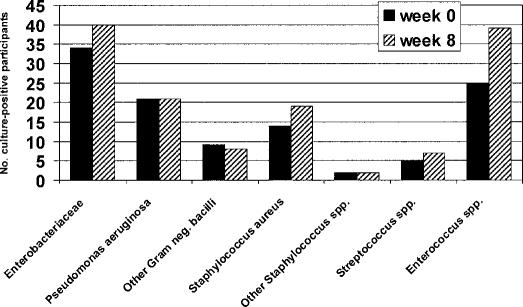
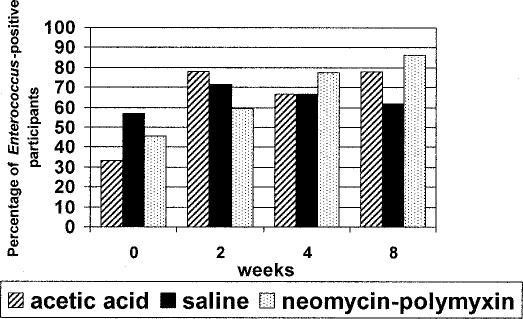
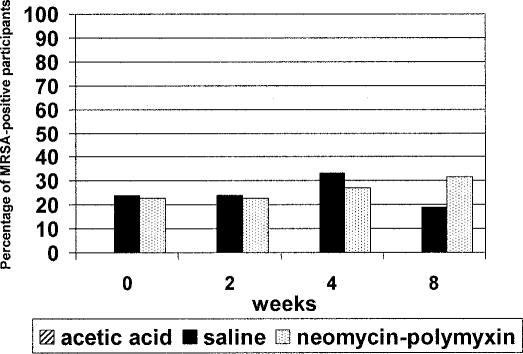
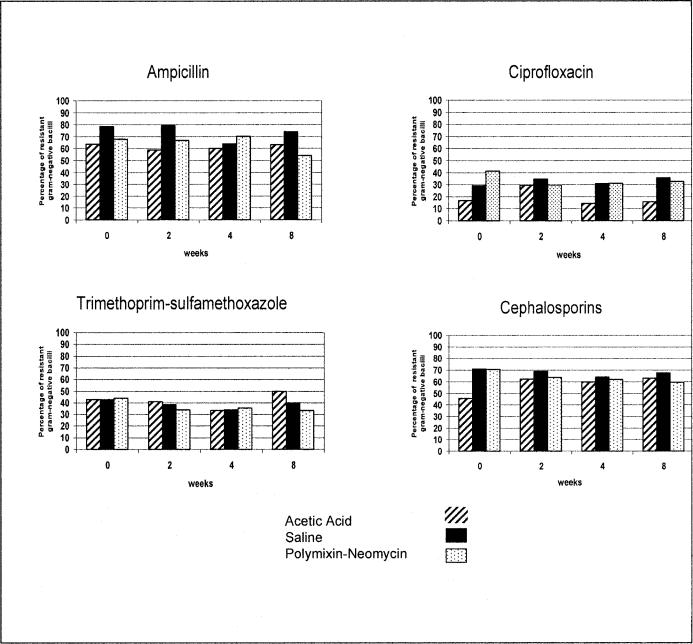
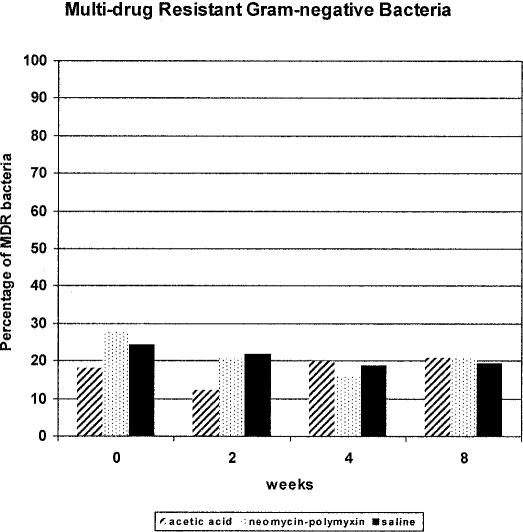
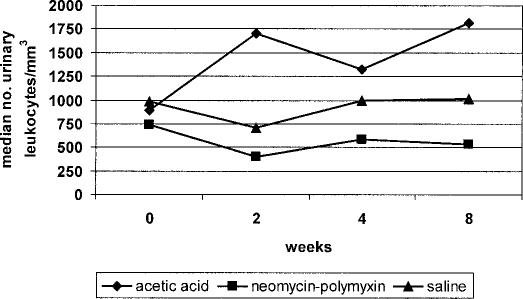
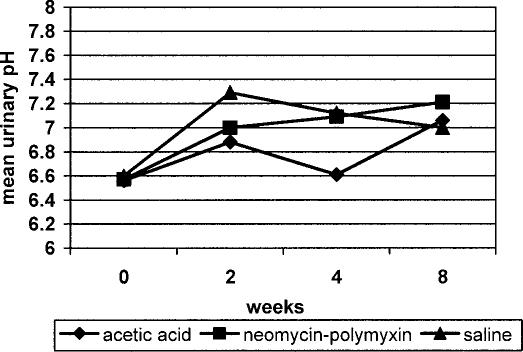
Results: Bladder irrigation was well tolerated with the exception of 3 participants who had bladder spasms. None of the 3 irrigants had a detectable effect on the degree of bacteriuria or pyuria in 52 persons who completed the study protocol. A significant increase in urinary pH occurred in all 3 groups. No significant development of resistance to oral antimicrobials beyond what was observed at baseline was detected.
Conclusions: Bladder irrigation was generally well tolerated for 8 weeks. No advantages were detected for neomycin-polymyxin or acetic acid over saline in terms of reducing the urinary bacterial load and inflammation. We cannot recommend bladder irrigation as a means of treatment for bacteriuria in persons with neurogenic bladder.
Figures
Similar articles
-
Effectiveness of neomycin/polymyxin bladder irrigation to treat resistant urinary pathogens in those with spinal cord injury.J Spinal Cord Med. 1999 Winter;22(4):252-7. doi: 10.1080/10790268.1999.11719578. J Spinal Cord Med. 1999. PMID: 10751129
-
Effect of cranberry extract on bacteriuria and pyuria in persons with neurogenic bladder secondary to spinal cord injury.J Spinal Cord Med. 2004;27(1):35-40. doi: 10.1080/10790268.2004.11753728. J Spinal Cord Med. 2004. PMID: 15156935 Clinical Trial.
-
Prophylaxis of bacteriuria during intermittent catheterization of the acute neurogenic bladder.J Urol. 1980 Mar;123(3):364-6. doi: 10.1016/s0022-5347(17)55938-8. J Urol. 1980. PMID: 6244414 Clinical Trial.
-
Prevention and management of urinary tract infections in paralyzed persons.Evid Rep Technol Assess (Summ). 1999 Jan;(6):1-3. Evid Rep Technol Assess (Summ). 1999. PMID: 11487801 Free PMC article. Review. No abstract available.
-
The pathogenesis, prevention, and management of urinary tract infection in patients with spinal cord injury.Curr Clin Top Infect Dis. 1993;13:1-25. Curr Clin Top Infect Dis. 1993. PMID: 8397904 Review. No abstract available.
Cited by
-
Are Intravesical Aminoglycosides the New Gold Standard in the Management of Refractory Urinary Tract Infection: A Systematic Review of Literature.J Clin Med. 2022 Sep 27;11(19):5703. doi: 10.3390/jcm11195703. J Clin Med. 2022. PMID: 36233570 Free PMC article. Review.
-
CATHETER II: a randomised controlled trial comparing the clinical effectiveness of various washout policies versus no washout policy in preventing catheter-associated complications in adults living with long-term catheters.BMJ Open. 2024 Dec 2;14(12):e087203. doi: 10.1136/bmjopen-2024-087203. BMJ Open. 2024. PMID: 39622574 Free PMC article. Clinical Trial.
-
Gentamicin bladder instillations decrease symptomatic urinary tract infections in neurogenic bladder patients on intermittent catheterization.Can Urol Assoc J. 2017 Sep;11(9):E350-E354. doi: 10.5489/cuaj.4434. Can Urol Assoc J. 2017. PMID: 29382457 Free PMC article.
-
Management of urinary tract infections in patients with neurogenic bladder: challenges and solutions.Res Rep Urol. 2017 Jul 11;9:121-127. doi: 10.2147/RRU.S113610. eCollection 2017. Res Rep Urol. 2017. PMID: 28761863 Free PMC article. Review.
-
Rescuing the Last-Line Polymyxins: Achievements and Challenges.Pharmacol Rev. 2021 Apr;73(2):679-728. doi: 10.1124/pharmrev.120.000020. Pharmacol Rev. 2021. PMID: 33627412 Free PMC article. Review.
References
-
- Montgomerie JZ. Infections in patients with spinal cord injuries. Clin Infect Dis. 1997;25:1285–1290. - PubMed
-
- Cardenas DD, Hooton TM. Urinary tract infection in persons with spinal cord injury. Arch Phys Med Rehabil. 1995;76:272–280. - PubMed
-
- DeVivo MJ, Stover SL. Long-term survival and causes of death. In: Stover SL, DeLisa JA, Whiteneck G, editors. Spinal Cord Injury: Clinical Outcomes From the Model Systems. Gaithersburg, MD: Aspen Publisher; 1995. pp. 289–316.
-
- Van Kerrebroeck PE, Koldewijn EL, Scherpenhuizen S, Debruyne FM. The morbidity due to lower urinary tract function in spinal cord injury patients. Paraplegia. 1993;31:320–329. - PubMed
-
- Cardenas DD, Farrell-Roberts L, Sipski ML, Rubner D. Management of gastrointestinal, genitourinary, and sexual function. In: Stover SL, DeLisa JA, Whiteneck G, editors. Spinal Cord Injury: Clinical Outcomes From the Model Systems. Gaithersburg, MD: Aspen Publishers; 1995. pp. 120–144.
Publication types
MeSH terms
Substances
LinkOut - more resources
Full Text Sources
Other Literature Sources
Medical
