. 2006 Aug;74(8):4708-14.
doi: 10.1128/IAI.02066-05.

Expression and antimicrobial function of bactericidal permeability-increasing protein in cystic fibrosis patients

Affiliations

Expression and antimicrobial function of bactericidal permeability-increasing protein in cystic fibrosis patients

Diana Aichele et al. Infect Immun. 2006 Aug.

Abstract

In cystic fibrosis (CF), the condition limiting the prognosis of affected children is the chronic obstructive lung disease accompanied by chronic and persistent infection with mostly mucoid strains of Pseudomonas aeruginosa. The majority of CF patients have antineutrophil cytoplasmic antibodies (ANCA) primarily directed against the bactericidal permeability-increasing protein (BPI) potentially interfering with antimicrobial effects of BPI. We analyzed the expression of BPI in the airways of patients with CF. In their sputum samples or bronchoalveolar lavage specimens, nearly all patients expressed BPI mRNA and protein, which were mainly products of neutrophil granulocytes as revealed by intracellular staining and subsequent flow cytometry. Repeated measurements revealed consistent individual BPI expression levels during several months quantitatively correlating with interleukin-8. In vitro, P. aeruginosa isolates from CF patients initiated the rapid release of BPI occurring independently of protein de novo syntheses. Furthermore, purified natural BPI as well as a 27-mer BPI-derived peptide displayed antimicrobial activity against even patient-derived mucoid P. aeruginosa strains and bacteria resistant against all antibiotics tested. Thus, BPI that is functionally active against mucoid P. aeruginosa strains is expressed in the airways of CF patients but may be hampered by autoantibodies, resulting in chronic infection.


Figures
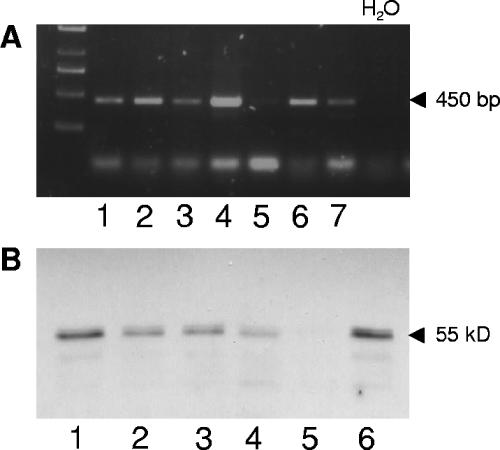
FIG. 1.
FIG. 1.
BPI is expressed in sputum samples of CF patients. BPI mRNA was detected with specific primers by reverse transcription-PCR (A) of sputum-derived cells from CF patients. BPI was detected by immunoblotting (B) whole-cell lysates of sputum-derived cells. BPI mRNA (panel A, lanes 1 to 7) and protein (panel B, lanes 1 to 6) are shown for the same CF patients.
FIG. 2.
FIG. 2.
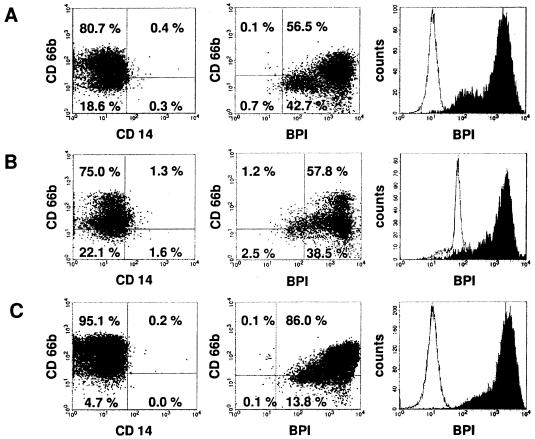
Neutrophils are the major source of BPI in lung fluid from CF patients. Isolated cells from sputum samples (A and B) or BAL (C) of CF patients were analyzed by flow cytometry. Cell types were distinguished by extracellular staining of CD66b for granulocytes and CD14 for monocytes. BPI was detected by intracellular staining. Percentages of the total amount of cells are given within the charts for each quadrant. The histograms to the right show BPI-positive cells (black) versus the isotype control (white).
FIG. 3.
FIG. 3.
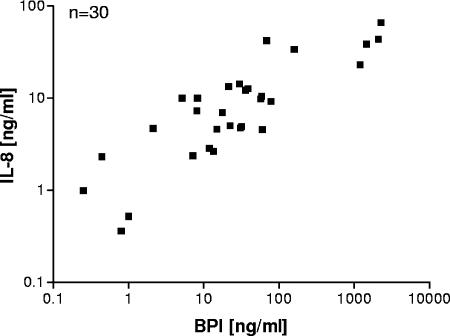
Positive correlation of BPI and IL-8 concentrations in cell-free lung fluid from CF patients. Supernatants of sputum samples from CF patients were collected after treatment with sputolysin and subsequent centrifugation. IL-8 and BPI levels were determined by ELISA. Linear regression shows the positive correlation r2 = 0.6785. The P value was <0.0001.
FIG. 4.
FIG. 4.
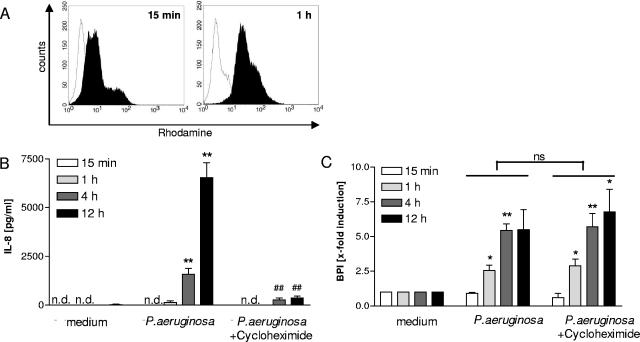
BPI is released from neutrophils after stimulation with P. aeruginosa. Human PMNs were isolated from whole blood from healthy donors by density gradient centrifugation. Oxidative burst was analyzed by flow cytometry of dihydrorhodamine-labeled cells stimulated with P. aeruginosa for the time periods indicated (A). Histograms are shown for stimulated cells (black) versus nonstimulated controls (white). The release of BPI and IL-8 was determined after stimulation with UV-inactivated bacteria (MOI, 20 CFU) in the presence or absence of cycloheximide, which was applied 15 min before the bacteria. Cell-free supernatants were collected after distinct time points, and IL-8 (B) and BPI (C) protein was measured by ELISA. Three individual experiments are shown for IL-8 and BPI measurements. Due to variances in the level of BPI from different blood donors, the results are given as induction levels (n-fold). *, P <0.05 for P. aeruginosa-stimulated cells versus median controls; **, P <0.01 for P. aeruginosa-stimulated cells versus median controls; ##, P <0.01 for P. aeruginosa-stimulated cells with cycloheximide versus P. aeruginosa-stimulated cells. n.d., not detected; ns, not significant. Error bars indicate standard deviations.
FIG. 5.
FIG. 5.
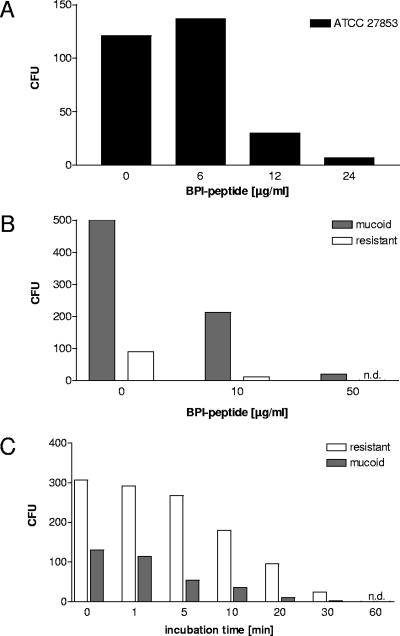
Antimicrobial activity of a BPI-derived peptide and kinetics of BPI-mediated killing. A 27-amino-acid peptide from the amino-terminal region of BPI was synthesized and compared to natural BPI isolated from human granulocytes. BPI peptide was used at the indicated concentrations to determine bactericidal activity against P. aeruginosa. BPI peptide was coincubated with the bacteria for 1 h at increasing concentrations (A and B), whereas BPI was applied at 10 μg/ml for time-dependent killing of P. aeruginosa (C) and then plated on blood agar to quantify surviving bacteria (A, B, and C). In panel A, the ATCC 27853 strain was used. In panels B and C, the P. aeruginosa stains used were freshly isolated from the lungs of CF patients, one showing a mucoid phenotype (gray bars) and the other being fully resistant to common antibiotics applied in CF lung infection (white bars). n.d., not detected.
FIG. 6.
FIG. 6.
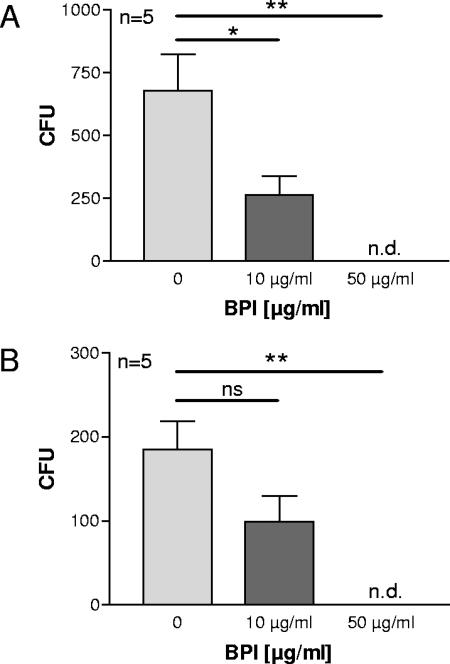
Mucoid and antibiotic-resistant clinical P. aeruginosa isolates are killed by BPI. Natural BPI isolated from human granulocytes was used at the indicated concentrations to determine bactericidal activity. The experiments were performed as described in the legend for Fig. 5. All bacteria shown are clinical P. aeruginosa isolates from CF patients. (A) P. aeruginosa strains with a mucoid phenotype, three of which have resistance to up to four antibiotics. (B) P. aeruginosa strains that are multiresistant to antibiotics. Two of the strains are fully resistant to all antibiotics applied. Statistically significant differences are given as P values (*, P <0.05; **, P <0.01). ns, not significant. Error bars indicate standard deviations.

References

    1. Aebi, C., F. Theiler, C. C. Aebischer, and M. H. Schoeni. 2000. Autoantibodies directed against bactericidal/permeability-increasing protein in patients with cystic fibrosis: association with microbial respiratory tract colonization. Pediatr. Infect. Dis. J. 19:207-212. - PubMed
    1. Calafat, J., H. Janssen, E. F. Knol, J. Malm, and A. Egesten. 2000. The bactericidal/permeability-increasing protein (BPI) is membrane-associated in azurophil granules of human neutrophils, and relocation occurs upon cellular activation. APMIS 108:201-208. - PubMed
    1. Canny, G., O. Levy, G. T. Furuta, S. Narravula-Alipati, R. B. Sisson, C. N. Serhan, and S. P. Colgan. 2002. Lipid mediator-induced expression of bactericidal/permeability-increasing protein (BPI) in human mucosal epithelia. Proc. Natl. Acad. Sci. USA 99:3902-3907. - PMC - PubMed
    1. Carlsson, M., L. Eriksson, I. Erwander, J. Wieslander, and M. Segelmark. 2003. Pseudomonas-induced lung damage in cystic fibrosis correlates to bactericidal-permeability increasing protein (BPI)-autoantibodies. Clin. Exp. Rheumatol. 21:S95-100. - PubMed
    1. Ciofu, O., B. Riis, T. Pressler, H. E. Poulsen, and N. Hoiby. 2005. Occurrence of hypermutable Pseudomonas aeruginosa in cystic fibrosis patients is associated with the oxidative stress caused by chronic lung inflammation. Antimicrob. Agents Chemother. 49:2276-2282. - PMC - PubMed

Publication types

MeSH terms

Substances