


Social behaviour and mood in everyday life: the effects of tryptophan in quarrelsome individuals
- PMID: 16862243
- PMCID: PMC1488902
Social behaviour and mood in everyday life: the effects of tryptophan in quarrelsome individuals
Abstract
Objective: We hypothesized that increasing brain serotonin in healthy individuals with high scores on 2 self-report measures of trait quarrelsomeness would reduce quarrelsome behaviours and enhance agreeable behaviours when measured ecologically using an event-contingent recording method.
Methods: We conducted a double-blind crossover study, in which participants took tryptophan (3 g/d) and placebo for 15 days each and recorded how they behaved, felt and perceived others during everyday social interactions.
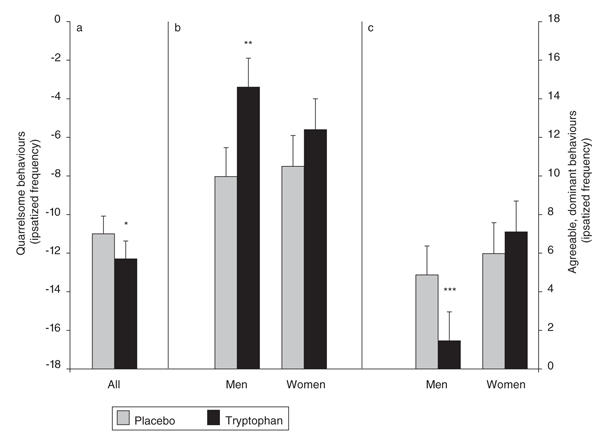
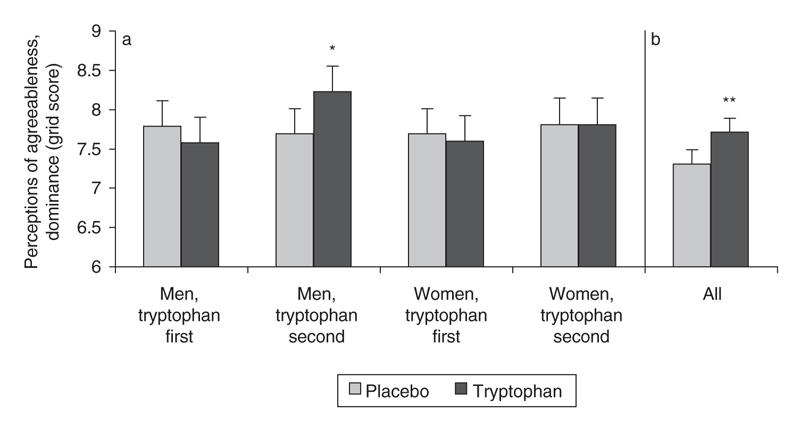
Results: Tryptophan significantly decreased quarrelsome behaviours and increased agreeable behaviours and perceptions of agreeableness. Men also behaved less dominantly, whereas both men and women perceived others as more dominant.
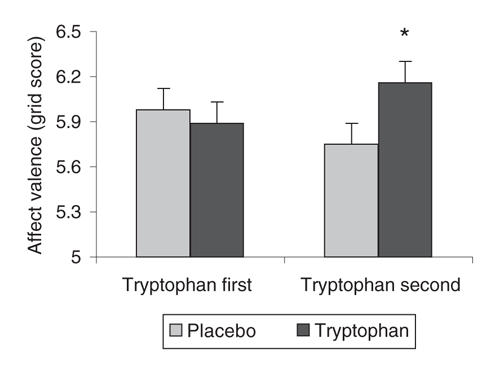
Conclusion: Tryptophan's effects on behaviours and perceptions, while more marked in the men, were generally positive and accompanied by improved affect. Increasing serotonin in quarrelsome people may not only reduce behaviours associated with a predisposition to various mental and physical disorders but also enhance socially constructive behaviours and improve social perceptions.
Objectif: Nous avons posé en hypothèse que l'élévation de la concentration de sérotonine cérébrale chez des sujets en bonne santé qui ont des résultats élevés à deux mesures autodéclarées du caractère belliqueux réduirait les comportements belliqueux et améliorerait les comportements affables lorsqu'on les mesure écologiquement au moyen d'une méthode de consignation contingente des événements.
Méthodes: Nous avons réalisé un essai croisé à double insu pour lequel les participants ont pris du tryptophane (3 g/j) et un placebo pendant 15 jours chacun et ont consigné leur comportement, leurs sentiments et leur perception à l'égard d'autrui pendant les interactions sociales quotidiennes.
Résultats: Le tryptophane réduit considérablement les comportements belliqueux et accroît les comportements affables et les perceptions d'un caractère affable. Les hommes se sont aussi comportés de façon moins dominante tandis que les hommes et les femmes percevaient les autres comme plus dominants.
Conclusion: Même s'ils sont plus marqués chez les hommes, les effets du tryptophane sur les comportements et les perceptions ont en général été positifs et ont entraîné une amélioration de l'affect. L'élévation de sérotonine chez les personnes belliqueuses peut non seulement atténuer les comportements associés à une prédisposition à divers troubles mentaux et physiques, mais aussi améliorer les comportements socialement constructifs et les perceptions sociales.
Figures
References
-
- Brown GL, Ebert MH, Goyer PF, et al. Aggression, suicide, and serotonin: relationships to CSF amine metabolites. Am J Psychiatry 1982;139:741-6. - PubMed
-
- Cleare AJ, Bond AJ. Does central serotonergic function correlate inversely with aggression? A study using D-fenfluramine in healthy subjects. Psychiatry Res 1997;69:89-95. - PubMed
-
- Higley JD, King ST, Hasert MF, et al. Stability of interindividual differences in serotonin function and its relationship to severe aggression and competent social behavior in rhesus macaque females. Neuropsychopharmacology 1996;14:67-76. - PubMed
-
- Higley JD, Mehlman PT, Poland RE, et al. CSF testosterone and 5-HIAA correlate with different types of aggressive behaviors. Biol Psychiatry 1996;40:1067-82. - PubMed
-
- Mehlman P, Higley J, Faucher I, et al. Low CSF 5-HIAA concentrations and severe aggression and impaired impulse control in nonhuman primates. Am J Psychiatry 1994;151:1485-91. - PubMed
Publication types
MeSH terms
Substances
LinkOut - more resources
Full Text Sources
Other Literature Sources