


Comparative Study
doi: 10.1128/AAC.00349-06.
Candida albicans and Candida glabrata clinical isolates exhibiting reduced echinocandin susceptibility
Affiliations
- PMID: 16870797
- PMCID: PMC1538661
- DOI: 10.1128/AAC.00349-06
Item in Clipboard
Comparative Study
Candida albicans and Candida glabrata clinical isolates exhibiting reduced echinocandin susceptibility
Antimicrob Agents Chemother.
2006 Aug.
Abstract
A recognized hotspot for mutations conferring reduced echinocandin susceptibility (RES) is residue S645 of Candida albicans Gsc1(Fks1). We report that the mutation F641Y is associated with RES in a C. albicans isolate. The analogous Fks2 residue is mutated F to V in a Candida glabrata RES isolate; the introduction of this mutation into susceptible C. glabrata confirmed its role in RES. Y641-equivalent Fks residues were identified in intrinsically RES Fusarium species and Candida guilliermondii.
Figures
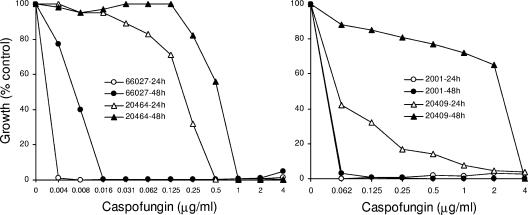
Broth microdilution assays examining caspofungin susceptibility of the indicated C. albicans or C. glabrata strains. Incubation was for 24 or 48 h, as indicated. Assays were performed in YPD medium at 35°C, as described previously (21).
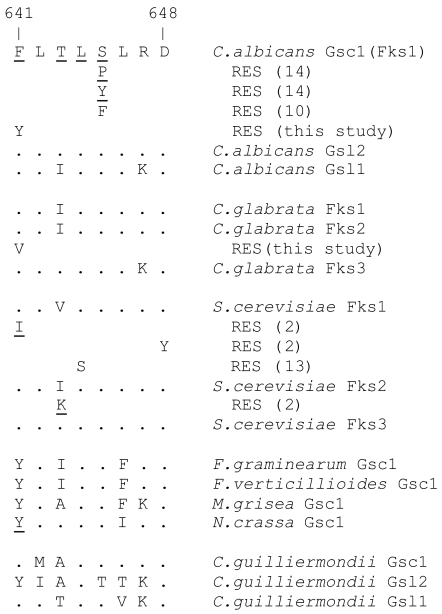
Alignment of GS sequences corresponding to amino acids 641 to 648 of C. albicans Gsc1. BLASTP searches of the respective genome databases were used to align full-length Gsc1 with its C. albicans homologs Gsl2 and Gsl1 (11) and its C. glabrata and S. cerevisiae homologs Fks1, Fks2, and Fks3. Amino acids that are conserved relative to Gsc1 are represented as dots; amino acids whose mutations have been associated with RES are underlined and are shown below the relevant GS. TBLASTN searches of the NCBI (www.ncbi.nlm.nih.gov/sutils/genom_table.cgi?organism = fungi) and Broad Institute Fungal Genome Initiative (www.broad.mit.edu/annotation/fgi ) databases were used to identify GS homologs from other species whose sequences predict RES based on alignment with the C. albicans, C. glabrata, and S. cerevisiae sequences and their RES mutants. To amplify and sequence the relevant GS regions in C. albicans 20464 or C. glabrata 20409, the following primer pairs were used: GSC1F (5′-TCATTGCTGTGGCCACTTTAG, located 1,718 bp from the start codon) and GSC1R (5′-TAGAATGAACGACCAATGGAGA, 2,135 bp); FKS1F (5′-GTTGCAGTCGCTACATTGCTA, 1,627 bp) and FKS1R (5′-TAGCGTTCCAGACTTGGGAA, 2,227 bp); FKS2F (5′-GGCCACTGTTTTATTCTTCTCG, 1,782 bp) and FKS2R (5′-GTAAATGTTCTCTGTACATGGA, 2,359 bp); and FKS3F (5′-TGGAGCCCAGCACTTAACAA, 1,389 bp) and FKS3R (5′-GTCCATCTCGGATGTTGCTA, 2,052 bp). For the amplification and sequencing of FKS2 from C. glabrata 2001-16 and 200989-16 transformants, FKS2F2 (5′-GTTCAATCAAAGGCAGGCCA, 1,747 bp) was used in place of FKS2F. Template DNA preparation and PCR amplification were performed as described previously (4). Following purification, PCR products were directly sequenced with one or both of the primers used to generate the product.
References
-
- Denning, D. W. 2003. Echinocandin antifungal drugs. Lancet 362:1142-1151. - PubMed
-
- Douglas, C. M. 2001. Fungal beta(1,3)-D glucan synthesis. Med. Mycol. 39(Suppl. 1):55-66. - PubMed
-
- Dujon, B, D. Sherman, G. Fischer, P. Durrens, S. Casaregola, I. Lafontaine, J. De Montigny, et al. 2004. Genome evolution in yeasts. Nature 430:35-44. - PubMed
-
- Edlind, T. D., K. W. Henry, J.-P. Vermitsky, M. P. Edlind, S. Raj, and S. K. Katiyar. 2005. Promoter-dependent disruption of genes: simple, rapid, and specific PCR-based method with application to three different yeast. Curr. Gen. 48:117-125. - PubMed
Publication types
MeSH terms
Substances
Grants and funding
LinkOut - more resources
Full Text Sources
Molecular Biology Databases
