


Spatiotemporal patterns of an evoked network oscillation in neocortical slices: coupled local oscillators
- PMID: 16870836
- PMCID: PMC4415382
- DOI: 10.1152/jn.00645.2006
Spatiotemporal patterns of an evoked network oscillation in neocortical slices: coupled local oscillators
Abstract
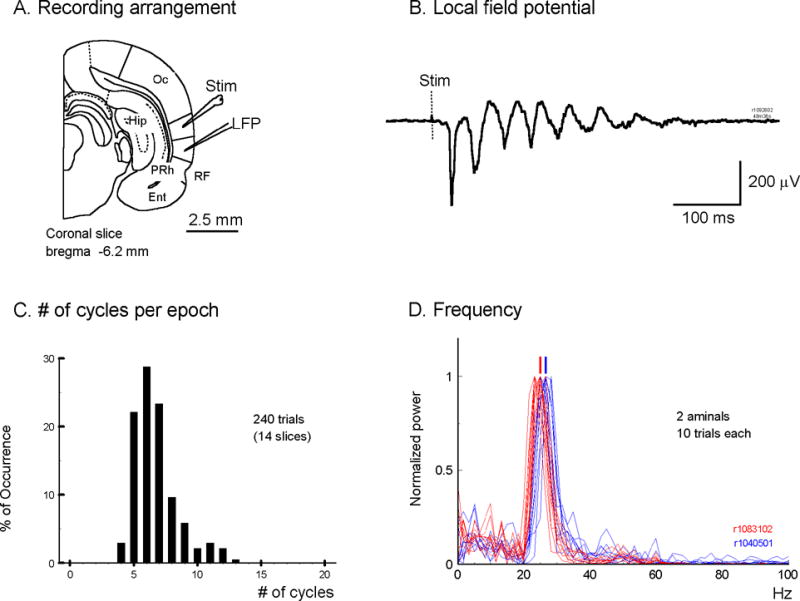
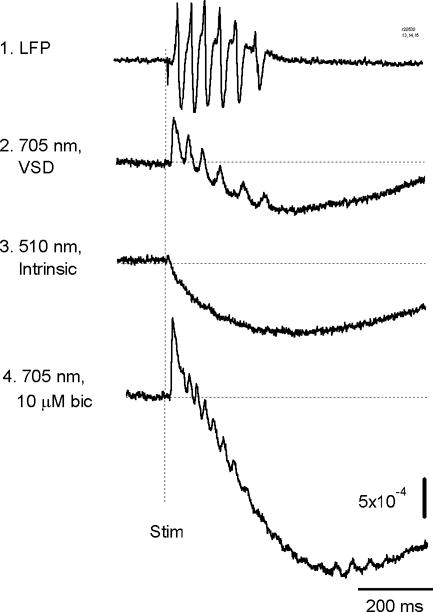
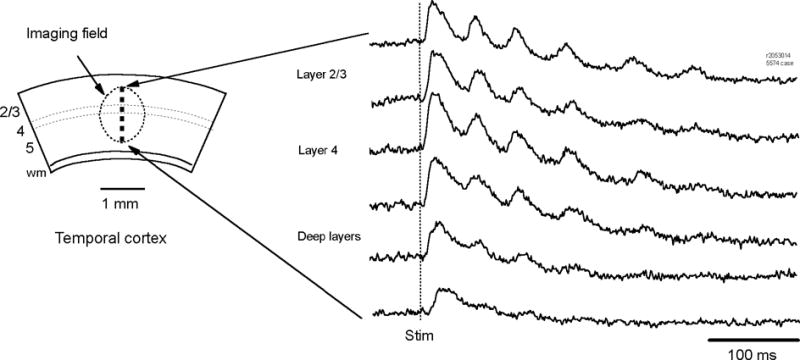
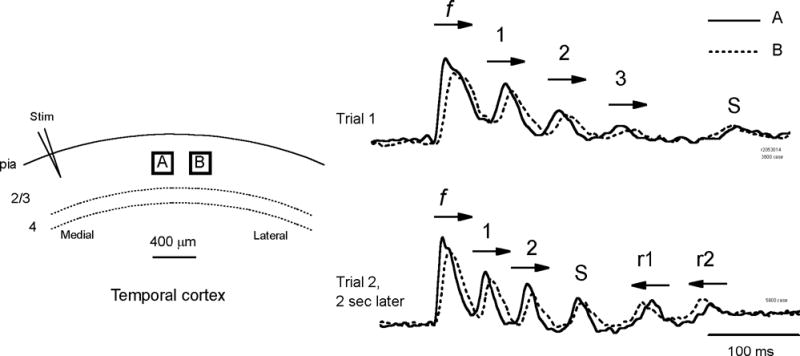
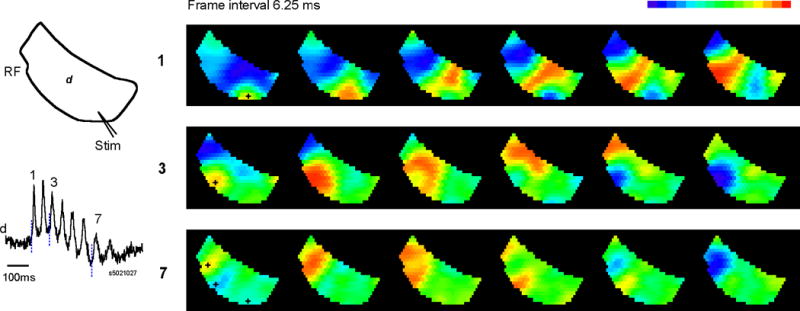
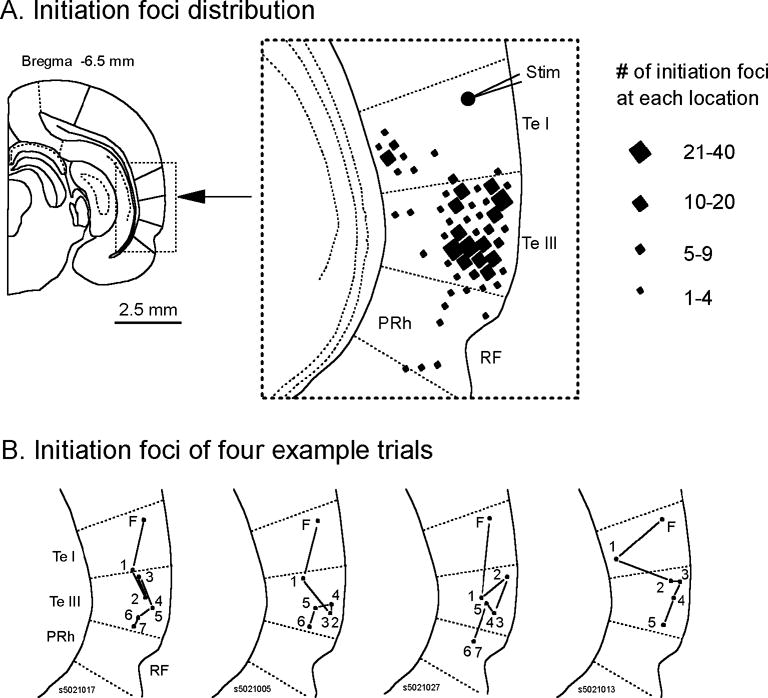
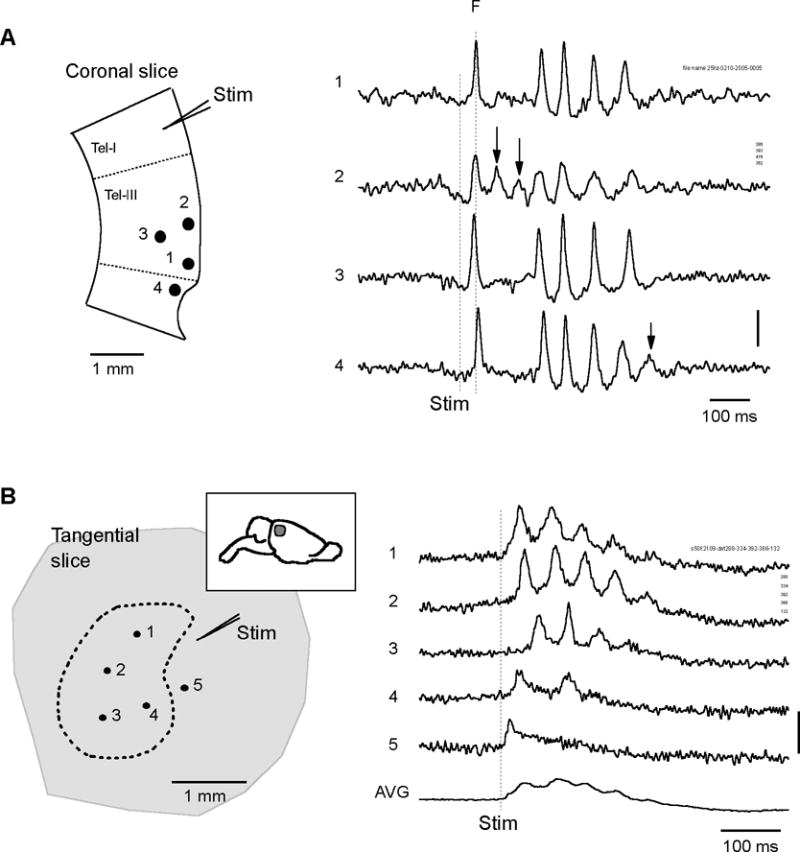
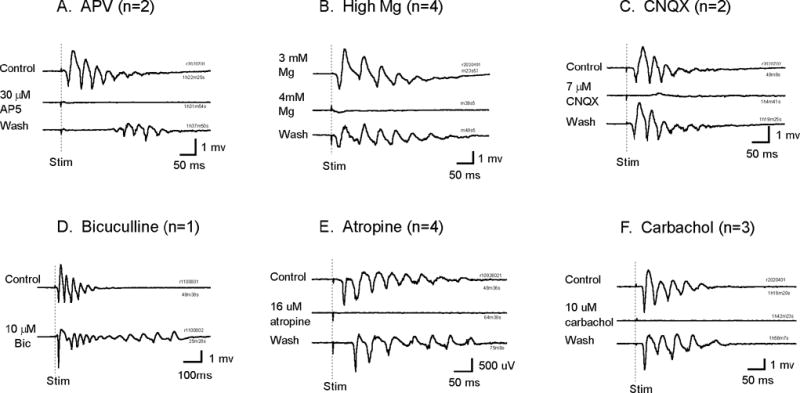
We have discovered an evoked network oscillation in rat neocortical slices and have examined its spatiotemporal patterns with voltage-sensitive dye imaging. The slices (visual and auditory cortices) were prepared in a medium of low calcium, high magnesium and with sodium replaced by choline to reduce the excito-toxicity and sodium loading. After slicing, the choline was washed out while normal calcium, magnesium, and sodium concentrations were restored. The oscillation was evoked by a single electrical shock to slices bathed in normal artificial cerebral spinal fluid (ACSF). The oscillation was organized as an all-or-none epoch containing 4-13 cycles at a central frequency approximately 25 Hz. The activity can be reversibly blocked by 6-cyano-7-nitroquinoxalene-2,3-dione (CNQX). 2-amino-5-phosphonopentanoic acid (APV), and atropine but not by bicuculline, indicating polysynaptic excitatory mechanisms. Voltage-sensitive dye imaging showed high-amplitude oscillation signals in superficial and middle cortical layers. Spatiotemporally, the oscillations were organized as waves, propagating horizontally along cortical laminar. Each oscillation cycle was associated with one wave propagating in space. The waveforms were often different at different locations (e.g., extra cycles), suggesting the co-existence of multiple local oscillators. For different cycles, the waves often initiated at different locations, suggesting that local oscillators are competing to initiate each oscillation cycle. Overall our results suggest that this cortical network oscillation is organized at two levels: locally, oscillating neurons are tightly coupled to form local oscillators, and globally the coupling between local oscillators is weak, allowing abrupt spatial phase lags and propagating waves with multiple initiation sites.
Figures
References
-
- Albowitz B, Kuhnt U. Epileptiform activity in the guinea-pig neocortical slice spreads preferentially along supragranular layers–recordings with voltage-sensitive dyes. Eur J Neurosci. 1995;7:1273–1284. - PubMed
-
- Anderson WW, Lewis DV, Swartzwelder HS, Wilson WA. Magnesium-free medium activates seizure-like events in the rat hippocampal slice. Brain Res. 1986;398:215–219. - PubMed
-
- Arieli A, Shoham D, Hildesheim R, Grinvald A. Coherent spatiotemporal patterns of ongoing activity revealed by real-time optical imaging coupled with single-unit recording in the cat visual cortex. J Neurophysiol. 1995;73:2072–2093. - PubMed
-
- Arieli A, Sterkin A, Grinvald A, Aertsen A. Dynamics of ongoing activity: explanation of the large variability in evoked cortical responses. Science. 1996;273:1868–1871. - PubMed
Publication types
MeSH terms
Substances
Grants and funding
LinkOut - more resources
Full Text Sources
