


doi: 10.1016/j.cell.2006.07.007.
Knocking down disease with siRNAs
Affiliations
- PMID: 16873051
- PMCID: PMC7125751
- DOI: 10.1016/j.cell.2006.07.007
Item in Clipboard
Knocking down disease with siRNAs
Cell.
.
Abstract
Knocking down expression of disease-related genes using small interfering RNAs (siRNAs) has potential for treating a variety of illnesses. This Essay will examine the opportunities for harnessing RNA interference (RNAi) for therapy, as well as the obstacles and possible ways to circumvent them.
Figures
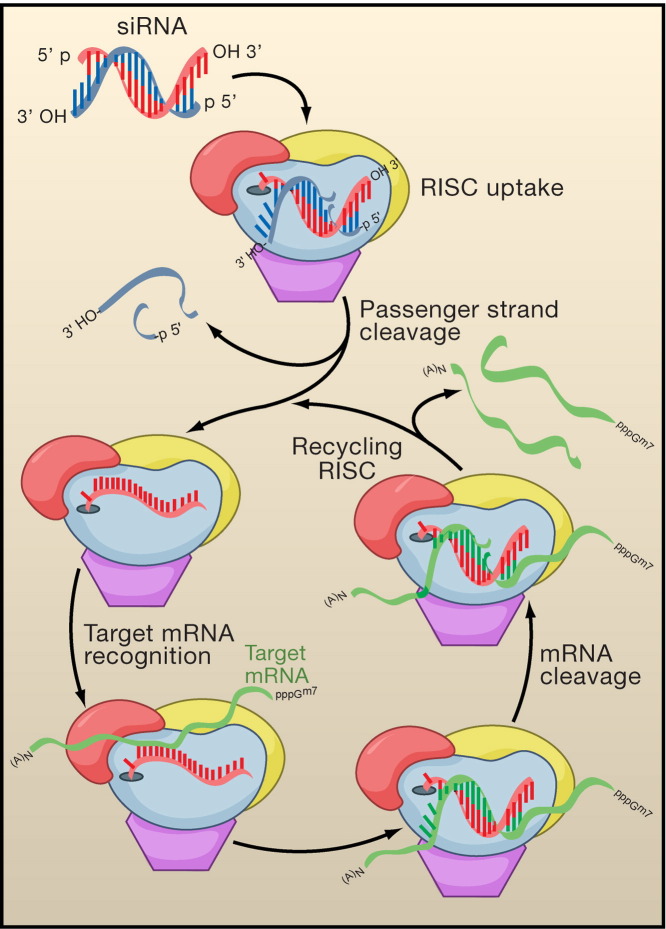
The Cellular Pathway for siRNA Drug Action Small interfering RNAs introduced into the cytoplasm are taken up by the RISC. The strand whose 5′-end is less tightly bound is incorporated as the active guide strand, whereas the other strand (the passenger strand) is cleaved. This activates the RISC, which then recognizes a target mRNA bearing a complementary sequence and cleaves it. Once the target mRNA is cleaved the RISC can be recycled to seek and destroy another mRNA. The potency of siRNA drugs is linked to their incorporation and stabilization in the endogenous RISC complex present in all cells, and the catalytic nature of the cleavage reaction.

Delivery of siRNAs for Therapy To be a useful drug, an siRNA (top) must be delivered into cells in vivo. Methods to accomplish this (middle) include chemical conjugation of the passenger strand to cholesterol; binding of the siRNA to an antibody fragment-protamine fusion protein for cell receptor-mediated uptake; incorporation of the siRNA into specialized liposomes or nanoparticles; or expression of an shRNA precursor from a viral vector. (Bottom) Delivered siRNAs can then be tested in small animals, nonhuman primates, and people. Application of siRNAs to mucosal tissues such as the lungs (using an inhaler, for example) does not require specialized delivery methods.
References
-
- Bitko V., Musiyenko A., Shulyayeva O., Barik S. Nat. Med. 2005;11:50–55. - PubMed
-
- Croce C.M., Calin G.A. Cell. 2005;122:6–7. - PubMed
-
- Elbashir S.M., Harborth J., Lendeckel W., Yalcin A., Weber K., Tuschl T. Nature. 2001;411:494–498. - PubMed
-
- Grimm D., Streetz K.L., Jopling C.L., Storm T.A., Pandey K., Davis C.R., Marion P., Salazar F., Kay M.A. Nature. 2006;441:537–541. - PubMed
Publication types
MeSH terms
Substances
Grants and funding
LinkOut - more resources
Full Text Sources
Other Literature Sources
