. 2006 Aug 8;103(32):11838-43.
doi: 10.1073/pnas.0602615103. Epub 2006 Jul 27.

Aptamers evolved from live cells as effective molecular probes for cancer study

Affiliations

Aptamers evolved from live cells as effective molecular probes for cancer study

Dihua Shangguan et al. Proc Natl Acad Sci U S A. .

Abstract

Using cell-based aptamer selection, we have developed a strategy to use the differences at the molecular level between any two types of cells for the identification of molecular signatures on the surface of targeted cells. A group of aptamers have been generated for the specific recognition of leukemia cells. The selected aptamers can bind to target cells with an equilibrium dissociation constant (K(d)) in the nanomolar-to-picomolar range. The cell-based selection process is simple, fast, straightforward, and reproducible, and, most importantly, can be done without prior knowledge of target molecules. The selected aptamers can specifically recognize target leukemia cells mixed with normal human bone marrow aspirates and can also identify cancer cells closely related to the target cell line in real clinical specimens. The cell-based aptamer selection holds a great promise in developing specific molecular probes for cancer diagnosis and cancer biomarker discovery.


Conflict of interest statement

Conflict of interest statement: No conflicts declared.

Figures

Fig. 1.
Fig. 1.
Schematic representation of the cell-based aptamer selection. Briefly, the ssDNA pool was incubated with CCRF-CEM cells (target cells). After washing, the bound DNAs were eluted by heating to 95°C. The eluted DNAs were then incubated with Ramos cells (negative cells) for counterselection. After centrifugation, the supernatant was collected and the selected DNA was amplified by PCR. The PCR products were separated into ssDNA for next-round selection or cloned and sequenced for aptamer identification in the last-round selection.
Fig. 2.
Fig. 2.
Binding assay of selected pool with CCRF-CEM and Ramos cells. (A) Flow cytometry assay to monitor the binding of selected pool with CCRF-CEM cells (target cells) and Ramos cells (negative cells). The green curve represents the background binding of unselected DNA library. For CEM cells, there was an increase in binding capacity of the pool as the selection was progressing, whereas there was little change for the control Ramos cells. (B) Confocal imaging of cells stained by the 20th-round selected pool labeled with tetramethylrhodamine dye molecules. (Upper Left) Fluorescence image of CCRF-CEM cells. (Upper Right) Optical image of CCRF-CEM cells. (Lower Left) Fluorescence image of Ramos cells. (Lower Right) Optical image of Ramos cells.
Fig. 3.
Fig. 3.
Characterization of selected aptamers. (A) Flow cytometry assay for the binding of the FITC-labeled sequences sga16 and sgc8 with CCRF-CEM cells (target cells) and Ramos cells (negative cells). The green curve represents the background binding of unselected DNA library. The concentration of the aptamers in the binding buffer was 250 nM. (B) Flow cytometry to determine the binding affinity of the FITC-labeled aptamer sequence sga16 to CCRF-CEM cells. The nonspecific binding was measured by using FITC-labeled unselected library DNA.
Fig. 4.
Fig. 4.
Aptamer sgc3 only recognizes a subset of CCRF-CEM cells. (A) Flow cytometry assay for the binding of the FITC-labeled sequence sgc3 with CCRF-CEM cells (target cells). The green curve represents the background binding of unselected DNA library. The second peak of the red curve represents the sgc3-labeled subset of cells. The concentration of the aptamer in the binding buffer was 250 nM. (B) Fluorescence confocal images of CEM and Ramos cells stained by sgc3 labeled with TAMRA. (Left) Fluorescence images of CCRF-CEM cells and Ramos cells. (Right) Optical images of CCRF-CEM cells and Ramos cells. (C) Flow cytometry assay for the binding of CCRF-CEM cells to aptamer sgc3 and monoclonal antibodies against CD5, CD7, and CD3. The yellow area represents the sgc3-labeled subset of cells. Aptamer sgc3 selectively bound to a subpopulation of CCRF-CEM cells, which expressed abundant CD7 and CD5 but not CD3. The final concentration of sgc3 in the binding buffer was 250 nM.
Fig. 5.
Fig. 5.
Molecular recognition of CCRF-CEM cells and human bone marrow cells incubated with FITC-labeled sgc8, sgc3, and peridinin chlorophyll protein-labeled anti-CD45 antibody. The aptamer sgc8 or sgc3 and monoclonal antibodies were incubated with the target CCRF-CEM cells and/or bone marrow cells. The sgc8 (A) and sgc3 (B) were able to recognize the target leukemia cells selectively when CCRF-CEM leukemia cells were mixed with cells from human bone marrow aspirates.
Fig. 6.
Fig. 6.
Molecular recognition of T-ALL cells in patient bone marrow aspirates with FITC-labeled sgc8, sgc3, sgc4, sgd2, sgd3, and R-phycoerythrin-labeled anti-CD7 antibody. The background was measured by using FITC-labeled unselected library. The red dots represent T-ALL cells.
Fig. 7.
Fig. 7.
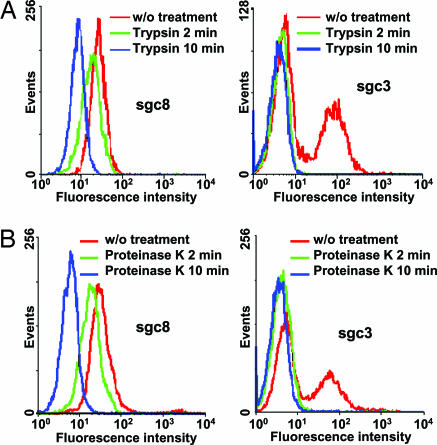
Binding of aptamers sgc8 and sgc3 to trypsin-treated (A) or proteinase K-treated (B) CCRF-CEM cells. The concentration of the aptamers in the binding buffer was 250 nM.

References

    1. Luo J., Isaacs W. B., Trent J. M., Duggan D. J. Cancer Invest. 2003;21:937–949. - PubMed
    1. Espina V., Geho D., Mehta A. I., Petricoin E. F., III, Liotta L. A., Rosenblatt K. P. Cancer Invest. 2005;23:36–46. - PubMed
    1. Osborne S. E., Ellington A. D. Chem. Rev. 1997;97:349–370. - PubMed
    1. Nutiu R., Li Y. Angew. Chem. Int. Ed. 2005;44:1061–1065. - PubMed
    1. Wilson D. S., Szostak J. W. Annu. Rev. Biochem. 1999;68:611–647. - PubMed

Publication types