


Hot water-extracted Lycium barbarum and Rehmannia glutinosa inhibit proliferation and induce apoptosis of hepatocellular carcinoma cells
- PMID: 16874858
- PMCID: PMC4125633
- DOI: 10.3748/wjg.v12.i28.4478
Hot water-extracted Lycium barbarum and Rehmannia glutinosa inhibit proliferation and induce apoptosis of hepatocellular carcinoma cells
Abstract
Aim: To investigate the effect of hot water-extracted Lycium barbarum (LBE) and Rehmannia glutinosa (RGE) on cell proliferation and apoptosis in rat and/or human hepatocellular carcinoma (HCC) cells.
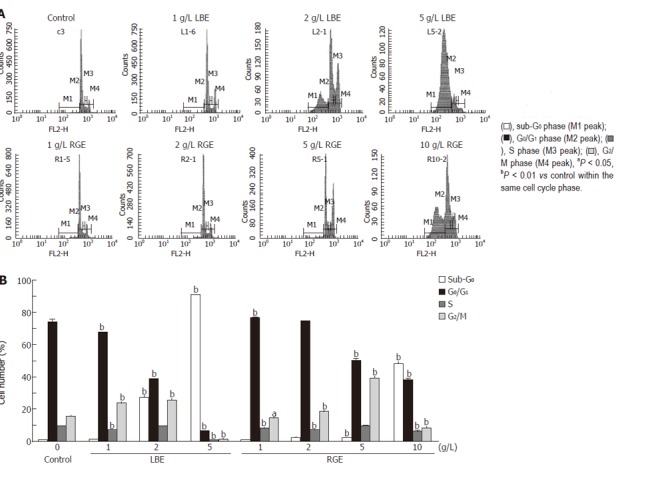
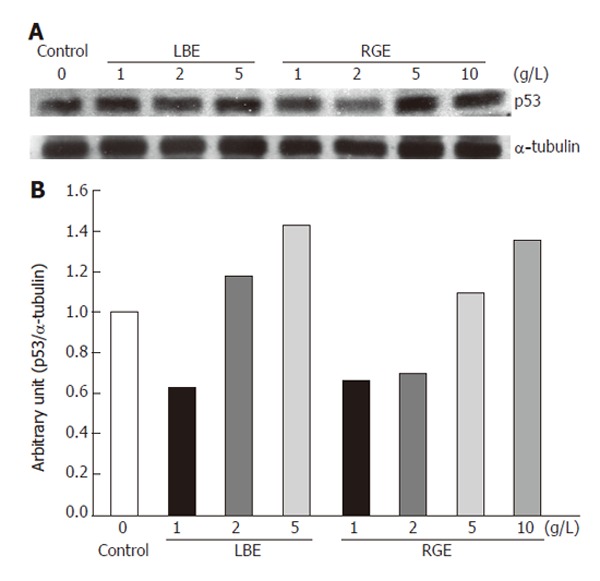
Methods: Rat (H-4-II-E) and human HCC (HA22T/VGH) cell lines were incubated with various concentrations (0-10 g/L) of hot water-extracted LBE and RGE. After 6-24 h incubation, cell proliferation (n = 6) was measured by a colorimetric method. The apoptotic cells (n = 6) were detected by flow cytometry. The expression of p53 protein (n = 3) was determined by SDS-PAGE and Western blotting.
Results: Crude LBE (2-5 g/L) and RGE (2-10 g/L) dose-dependently inhibited proliferation of H-4-II-E cells by 11% (P < 0.05) to 85% (P < 0.01) after 6-24 h treatment. Crude LBE at a dose of 5 g/L suppressed cell proliferation of H-4-II-E cells more effectively than crude RGE after 6-24 h incubation (P < 0.01). Crude LBE (2-10 g/L) and RGE (2-5 g/L) also dose-dependently inhibited proliferation of HA22T/VGH cells by 14%-43% (P < 0.01) after 24 h. Crude LBE at a dose of 10 g/L inhibited the proliferation of HA22T/VGH cells more effectively than crude RGE (56.8% +/- 1.6% vs 70.3% +/- 3.1% of control, P = 0.0003 < 0.01). The apoptotic cells significantly increased in H-4-II-E cells after 24 h treatment with higher doses of crude LBE (2-5 g/L) and RGE (5-10 g/L) (P < 0.01). The expression of p53 protein in H-4-II-E cells was 119% and 143% of the control group compared with the LBE-treated (2, 5 g/L) groups, and 110% and 132% of the control group compared with the RGE -treated (5, 10 g/L) groups after 24 h.
Conclusion: Hot water-extracted crude LBE (2-5 g/L) and RGE (5-10 g/L) inhibit proliferation and stimulate p53-mediated apoptosis in HCC cells.
Figures
References
-
- Zhi F, Zheng W, Chen P, He M. [Study on the extraction process of polysaccharide from Lycium barbarum] Zhongyaocai. 2004;27:948–950. - PubMed
-
- Gan L, Hua Zhang S, Liang Yang X, Bi Xu H. Immunomodulation and antitumor activity by a polysaccharide-protein complex from Lycium barbarum. Int Immunopharmacol. 2004;4:563–569. - PubMed
-
- Zhang R, Zhou J, Jia Z, Zhang Y, Gu G. Hypoglycemic effect of Rehmannia glutinosa oligosaccharide in hyperglycemic and alloxan-induced diabetic rats and its mechanism. J Ethnopharmacol. 2004;90:39–43. - PubMed
-
- Peng X, Tian G. Structural characterization of the glycan part of glycoconjugate LbGp2 from Lycium barbarum L. Carbohydr Res. 2001;331:95–99. - PubMed
Publication types
MeSH terms
Substances
LinkOut - more resources
Full Text Sources
Medical
Research Materials
Miscellaneous
