. 2006 Aug;169(2):617-32.
doi: 10.2353/ajpath.2006.050876.

Relaxin enhances the oncogenic potential of human thyroid carcinoma cells

Affiliations

Relaxin enhances the oncogenic potential of human thyroid carcinoma cells

Sabine Hombach-Klonisch et al. Am J Pathol. 2006 Aug.

Abstract

The role of members of the insulin-like superfamily in human thyroid carcinoma is primarily unknown. Here we demonstrate the presence of RLN2 relaxin and relaxin receptor LGR7 in human papillary, follicular, and undifferentiated anaplastic thyroid carcinoma suggesting a specific involvement of relaxin-LGR7 signaling in thyroid carcinoma. Stable transfectants of the LGR7-positive human follicular thyroid carcinoma cell lines FTC-133 and FTC-238 that secrete bioactive proRLN2 revealed this hormone to act as a multifunctional endocrine factor in thyroid carcinoma cells. Although RLN2 did not act as a mitogen, it acted as an autocrine/paracrine factor and significantly increased anchorage-independent growth and thyroid carcinoma cell motility and invasiveness through elastin matrices. Suppression of LGR7 expression by LGR7-siRNA abolished the RLN2-mediated accelerated tumor cell motility. The increased elastinolytic activity correlated with enhanced production and secretion of the lysosomal proteinases cathepsin-D (cath-D) and cath-L forms hereby identified as new RLN2 target molecules in human neoplastic thyrocytes. We found the intracellular distribution of procath-L specifically altered in RLN2 transfectants, providing first evidence for selective actions of relaxin on the powerful elastinolytic cath-L production, storage, and secretion in thyroid carcinoma cells. Thus, relaxin enhances the oncogenic potential and acts as novel endocrine modulator of invasiveness in human thyroid carcinoma cells.


Figures
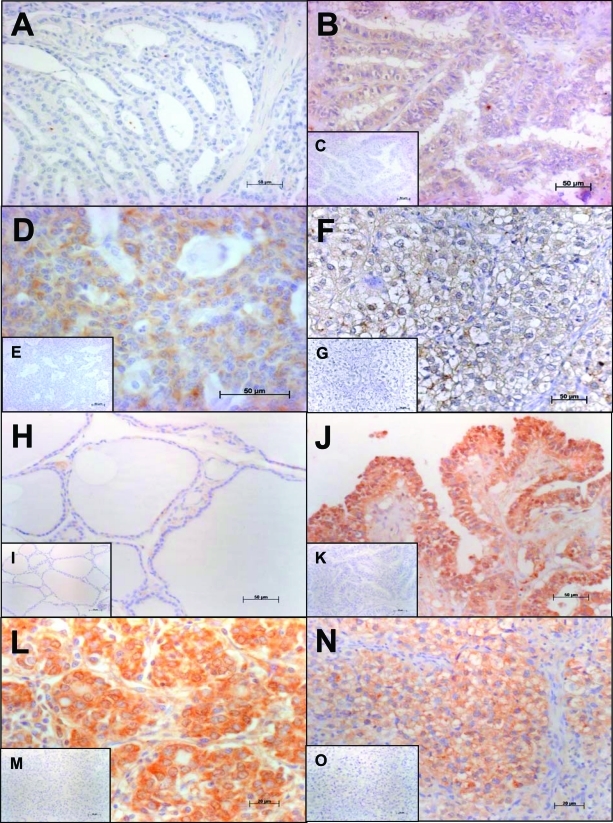
Figure 1-6913
Figure 1-6913
Immunolocalization of RLN2 and LGR7. Human goiter (A) and Graves’ disease (not shown) tissues were devoid of RLN2. By contrast, RLN2 immunoreactivity was present in human papillary (PTC; B), follicular (FTC; D), and dedifferentiated, anaplastic thyroid carcinoma (UTC; F). H: Using a previously characterized rabbit polyclonal antiserum to human LGR7, weak immunoreactivity for LGR7 was detected in thyrocytes of normal human thyroid tissues. Irrespective of pTNM classification of the tumor tissues investigated, immunoreactive LGR7 was up-regulated in PTC (J), FTC (L), and UTC (N) tissues (Table 1). Sections incubated with a rabbit nonimmune serum as control were devoid of immunostaining as demonstrated by the representative insets (C, E, G, I, K, M, O). Original magnifications: ×200 (A–C, E, H–K, M); ×400 (D, F, G, L, N, O).
Figure 2-6913
Figure 2-6913
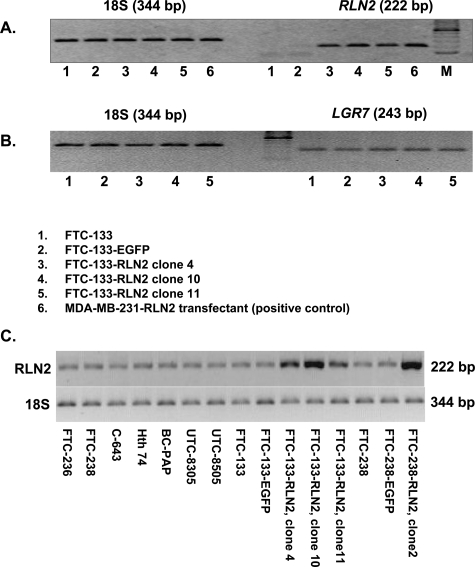
A: Representative RT-PCR of a specific 222-bp proRLN2 amplicon in stable FTC-133-RLN2 transfectants (lanes 3 to 5), an FTC-133-EGFP control clone (lane 2), and untransfected FTC-133 (lane 1). MDA-MB-231 human mammary carcinoma cell transfectant overexpressing proRLN2 relaxin served as positive control (A6).B: Amplification of 18S transcripts was used to ensure loading of equal cDNA amounts for semiquantitative RT-PCR. RT-PCR amplifications of LGR7 transcripts are shown for FTC-133 (lane 1), FTC-133-EGFP control (lane 2), and the FTC-133-RLN2 transfectants (lanes 3 to 5). Comparative analysis of RLN2 transcriptional gene activity in eight established human thyroid carcinoma cell lines and the stable FTC-133 and FTC-238 transfectants investigated. C: The human thyroid carcinoma cell lines BC-PAP, UTC-8305, UTC-8505, and C643 demonstrated increasing proRLN2 expression in ascending order. Strongest expression of RLN2 amplicons was observed in all RLN2 stable transfectants.
Figure 3-6913
Figure 3-6913
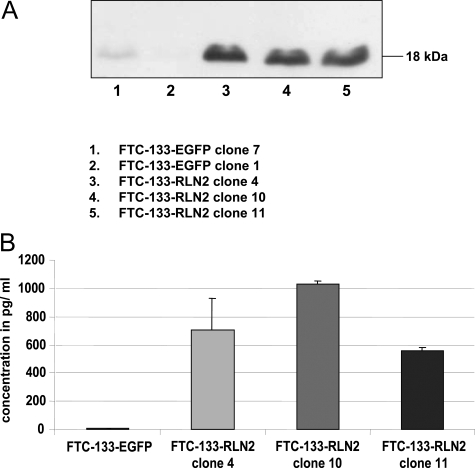
A: Representative Western blot analysis revealed an immunoreactive product resembling proRLN2 relaxin in size (18 kd) produced exclusively by the FTC-133-RLN2 (lanes 3 to 5) but not by FTC-133-EGFP transfectants (lanes 1 and 2). Similar RT-PCR and Western blot results were obtained for the FTC-238-RLN2 clones (not shown). Membranes were stripped and reprobed with an antibody to β-actin to demonstrate equal protein loading (not shown). B: Representative RLN2-ELISA of a confluent layer of FTC-133-RLN2 transfectants after 48 hours of culture. The amount of secreted relaxin ranged from 580 to 1050 pg/ml, maximally 95-fold higher as with a FTC-133-EGFP clone that secreted negligible levels of relaxin and served as a negative control in the RLN2-ELISA. FTC-238-RLN2 transfectants demonstrated an ∼70-fold increase in relaxin secretion (data not shown).
Figure 4-6913
Figure 4-6913
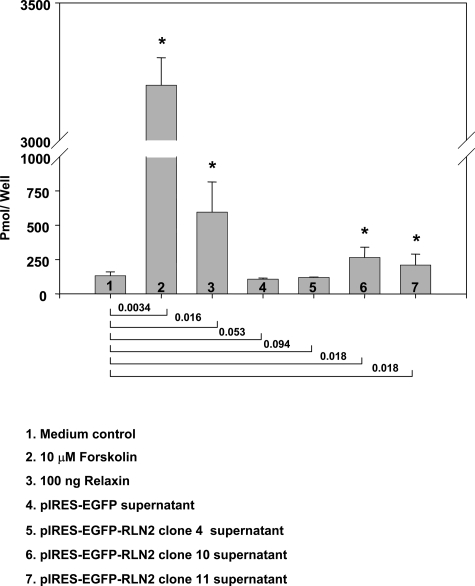
Representative result from cAMP enzyme immunoassay assays with the responder transfectant FTC-133-RLN2, clone 10, incubated for 1 hour with supernatants derived from FTC-133-EGFP (negative control) and different FTC-133-RLN2 transfectants. Exposure to 10 μmol/L forskolin as a positive control resulted in a highly significant increase in cAMP levels indicating the presence of a functional adenylate cyclase system in FTC-133. P values were calculated in relation to cAMP values obtained from the responder cells exposed to normal culture medium as negative control and are shown for each comparison below the graph; a P < 0.05 was considered significant (asterisk).
Figure 5-6913
Figure 5-6913
A: FTC-133-RLN2 transfectants (gray columns) displayed significantly (asterisk) increased NADH2-dependent production of formazan salts after 6-hour incubations compared to FTC-133-EGFP controls (black columns). B: Also reflecting enhanced mitochondrial activity, increased intracellular ATP levels were determined in the FTC-133-RLN2 clones at all cell densities investigated. Nonradioactive BrdU proliferation assays of FTC-133 transfectants revealed a small but significant (asterisk) increase in proliferation rates by FTC-133-RLN2 when seeded at lower cell numbers (0.5 × 10⁴ cells with P ≤ 0.005). A statistically less significant (P ≤ 0.01) increase in proliferation was observed with 0.25 × 10⁴ cells per well. C: The proliferative response to relaxin was diminished at high cell numbers (104 cells) indicating that RLN2 did not act as a strong mitogen on FTC-133. All data from these three assays were normalized to 0.5 × 10⁴ cells.
Figure 6-6913
Figure 6-6913
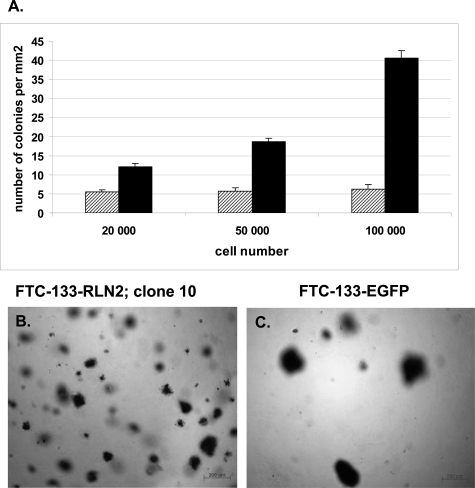
A: Representative soft agar colony assay for FTC-133-RLN2 clone 10 revealed an up to eight times higher number of colonies formed by FTC-133-RLN2 transfectants (black columns) as compared to the FTC-133-EGFP controls (gray columns). In addition, the colonies formed by the relaxin-secreting FTC-133 transfectants were smaller and more disseminated throughout the soft agar (B) as compared to EGFP controls (C). The number of cell colonies is represented as means of the counting results from 10 different areas.
Figure 7-6913
Figure 7-6913
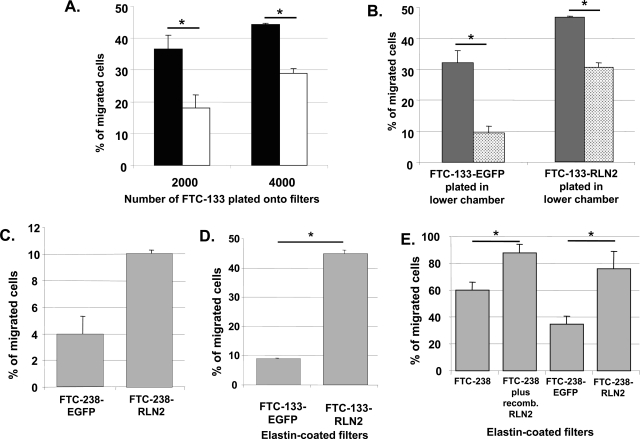
A: In a two-chambered motility assay, untransfected FTC-133 exposed to 100 ng/ml of recombinant RLN2 (black column) showed significantly increased motility when compared with untreated FTC-133 (white column) as determined by the number of cells that had traversed the 8-μm filter pores. B: Enhanced motility was also observed with FTC-133-RLN2 transfectants (gray column) as compared to FTC-133-EGFP controls (dotted column). A paracrine motility-promoting effect was observed for the FTC-133-RLN2 (gray column) and FTC-133-EGFP clones (dotted column) when relaxin-secreting FTC-133-RLN2 transfectants (5 × 10⁴ cells) were additionally plated into the lower chamber. This paracrine effect was absent when FTC-133-EGFP (5 × 10⁴) cells were plated in the lower chamber. C: FTC-238-RLN2 transfectants also showed enhanced motility as compared to FTC-238-EGFP controls. D: Migration assays through elastin-coated filters demonstrated an ∼4.5-fold enhanced migration of the FTC-133-RLN2 transfectants as compared to the FTC-133-EGFP controls indicating relaxin-mediated enhanced elastinolytic activity in these FTC-133-RLN2 transfectants. E: RLN2 also increased the elastinolytic activity in FTC-238 as shown for FTC-238 treated with recombinant RLN2 and for stable FTC-238-RLN2 transfectants.
Figure 8-6913
Figure 8-6913
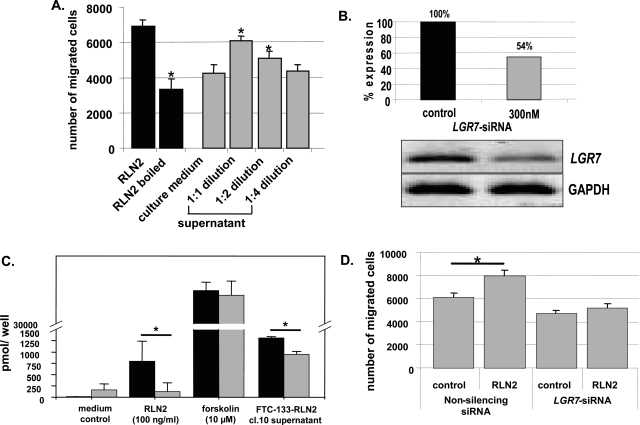
The specificity of the RLN2-LGR7 signaling in mediating the described tumor-promoting activity of RLN2 was shown by reducing the amount of bioactive RLN2 ligands (A) and by decreasing the number of LGR7 transcripts using a specific siRNA-LGR7 construct (B–D). A: Heat-inactivation of 500 ng/ml of RLN2 significantly decreased cellular motility (black columns). Dilution of culture supernatants from FTC-133-RLN2 transfectants also revealed a clear concentration-dependent decrease in motility of FTC-133 (gray columns). FTC-133 exposed to normal culture medium served as negative control. B: After 3 days of incubation with a specific siRNA-LGR7 at 300 nmol/L, FTC-133 displayed an ∼50% reduction in LGR7 transcripts. C: These siRNA-LGR7-treated FTC-133 cells (gray columns) displayed a significant reduction in cAMP response on stimulation with either recombinant human RLN2 or supernatants derived from FTC-133-RLN2 (clone 10) as compared to FTC-133 transfected with the nonsilencing siRNA construct (black columns). D: Nonsilencing siRNA also failed to inhibit the motility-promoting effect of recombinant RLN2 when compared to control cells not exposed to recombinant RLN2. FTC-133 and FTC-238 (not shown) treated with the siRNA-LGR7 did not elicit increased motility in the presence of exogenous RLN2. Thus, the cAMP response toward RLN2 and the motility-enhancing action of (pro)RLN2 were both mediated by the LGR7 signaling pathway in FTC-133 human thyroid carcinoma cells.
Figure 9-6913
Figure 9-6913
Western blot analyses for cellular and secreted cath-L and cath-D from FTC-133-EGFP (A–C, lanes 1) and different FTC-133-RLN2 transfectants (A–C, lanes 2 to 4). B: Immunoreactive forms at 24, 31, and 42 kd resembling the heavy chain, single chain, and procath-L, respectively, were detected with the mAb 33/1 in the cellular and secreted protein fractions of all FTC-133 transfectants investigated. When compared with FTC-133-EGFP clones (A and B, lanes 1), FTC-133-RLN2 (A and B, lanes 2 to 4) displayed increased production and secretion of the cath-L proform (42 kd) as determined by the mAb 2D4 specific for procath-L (A) and the mAb 33/1 against an epitope present in all three cath-L forms (B). B: In addition, FTC-133-RLN2 clones (lanes 2 to 4) showed enhanced production and secretion of the 31-kd and 24-kd bioactive cath-L forms as compared to FTC-133-EGFP clones (lane 1). C: Two immunoreactive cath-D forms at 52 kd and 25 kd were detected in the cellular protein fractions of both FTC-133-EGFP (lane 1) and FTC-133-RLN2 (lanes 2 to 4) transfectants. FTC-133-RLN2 displayed significantly increased amounts of procath-D at 52 kd in cellular extracts (lanes 2 to 4) as compared to FTC-133-EGFP controls (lane 1). The amount of the 25-kd cath-D in the cellular extracts was slightly reduced in all FTC-133 clones studied (lanes 1 to 4). The secreted protein fraction exclusively contained procath-D (52 kd) at similar levels in FTC-133-EGFP (lane 1) and FTC-133-RLN2 (lanes 2 to 4) transfectants. Equal protein loading was checked by β-actin staining of stripped membranes. D: Representative Western blots are shown for cellular and secreted cath-L of FTC-238-EGFP (lane 1) and FTC-238-RLN2 clones (lane 2). Similar to FTC-133-RLN2 clones, corresponding FTC-238-RLN2 transfectants demonstrated an up-regulation in cath-L single chain (31 kd) and heavy chain (24 kd), whereas the amount of procath-L (42 kd) produced by the FTC-238 clones was negligible. The pattern of cellular and secreted cath-D in the FTC-238-RLN2 transfectant was similar to corresponding FTC-133 clones (data not shown).
Figure 10-6913
Figure 10-6913
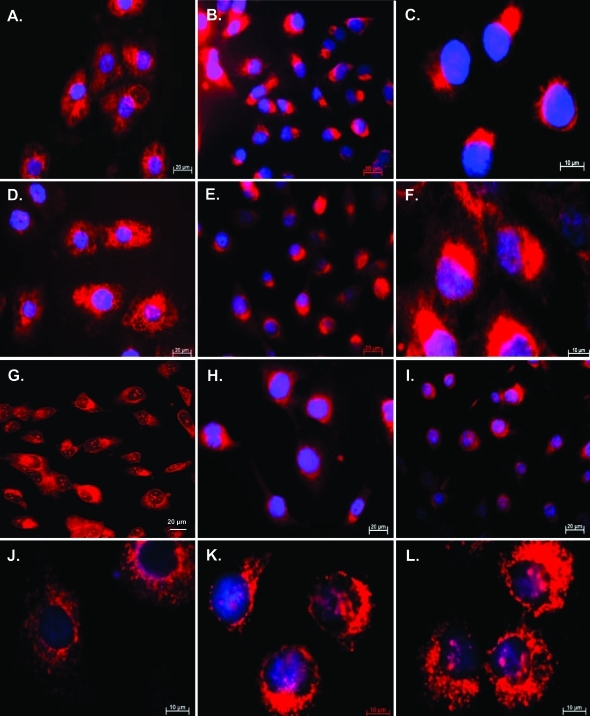
A: Immunofluorescent detection of human procath-L using the mAb 2D4 specific for human procath-L revealed randomized cytoplasmic immunostaining in FTC-133-EGFP clones. B, C: By contrast, a perinuclear and polar distribution of immunoreactive procath-L was observed in the FTC-133-RLN2 transfectants. Using the mAb 33/1 recognizing a common epitope in all three known human cath-L forms, FTC-133-EGFP clones (D) displayed a similar cytoplasmic immunostain as observed with the procath-L mAb 2D4 (A). E and F: FTC-133-RLN2 clones and FTC-238-RLN2 transfectants (not shown) showed a localized perinuclear distribution and cytoplasmic immunostain of cath-L. G: Confocal microscopy confirmed the perinuclear localization of cath-L in RLN2 transfectants only and revealed immunoreactive cath-L in the nucleus of FTC-133-RLN2 and FTC-133–EGFP transfectants (not shown). H and I: Cath-D was detected as a cytosolic immunoprotein with no apparent differences in the distribution between FTC-133-EGFP-transfectants (H) and FTC-133-RLN2 clones (I). Immunofluorescent detection of mannose-6-phosphate receptors in FTC-133-EGFP controls (J) showed a cytoplasmic granular stain, whereas a distinct polar to perinuclear distribution resembling the distribution of procath-L (C) was observed in FTC-133-RLN2 (K). L: Both FTC-133-RLN2 and FTC-133-EGFP clones showed a similar granular cytoplasmic immunostaining for the lysosmal marker CD63. Original magnifications: ×400 (A, B, D, E, G–I); ×1000 (C, F, J–L).

References

    1. Ivell R, Einspanier A. Relaxin peptides are new global players. Trends Endocrinol Metab. 2002;13:343–348. - PubMed
    1. Silvertown JD, Summerlee AJ, Klonisch T. Relaxin-like peptides in cancer. Int J Cancer. 2003;107:513–519. - PubMed
    1. Plunkett ER, Squires BP, Richardson SJ. The effect of relaxin on thyroid weights in laboratory animals. J Endocrinol. 1960;21:241–246. - PubMed
    1. Plunkett ER, Squires BP, Heagy FC. Effect of relaxin on thyroid function in the rat. J Endocrinol. 1963;26:331–338. - PubMed
    1. Braverman LE, Ingbar SH. Effects of preparations containing relaxin on thyroid function in the female rat. Endocrinology. 1963;72:337–341. - PubMed

Publication types

MeSH terms