. 2006 Aug 8;103(32):12087-92.
doi: 10.1073/pnas.0600291103. Epub 2006 Jul 28.

Identification of IgF, a hinge-region-containing Ig class, and IgD in Xenopus tropicalis

Affiliations

Identification of IgF, a hinge-region-containing Ig class, and IgD in Xenopus tropicalis

Yaofeng Zhao et al. Proc Natl Acad Sci U S A. .

Abstract

Only three Ig isotypes, IgM, IgX, and IgY, were previously known in amphibians. Here, we describe a heavy-chain isotype in Xenopus tropicalis, IgF (encoded by C(phi)), with only two constant region domains. IgF is similar to amphibian IgY in sequence, but the gene contains a hinge exon, making it the earliest example, in evolution, of an Ig isotype with a separately encoded genetic hinge. We also characterized a gene for the heavy chain of IgD, located immediately 3' of C(mu), that shares features with the C(delta) gene in fish and mammals. The latter gene contains eight constant-region-encoding exons and, unlike the chimeric splicing of muC(H)1 onto the IgD heavy chain in teleost fish, it is expressed as a unique IgD heavy chain. The IgH locus of X. tropicalis shows a 5' V(H)-D(H)-J(H)-C(mu)-C(delta)-C(chi)-C(upsilon)-C(phi) 3' organization, suggesting that the mammalian and amphibian Ig heavy-chain loci share a common ancestor.


Conflict of interest statement

Conflict of interest statement: No conflicts declared.

Figures
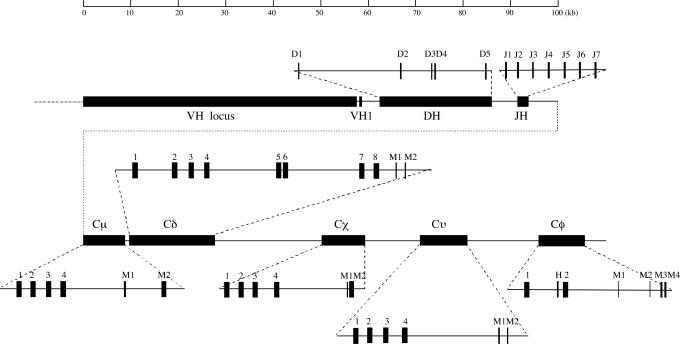
Fig. 1.
Fig. 1.
Assembly of the X. tropicalis IgH gene locus. VH, heavy-chain variable genes; DH, heavy-chain diversity gene segments; JH, heavy-chain joining gene segments; Cμ, IgM encoding gene; Cδ, IgD encoding gene. The filled boxes indicate exons encoding structurally conserved IgC domains: Cχ, IgX encoding gene; Cυ, IgY encoding gene; Cφ, IgF encoding gene; M, membrane exon. The domains encoding exons of each constant region gene are indicated with Arabic numbers. The position of the χCH1 exon is uncertain because it is missing in Scaffold_928 due to a small sequence gap.
Fig. 2.
Fig. 2.
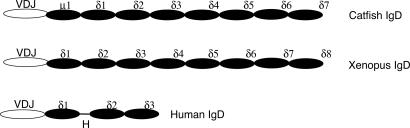
Structure of IgD heavy chains in different vertebrates. Catfish IgD (GenBank accession no. U67437); human IgD (GenBank accession no. AAB21246); H, hinge region.
Fig. 3.
Fig. 3.
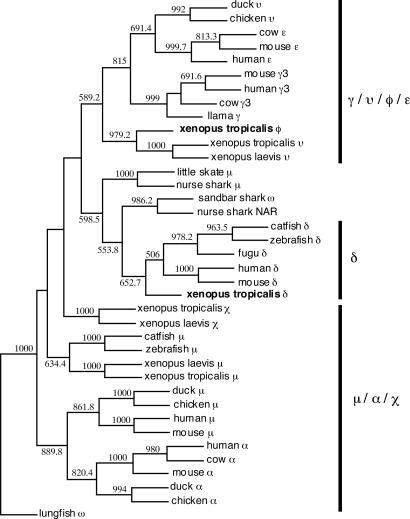
An unrooted phylogenetic tree of Igs in vertebrates. The tree was constructed by using protein sequences of the first and last CH domains (fish δCH6 and Xenopus δCH7 were used as the last domain) of all heavy-chain classes. Except for the Ig sequences obtained in this study, all other sequences were taken from the GenBank database, with the following accession numbers: Cδ gene: catfish (AF363450), fugu (AB159481), human (BC021276), mouse (J00449), and zebrafish (BX510335); Cμ gene: catfish (M27230), chicken (X01613), duck (AJ314750), human (X14940), mouse (V00818), nurse shark (M92851), little skate (M29679), X. laevis (BC084123), and zebrafish (AY643751); Cα gene: chicken (S40610), cow (AF109617), duck (U27222), human (P01877), and mouse (BC010324); Cε gene: cow (BTU63640), human (AK130825), and mouse (X01857); Cγ gene: cow (S82407), human (BX640623), llama (AF305955), and mouse (AY498569); Cυ gene: chicken (X07174), duck (AJ314754), and X. laevis (X15114); and Cχ gene: X. laevis (BC072981), nurse shark NAR (U18701), sandbar shark IgW (U40560), and lungfish IgW (AF437727).
Fig. 4.
Fig. 4.
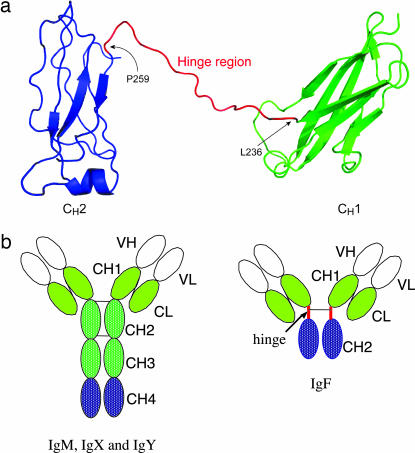
Structure of Igs in X. tropicalis. (a) A ribbon representation of the predicted structural model of the X. tropicalis IgF heavy chain. The CH1 and CH2 domains are colored green and blue, respectively. The putative hinge region between the two domains is colored red. Note that the hinge between CH1 and CH2 contains a gap (Ser-248 to Gly-252), which is due to the absence of corresponding residues in the template structure. The figure was prepared with PyMOL software. (b) Domain structure of IgF as compared with IgM, IgX, and IgY. There is only one cysteine in the C terminus of the CH2 domain of IgM for potential inter-heavy-chain disulfide bonding. CH, heavy-chain constant region domain; CL, light-chain constant region domain; VH, heavy-chain variable region; VL, light-chain variable region.
Fig. 5.
Fig. 5.
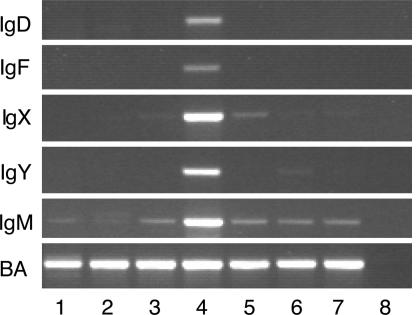
Expression of X. tropicalis IgD, IgF, IgX, IgY, and IgM in different organs as detected by RT-PCR. BA, β actin; 1, kidney; 2, thymus; 3, intestine; 4, spleen; 5, stomach; 6, liver; 7, caecum; 8, negative control.

References

    1. Flajnik M. F. Nat. Rev. Immunol. 2002;2:688–698. - PubMed
    1. Stavnezer J., Amemiya C. T. Semin. Immunol. 2004;16:257–275. - PubMed
    1. Lin L. C., Putnam F. W. Proc. Natl. Acad. Sci. USA. 1981;78:504–508. - PMC - PubMed
    1. Tucker P. W., Liu C. P., Mushinski J. F., Blattner F. R. Science. 1980;209:1353–1360. - PubMed
    1. Tucker P. W., Marcu K. B., Newell N., Richards J., Blattner F. R. Science. 1979;206:1303–1306. - PubMed

Publication types

Associated data