Review
. 2006 Aug 8;103(32):11821-7.
doi: 10.1073/pnas.0601617103. Epub 2006 Aug 1.

Rabs and their effectors: achieving specificity in membrane traffic

Affiliations
Review

Rabs and their effectors: achieving specificity in membrane traffic

Bianka L Grosshans et al. Proc Natl Acad Sci U S A. .

Abstract

Rab proteins constitute the largest branch of the Ras GTPase superfamily. Rabs use the guanine nucleotide-dependent switch mechanism common to the superfamily to regulate each of the four major steps in membrane traffic: vesicle budding, vesicle delivery, vesicle tethering, and fusion of the vesicle membrane with that of the target compartment. These different tasks are carried out by a diverse collection of effector molecules that bind to specific Rabs in their GTP-bound state. Recent advances have not only greatly extended the number of known Rab effectors, but have also begun to define the mechanisms underlying their distinct functions. By binding to the guanine nucleotide exchange proteins that activate the Rabs certain effectors act to establish positive feedback loops that help to define and maintain tightly localized domains of activated Rab proteins, which then serve to recruit other effector molecules. Additionally, Rab cascades and Rab conversions appear to confer directionality to membrane traffic and couple each stage of traffic with the next along the pathway.


Conflict of interest statement

Conflict of interest statement: No conflicts declared.

Figures
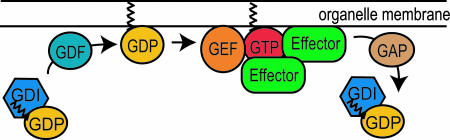
Fig. 1.
Fig. 1.
The nucleotide and membrane attachment/detachment cycles of Rab GTPases. Inactive (GDP-bound) prenylated Rab GTPases are bound to GDI, which masks their isoprenyl anchor and thereby keeps the Rab in a soluble cytosolic form (–20, 23). Membrane attachment of Rabs requires the function of a GDF that dissociates the GDI–Rab complex and allows the prenyl anchor to be inserted into the membrane. Subsequently, specific GEFs exchange the bound GDP for GTP, thereby activating the Rab GTPases. The active, membrane-bound Rabs are then able to fulfill their various functions in membrane traffic by binding to their specific effector proteins. Finally, specific GAPs inactivate the Rabs by accelerating the hydrolysis of the bound GTP into GDP. The inactive, GDP-bound Rabs can then be extracted from the membrane by GDI and recycled for another round of function (reviewed in ref. 22).
Fig. 2.
Fig. 2.
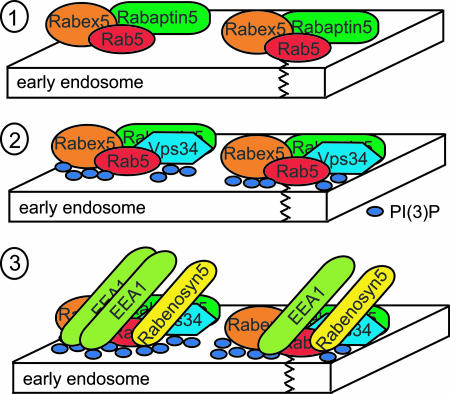
Rab–GEF effector complexes stabilize activated Rabs on membranes and allow the installment of Rab-specific membrane domains. (Top) After recruitment to the membrane of the early endosome, Rab5 is activated by its GEF Rabex-5 (103, 104). GTP–Rab5 then interacts with its effector Rabaptin5 (105). Rabaptin5 in turn binds to Rabex-5 and, additionally, increases the exchange activity of Rabex-5 on Rab5 (106), thereby stabilizing Rab5 in its GTP-bound state. This positive feedback loop counteracts GAP inactivation and GDI-mediated membrane extraction, thereby ensuring that GTP–Rab5 stays attached to the early endosome as long as necessary to recruit other necessary effectors. (Middle) The PI-3-OH kinase hVPS34/p150 (VPS34) is a Rab5 effector recruited to the Rabex-5–Rab5–Rabaptin5 platform (110). VPS34 generates the lipid PI(3)P (111), which is subsequently enriched on the early endosomal membrane (112). (Bottom) Both signals, PI(3)P and GTP–Rab5, are required to recruit more Rab5 effectors, such as EEA1 (, , –118) and Rabenosyn5 (85). EEA1 and Rabenosyn5 are factors required for homotypic early endosome fusion and fusion of vesicles to the early endosome (85, 110). Therefore, the specificity of early endosomal membrane traffic is ensured by the specific recruitment of the key proteins into Rab-defined membrane domains.
Fig. 3.
Fig. 3.
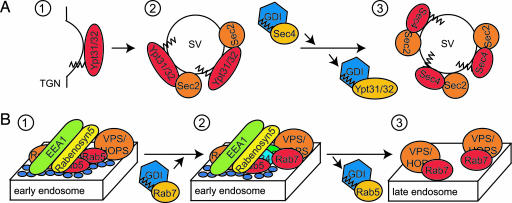
Rab cascades/Rab conversion. (A) Yeast Ypt31/32 form a Rab cascade with Sec2p and Sec4p. The redundant yeast Rab GTPases Ypt31p and Ypt32p are involved in several Golgi-related trafficking steps, including the exit of secretory vesicles from the trans-Golgi network (TGN) (1) (30, 127). Sec2p is the GEF for the Rab GTPase Sec4p (39). Both Sec2p and Sec4p are required for the transport of secretory vesicles (SV) from the TGN to the plasma membrane (37). Biochemical characterization revealed that Sec2p is an effector of Ypt31/32p (128). Ypt31/32p are at least partially responsible for the recruitment of Sec2p to secretory vesicles (2) (128), leading to the activation of Sec4p (3). (B) Rab conversion of Rab5 to Rab7 might drive early to late endosome maturation. Early endosomes are partially marked by the presence of Rab5 and its effectors (1; see Fig. 2). One Rab5 effector is Vps11p, a subunit of the conserved class C VPS/HOPS complex (1) (110, 129). A second subunit of this complex, Vps39p, displays GEF activity toward the yeast Rab7 ortholog, Ypt7p (107). Therefore, Rab5, class C VPS/HOPS, and Rab7 appear to form a Rab cascade on early endosomes (2). Gradual inactivation and replacement of Rab5 and its effectors concomitant with recruitment and activation of Rab7 and its effectors might lead to maturation of early endosomes into late endosomes (3) as has been observed (129).

References

    1. Geli M. I., Riezman H. J. Cell Sci. 1998;111:1031–1037. - PubMed
    1. Palade G. Science. 1975;189:347–358. - PubMed
    1. Rothman J. E. Nature. 1994;372:55–63. - PubMed
    1. Kartberg F., Elsner M., Froderberg L., Asp L., Nilsson T. Biochim. Biophys. Acta. 2005;1744:351–363. - PubMed
    1. Chavrier P., Goud B. Curr. Opin. Cell. Biol. 1999;11:466–475. - PubMed

MeSH terms

LinkOut - more resources