


Distance stereoacuity in intermittent exotropia
- PMID: 16885187
- PMCID: PMC1857613
- DOI: 10.1136/bjo.2006.099465
Distance stereoacuity in intermittent exotropia
Abstract
Background: Studies of distance stereoacuity in intermittent exotropia suggest that normal stereoacuity corresponds to good control of the deviation and that reduced or negative stereoacuity signifies poorer control.
Aim: : To evaluate distance stereoacuity in intermittent exotropia using the Frisby Davis Distance stereo test (FD2).
Methods: Children with intermittent exotropia where the near angle was less than or equal to distance were eligible for recruitment. Standardised prospective data collection included FD2 distance stereoacuity. This was a longitudinal study in which outcomes are reported for baseline, last follow-up (> or =6 months before any surgery) or preoperative and last postoperative visits for those undergoing surgery.
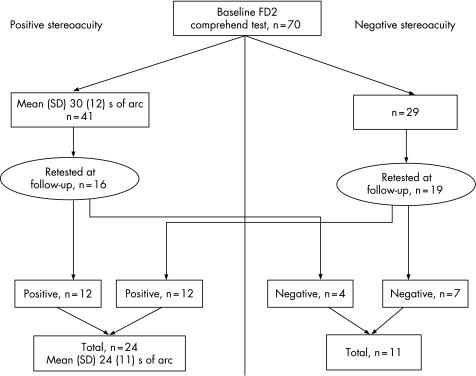
Results: 110 children with intermittent exotropia had FD2 stereoacuity tested at baseline: 70 comprehended the test. Mean (standard deviation (SD)) age was 4.6 (1.7) years (range 2-10 years). 41/70 (59%) showed positive responses: mean (SD) stereoacuity 30 (12) s of arc. The mean follow-up period before any surgery was 13 months (range 6-27 months). At follow-up, mean (SD) stereoacuity was 24 (11) s of arc. Preoperative and postoperative stereoacuity were not significantly different from those not undergoing surgery.
Conclusion: This study was the first to report distance stereoacuity in intermittent exotropia using the FD2 stereo test: patients with intermittent exotropia can achieve normal levels of distance stereoacuity, but a considerable proportion, despite comprehending, showed a negative response. This suggests that using the FD2, distance stereoacuity in intermittent exotropia is either absent or normal rather than reduced. Possible reasons for this and its implications are discussed.
Conflict of interest statement
Competing interests: None.
References
-
- Bishop P. Binocular vision. In: HW Moses RA, ed. Adler's Physiology of the Eye. St Louis: CV Mosby, 1987619–689.
-
- Westheimer G. Seeing depth with two eyes: stereopsis. Proc R Soc London 1994257205–214. - PubMed
-
- Zanoni D, Rosenbaum A. A new method for evaluating distance stereoacuity. J Pediatr Ophthalmol Strabismus 199128255–260. - PubMed
Publication types
MeSH terms
LinkOut - more resources
Full Text Sources
