. 2006 Aug 3:2:27.
doi: 10.1186/1744-9081-2-27.

The IMAGE project: methodological issues for the molecular genetic analysis of ADHD

Affiliations

The IMAGE project: methodological issues for the molecular genetic analysis of ADHD

Jonna Kuntsi et al. Behav Brain Funct. .

Abstract

The genetic mechanisms involved in attention deficit hyperactivity disorder (ADHD) are being studied with considerable success by several centres worldwide. These studies confirm prior hypotheses about the role of genetic variation within genes involved in the regulation of dopamine, norepinephrine and serotonin neurotransmission in susceptibility to ADHD. Despite the importance of these findings, uncertainties remain due to the very small effects sizes that are observed. We discuss possible reasons for why the true strength of the associations may have been underestimated in research to date, considering the effects of linkage disequilibrium, allelic heterogeneity, population differences and gene by environment interactions. With the identification of genes associated with ADHD, the goal of ADHD genetics is now shifting from gene discovery towards gene functionality--the study of intermediate phenotypes ('endophenotypes'). We discuss methodological issues relating to quantitative genetic data from twin and family studies on candidate endophenotypes and how such data can inform attempts to link molecular genetic data to cognitive, affective and motivational processes in ADHD. The International Multi-centre ADHD Gene (IMAGE) project exemplifies current collaborative research efforts on the genetics of ADHD. This European multi-site project is well placed to take advantage of the resources that are emerging following the sequencing of the human genome and the development of international resources for whole genome association analysis. As a result of IMAGE and other molecular genetic investigations of ADHD, we envisage a rapid increase in the number of identified genetic variants and the promise of identifying novel gene systems that we are not currently investigating, opening further doors in the study of gene functionality.


Figures
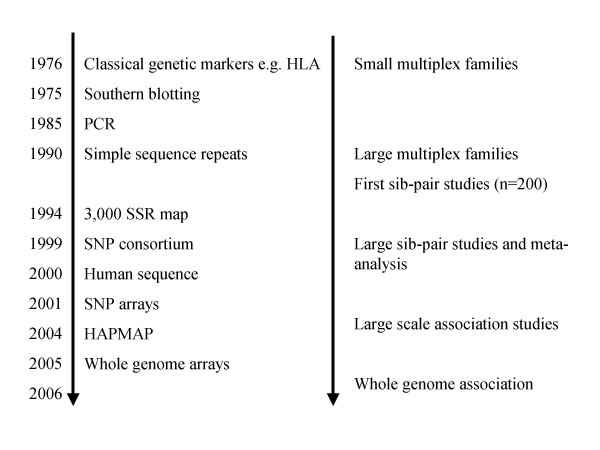
Figure 1
Figure 1
Historical perspective on gene mapping in common disorders. Initial studies, before DNA markers became available, relied on classical genetic markers such as blood or HLA types and therefore provided very limited information on a few regions of the human genome. The early genetic markers that used restriction enzymes to cut DNA at specific DNA sequences could identify sites that differed by one or more DNA bases. These restriction fragment length polymorphisms (RFLPs) were analyzed using a technique called Southern blotting that could identify one or a few markers at a time and was a relatively slow process. Linkage analysis came of age with the identification of another class of genetic variants, the simple sequence repeats (SSRs) that commonly consist of between two to four base pairs that are repeated in variable number tandem sequences (e.g. (AC)n) and are found approximately one every 50 thousand base pairs (Kb) across the genome. Around 3,000 such SSRs were identified for the first major human genome map in the mid 1990's, whereas only 400 of such markers are required for a first pass linkage scan. More recently the SNP consortium was established to identify single nucleotide polymorphisms (SNPs) that occur far more frequently, approximately one every 500 base pairs and are therefore useful for high-density association mapping. These are key to current studies since association, unlike linkage, can only be detected by markers that are correlated with functional variants in the population and are informative over very small distances. The HapMap project was set up to genotype SNPs across the genome in representative populations and establish the structure of linkage disequilibrium. High-density arrays that can be used to genotype between 350,000 – 500,000 SNPs in a single assay are now available and provide between 65–75% coverage for all SNPs with a minor allele frequency greater than 0.05. Further development of 1,000,000 plus arrays will be able to detect all common variation across the genome.
Figure 2
Figure 2
Illustration of a typical protein-coding gene. The promoter sequence regulates the process of messenger RNA (mRNA) production. mRNA is the template from which proteins are translated by matching of amino acids to the mRNA sequence. The gene is divided into exons (yellow), which are the coding regions for the amino acids in the protein. The untranslated regions (red) are found at either end of the mRNA and have various regulatory functions affecting mRNA expression and protein translation; because these regions appear in the mature mRNA molecule, they are also classified as exon sequences. Introns (blue) are found in the primary transcript and are spliced out to form the mature mRNA molecule. Sequences flanking each exon direct the splicing process. Additional elements regulating mRNA production can be found both within introns as well as outside of the gene. Genetic variation in any of the functional regions may alter either protein structure or expression.
Figure 3
Figure 3
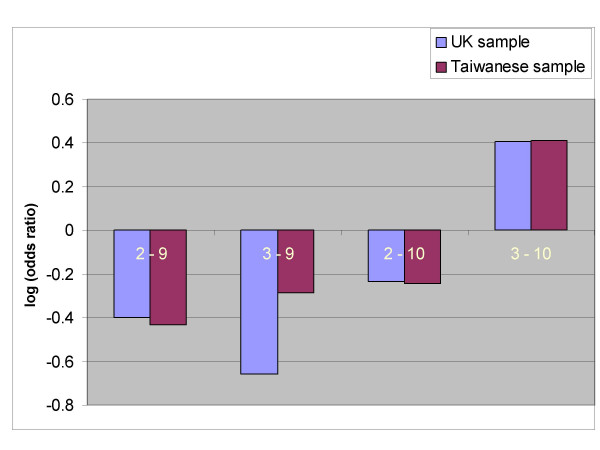
Log of the odds ratios for haplotype specific associations between ADHD and the intron 8 and 3'-UTR repeat polymorphisms in DAT1. Only chromosomes that contained the specific combination of the 3-repeat allele at the intron 8 marker and the 10-repeat at the 3'-UTR marker were over-transmitted from heterozygote parents to their affected offspring with ADHD (adapted from Brookes et al., 2005) [14].

References

    1. Faraone SV, Perlis RH, Doyle AE, Smoller JW, Goralnick JJ, Holmgren MA, Sklar P. Molecular genetics of attention-deficit/hyperactivity disorder. Biol Psychiatry. 2005;57:1313–1323. doi: 10.1016/j.biopsych.2004.11.024. - DOI - PubMed
    1. Asherson P. Attention-Deficit Hyperactivity Disorder in the post-genomic era. Eur Child Adolesc Psychiatry. 2004;13:I50–70. - PubMed
    1. Sham PC, Cherny SS, Purcell S, Hewitt JK. Power of linkage versus association analysis of quantitative traits, by use of variance-components models, for sibship data. Am J Hum Genet. 2000;66:1616–1630. doi: 10.1086/302891. - DOI - PMC - PubMed
    1. Freimer NB, Reus VI, Escamilla MA, McInnes LA, Spesny M, Leon P, Service SK, Smith LB, Silva S, Rojas E, Gallegos A, Meza L, Fournier E, Baharloo S, Blankenship K, Tyler DJ, Batki S, Vinogradov S, Weissenbach J, Barondes SH, Sandkuijl LA. Genetic mapping using haplotype, association and linkage methods suggests a locus for severe bipolar disorder (BPI) at 18q22-q23. Nat Genet. 1996;12:436–441. doi: 10.1038/ng0496-436. - DOI - PubMed
    1. Hastbacka J, de la Chapelle A, Kaitila I, Sistonen P, Weaver A, Lander E. Linkage disequilibrium mapping in isolated founder populations: diastrophic dysplasia in Finland. Nat Genet. 1992;2:204–211. doi: 10.1038/ng1192-204. - DOI - PubMed