


doi: 10.1016/j.jpeds.2006.03.014.
Autosomal recessive polycystic kidney disease and congenital hepatic fibrosis: summary statement of a first National Institutes of Health/Office of Rare Diseases conference
Affiliations
- PMID: 16887426
- PMCID: PMC2918414
- DOI: 10.1016/j.jpeds.2006.03.014
Item in Clipboard
Autosomal recessive polycystic kidney disease and congenital hepatic fibrosis: summary statement of a first National Institutes of Health/Office of Rare Diseases conference
J Pediatr.
2006 Aug.
Abstract
Researchers and clinicians with expertise in autosomal recessive polycystic kidney disease and congenital hepatic fibrosis (ARPKD/CHF) and related fields met on May 5-6, 2005, on the National Institutes of Health (NIH) campus for a 1.5-day symposium sponsored by the NIH Office of Rare Diseases, the National Human Genome Research Institute (NHGRI), and in part by the ARPKD/CHF Alliance. The meeting addressed the present status and the future of ARPKD/CHF research.
Figures
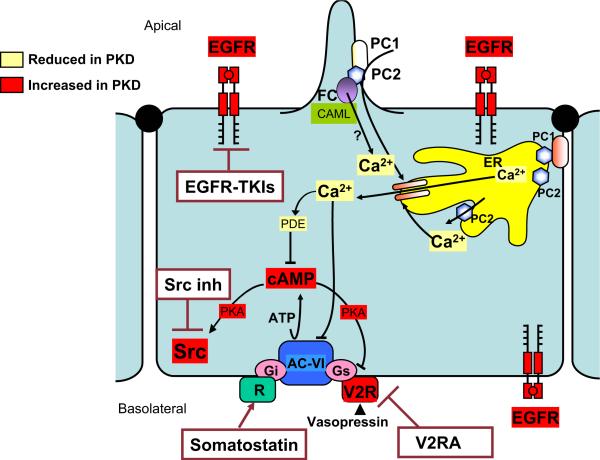
Hypothetical representation of regulation of calcium ion [Ca2+]i homeostasis by PKD-related proteins and summary of potential novel therapeutic interventions targeting major downstream effects of mutations disrupting this pathway. In response to mechanical stimulation of primary cilium, polycystin-1/2 complex mediates Ca2+ entry into cell. This triggers Ca2+ release from endoplasmic reticulum (ER). Fibrocystin (FC) may regulate [Ca2+]i homeostasis by its interaction with polycystin-2 (PC2) and Ca2+-modulating cyclophilin ligand (CAML). Major downstream effects from disruptions of this pathway include elevated cAMP, up-regulated and apically mislocalized epidermal growth factor receptor (EGFR) and up-regulated vasopressin V2 receptor (V2R). Cellular content of cAMP is determined by balance between activities of synthesizing adenylyl cyclases (AC) and catabolizing cAMP phosphodiesterases (PDE). Adenylyl cyclase VI (AC-VI), predominant AC in collecting duct epithelial cells, is stimulated by αs-subunit of heteromeric G proteins (Gs) and is inhibited by Gi and by Ca2+. Activation of V2R by vasopressin increases cAMP production. Somatostatin and vasopressin V2 receptor antagonists inhibit cAMP production. PDE1 and PDE4 are predominant PDEs in collecting duct principal cells. PDE1 is activated by Ca2+/calmodulin. PKA, Protein kinase A; Src, membrane-associated tyrosine-specific kinase; V2RA, vasopressin 2 receptor antagonist; Src inh, Src inhibitors; EGFRTKI, epidermal growth factor receptor tyrosine kinase inhibitor. Modified from VE Torres and PC Harris: Mechanisms of disease: autosomal dominant and recessive polycystic kidney diseases. Nat Clin Pract Nephrol 2006;2:40-55.
References
-
- Zerres K, Rudnik-Schoneborn S, Deget F, Holtkamp U, Brodehl J, Geisert J, et al. Clinical course of 115 children with autosomal recessive polycystic kidney disease. Acta Pediatr. 1996;85:437–45. - PubMed
-
- Capisonda R, Phan V, Traubuci J, Daneman A, Balfe JW, Guay-Woodford LM. Autosomal recessive polycystic kidney disease: outcomes from a single-center experience. Pediatr Nephrol. 2003;18:119–26. - PubMed
-
- Onuchic LF, Furu L, Nagasawa Y, Hou X, Eggermann T, Ren Z, et al. PKHD1, the polycystic kidney and hepatic disease 1 gene, encodes a novel large protein containing multiple immuneglobulin-like plexin transcription factor domain and parallel beta-helix 1 repeats. Am J Hum Genet. 2002;70:1305–17. - PMC - PubMed
-
- Ward CJ, Hogan MC, Rossetti S, Walker D, Sneddon T, Wang X, et al. The gene mutated in autosomal recessive polycystic kidney disease encodes a large receptor-like protein. Nat Genet. 2002;30:259–69. - PubMed
-
- Bergmann C, Senderek J, Windelen E, Kupper F, Middeldorf I, Schneider F, et al. Clinical consequences of PKHD1 mutations in 164 patients with autosomal-recessive polycystic kidney disease (ARPKD). Kidney Int. 2005;67:829–48. - PubMed
Publication types
MeSH terms
Substances
Grants and funding
LinkOut - more resources
Full Text Sources
Medical
Miscellaneous
