


The genetic architecture of life span and mortality rates: gender and species differences in inbreeding load of two seed-feeding beetles
- PMID: 16888331
- PMCID: PMC1602065
- DOI: 10.1534/genetics.106.060392
The genetic architecture of life span and mortality rates: gender and species differences in inbreeding load of two seed-feeding beetles
Abstract
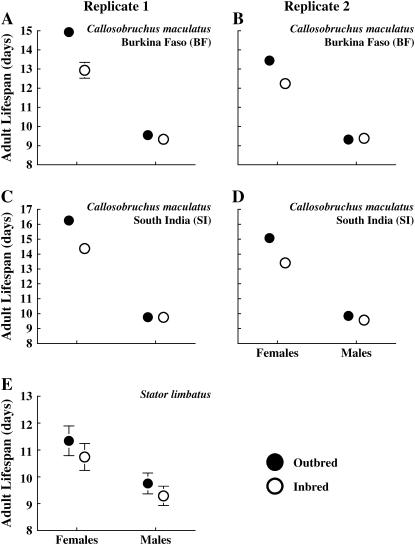
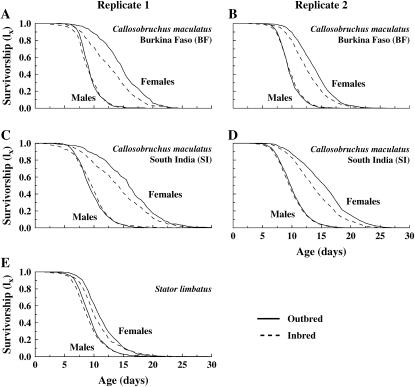
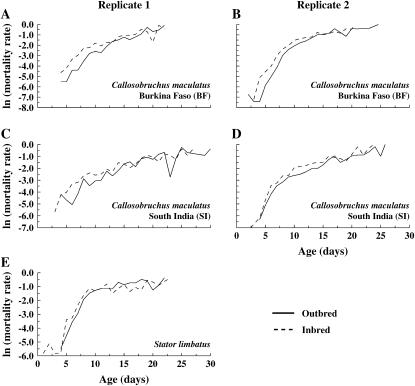
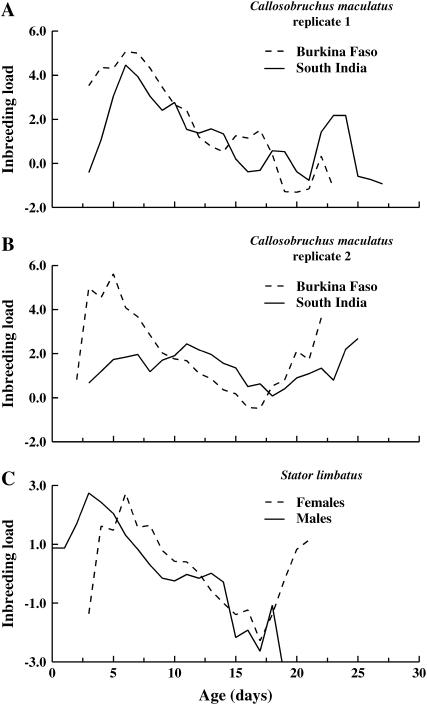
We examine the inbreeding load for adult life span and mortality rates of two seed beetle species, Callosobruchus maculatus and Stator limbatus. Inbreeding load differs substantially between males and females in both study populations of C. maculatus--life span of inbred females was 9-13% shorter than the life span of outbred females, whereas the life span of inbred males did not differ from the life span of outbred males. The effect of inbreeding on female life span was largely due to an increase in the slope of the mortality curve. In contrast, inbreeding had only a small effect on the life span of S. limbatus--life spans of inbred beetles were approximately 5% shorter than those of outbred beetles, and there was no difference in inbreeding load between the sexes. The inbreeding load for mean life span was approximately 0.4-0.6 lethal equivalents per haploid gamete for female C. maculatus and approximately 0.2-0.3 for both males and females of S. limbatus, all within the range of estimates commonly obtained for Drosophila. However, contrary to the predictions of mutation-accumulation models, inbreeding load for loci affecting mortality rates did not increase with age in either species, despite an effect of inbreeding on the initial rate of increase in mortality. This was because mortality rates decelerated with age and converged to a mortality plateau for both outbred and inbred beetles.
Figures
References
-
- Carey, J. R., P. Liedo, D. Orozco and J. W. Vaupel, 1992. Slowing of mortality-rates at older ages in large medfly cohorts. Science 258: 457–461. - PubMed
-
- Cassinello, J., 2005. Inbreeding depression on reproductive performance and survival in captive gazelles of great conservation value. Biol. Conserv. 122: 453–464.
-
- Charlesworth, B., and D. Charlesworth, 1999. The genetic basis of inbreeding depression. Genet. Res. 74: 329–340. - PubMed
Publication types
MeSH terms
LinkOut - more resources
Full Text Sources
