Double-strand breaks arising by replication through a nick are repaired by cohesin-dependent sister-chromatid exchange
- PMID: 16888651
- PMCID: PMC1559660
- DOI: 10.1038/sj.embor.7400774
Double-strand breaks arising by replication through a nick are repaired by cohesin-dependent sister-chromatid exchange
Abstract
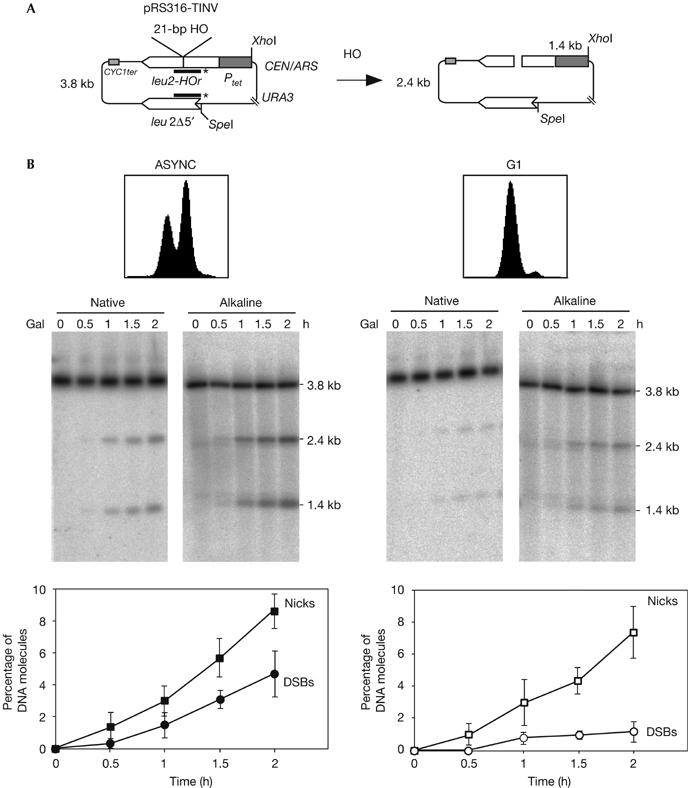
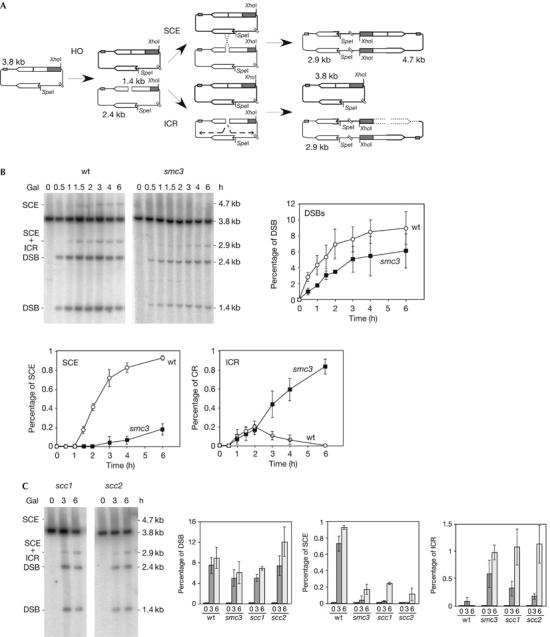
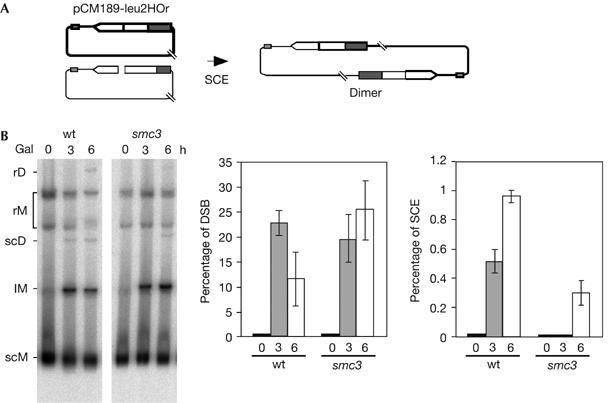
Molecular studies on double-strand break (DSB) repair in mitosis are usually performed with enzymatically induced DSBs, but spontaneous DSBs might arise because of replication failures, for example when replication encounters nicks. To study repair of replication-born DSBs, we defined a system in Saccharomyces cerevisiae for the induction of a site-specific single-strand break. We show that a 21-base pair (bp) HO site is cleaved at only one strand by the HO endonuclease, with the resulting nick being converted into a DSB by replication during the S phase. Repair of such replication-born DSBs occurs by sister-chromatid exchange (SCE). We provide molecular evidence that cohesins are required for repair of replication-born DSBs by SCE, as determined in smc3, scc1 and scc2 mutants, but not for other recombinational repair events. This work opens new perspectives to understand the importance of single-strand breaks as a source of recombination and the relevance of cohesion in the repair of replication-born DSBs.
Figures



References
-
- Branzei D, Foiani M (2005) The DNA damage response during DNA replication. Curr Opin Cell Biol 17: 568–575 - PubMed
-
- Gonzalez-Barrera S, Cortes-Ledesma F, Wellinger RE, Aguilera A (2003) Equal sister chromatid exchange is a major mechanism of double-strand break repair in yeast. Mol Cell 11: 1661–1671 - PubMed
-
- Ivanov D, Nasmyth K (2005) A topological interaction between cohesin rings and a circular minichromosome. Cell 122: 849–860 - PubMed
Publication types
MeSH terms
Substances
LinkOut - more resources
Full Text Sources
Other Literature Sources
Molecular Biology Databases
Research Materials
Miscellaneous