


Epidemiology of candidemia in Brazil: a nationwide sentinel surveillance of candidemia in eleven medical centers
- PMID: 16891497
- PMCID: PMC1594610
- DOI: 10.1128/JCM.00773-06
Epidemiology of candidemia in Brazil: a nationwide sentinel surveillance of candidemia in eleven medical centers
Abstract
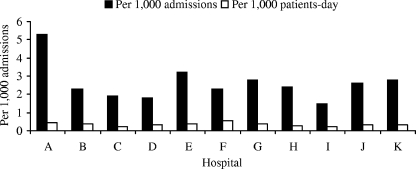
Candidemia studies have documented geographic differences in rates and epidemiology, underscoring the need for surveillance to monitor trends. We conducted prospective candidemia surveillance in Brazil to assess the incidence, species distribution, frequency of antifungal resistance, and risk factors for fluconazole-resistant Candida species. Prospective laboratory-based surveillance was conducted from March 2003 to December 2004 in 11 medical centers located in 9 major Brazilian cities. A case of candidemia was defined as the isolation of Candida spp. from a blood culture. Incidence rates were calculated per 1,000 admissions and 1,000 patient-days. Antifungal susceptibility tests were performed by using the broth microdilution assay, according to the Clinical and Laboratory Standards Institute guidelines. We detected 712 cases, for an overall incidence of 2.49 cases per 1,000 admissions and 0.37 cases per 1,000 patient-days. The 30-day crude mortality was 54%. C. albicans was the most common species (40.9%), followed by C. tropicalis (20.9%) and C. parapsilosis (20.5%). Overall, decreased susceptibility to fluconazole occurred in 33 (5%) of incident isolates, 6 (1%) of which were resistant. There was a linear correlation between fluconazole and voriconazole MICs (r = 0.54 and P < 0.001 [Spearman's rho]). This is the largest multicenter candidemia study conducted in Latin America and shows the substantial morbidity and mortality of candidemia in Brazil. Antifungal resistance was rare, but correlation between fluconazole and voriconazole MICs suggests cross-resistance may occur.
Figures
Comment in
-
Epidemiology of candidemia.J Clin Microbiol. 2008 May;46(5):1894; author reply 1894. doi: 10.1128/JCM.00417-08. J Clin Microbiol. 2008. PMID: 18460637 Free PMC article. No abstract available.
-
Why should the journal of clinical microbiology apologize for publishing a paper plagiarized from its archives?J Clin Microbiol. 2011 Aug;49(8):3109-10; author reply 3112. doi: 10.1128/JCM.00881-11. J Clin Microbiol. 2011. PMID: 21799091 Free PMC article. No abstract available.
References
-
- Alexander, B. D., W. A. Schell, J. L. Miller, G. D. Long, and J. R. Perfect. 2005. Candida glabrata fungemia in transplant patients receiving voriconazole after fluconazole. Transplantation 80:868-871. - PubMed
-
- Al-Jasser, A. M., and N. A. Elkhizzi. 2004. Distribution of Candida species among bloodstream isolates. Saudi Med. J. 25:566-569. - PubMed
-
- Almirante, B., D. Rodriguez, B. J. Park, M. Cuenca-Estrella, A. M. Planes, M. Almela, J. Mensa, F. Sanchez, J. Ayats, M. Gimenez, P. Saballs, S. K. Fridkin, J. Morgan, J. L. Rodriguez-Tudela, D. W. Warnock, and A. Pahissa. 2005. Epidemiology and predictors of mortality in cases of Candida bloodstream infection: results from population-based surveillance, Barcelona, Spain, from 2002 to 2003. J. Clin. Microbiol. 43:1829-1835. - PMC - PubMed
-
- Alonso-Valle, H., O. Acha, J. D. Garcia-Palomo, C. Farinas-Alvarez, C. Fernandez-Mazarrasa, and M. C. Farinas. 2003. Candidemia in a tertiary care hospital: epidemiology and factors influencing mortality. Eur. J. Clin. Microbiol. Infect. Dis. 22:254-257. - PubMed
-
- Antunes, A. G., A. C. Pasqualotto, M. C. Diaz, P. A. d'Azevedo, and L. C. Severo. 2004. Candidemia in a Brazilian tertiary care hospital: species distribution and antifungal susceptibility patterns. Rev. Inst. Med. Trop. Sao Paulo 46:239-241. - PubMed
Publication types
MeSH terms
Substances
LinkOut - more resources
Full Text Sources
Medical
Miscellaneous
