. 2006 Oct;142(2):574-85.
doi: 10.1104/pp.106.085886. Epub 2006 Aug 4.

IMMUTANS does not act as a stress-induced safety valve in the protection of the photosynthetic apparatus of Arabidopsis during steady-state photosynthesis

Affiliations

IMMUTANS does not act as a stress-induced safety valve in the protection of the photosynthetic apparatus of Arabidopsis during steady-state photosynthesis

Dominic Rosso et al. Plant Physiol. 2006 Oct.

Abstract

IMMUTANS (IM) encodes a thylakoid membrane protein that has been hypothesized to act as a terminal oxidase that couples the reduction of O(2) to the oxidation of the plastoquinone (PQ) pool of the photosynthetic electron transport chain. Because IM shares sequence similarity to the stress-induced mitochondrial alternative oxidase (AOX), it has been suggested that the protein encoded by IM acts as a safety valve during the generation of excess photosynthetically generated electrons. We combined in vivo chlorophyll fluorescence quenching analyses with measurements of the redox state of P(700) to assess the capacity of IM to compete with photosystem I for intersystem electrons during steady-state photosynthesis in Arabidopsis (Arabidopsis thaliana). Comparisons were made between wild-type plants, im mutant plants, as well as transgenics in which IM protein levels had been overexpressed six (OE-6 x) and 16 (OE-16 x) times. Immunoblots indicated that IM abundance was the only major variant that we could detect between these genotypes. Overexpression of IM did not result in increased capacity to keep the PQ pool oxidized compared to either the wild type or im grown under control conditions (25 degrees C and photosynthetic photon flux density of 150 micromol photons m(-2) s(-1)). Similar results were observed either after 3-d cold stress at 5 degrees C or after full-leaf expansion at 5 degrees C and photosynthetic photon flux density of 150 micromol photons m(-2) s(-1). Furthermore, IM abundance did not enhance protection of either photosystem II or photosystem I from photoinhibition at either 25 degrees C or 5 degrees C. Our in vivo data indicate that modulation of IM expression and polypeptide accumulation does not alter the flux of intersystem electrons to P(700)(+) during steady-state photosynthesis and does not provide any significant photoprotection. In contrast to AOX1a, meta-analyses of published Arabidopsis microarray data indicated that IM expression exhibited minimal modulation in response to myriad abiotic stresses, which is consistent with our functional data. However, IM exhibited significant modulation in response to development in concert with changes in AOX1a expression. Thus, neither our functional analyses of the IM knockout and overexpression lines nor meta-analyses of gene expression support the model that IM acts as a safety valve to regulate the redox state of the PQ pool during stress and acclimation. Rather, IM appears to be strongly regulated by developmental stage of Arabidopsis.


Figures
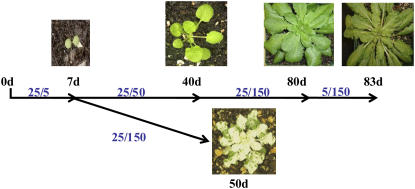
Figure 1.
Figure 1.
Experimental design for the suppression of the variegated phenotype. Seeds from im were germinated and allowed to grow at 25°C with an irradiance of 5 μmol photons m−2 s−1 (25/5) for 7 d. Plants were then shifted from an irradiance of 5 to 50 μmol photons m−2 s−1 (25/50) for 4 weeks. Once the first rosette appeared, the plants were then shifted to 150 μmol photons m−2 s−1 (25/150) for another 4 weeks until the second and third rosettes had completely developed. It is at this stage that fully expanded leaves were used for experimental analysis. Plants were then shifted from 25°C to 5°C for 3 d at an irradiance of 150 μmol photons m−2 s−1 (25/150) to cold stress the plants. Alternatively, when plants were shifted directly from 5 to 150 μmol photons m−2 s−1 after 7 d, im knockout plants exhibited a variegated phenotype when fully developed. All genotypes were grown with an 8/16-h day/night cycle.
Figure 2.
Figure 2.
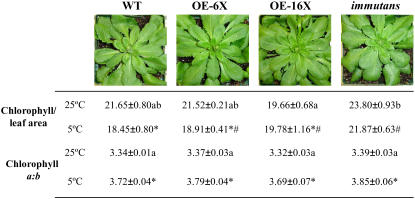
Morphology, Chl per leaf area (μg Chl cm−2), and Chl a/b ratios of different plant genotypes of Arabidopsis ecotype Columbia. Wild type (WT), OE-6×, OE-16×, and an all-green sectored knockout mutant (im) are shown. All plant genotypes were grown at 25°C at an irradiance of 150 μmol photons m−2 s−1 (25/150). Cold-stressed plants were shifted from 25°C to 5°C for an additional 3 d at the same irradiance (5/150). All plants were grown under an 8/16-h day/night cycle to prevent flowering. Photographs illustrate plants that were grown at 25°C. Letters represent significance between means for leaves grown at 25°C and symbols represent significance between means for leaves that were cold stressed at the 95% confidence interval.
Figure 3.
Figure 3.
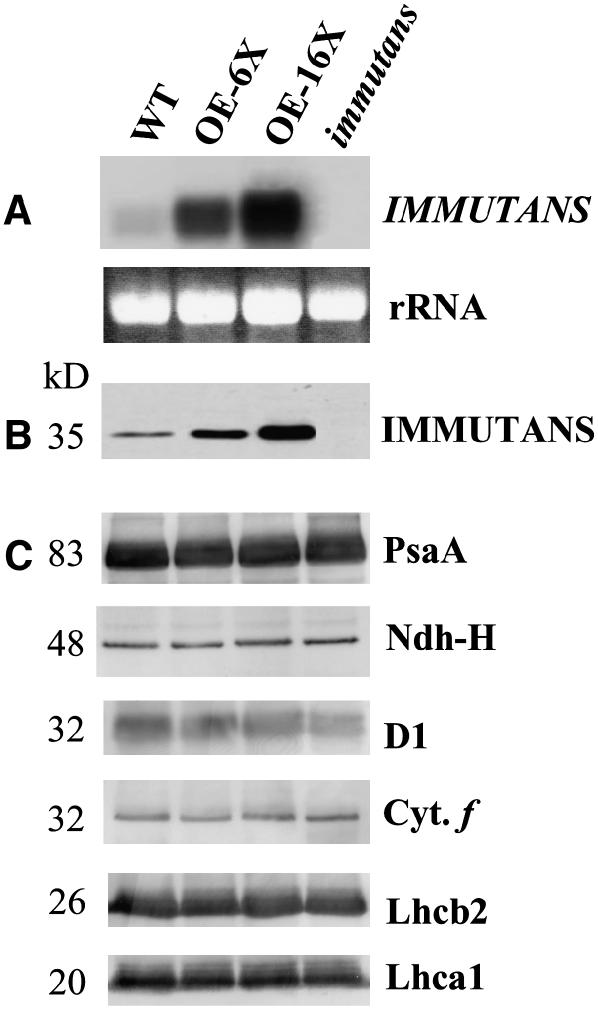
IM gene expression and protein abundance. mRNA expression of IM (A) relative abundance and of IM protein (B) and immunoblots of polypeptides of the major photosynthetic complexes of isolated thylakoid membranes (C) were performed on leaves obtained from the wild type (WT), OE-6× and OE-16×, and knockout mutant (im) of Arabidopsis. The RNA gel was stained with ethidium bromide to show rRNA and demonstrate equal loading (A). Solubilized thylakoid membranes were loaded equally with 5 μg Chl/lane. Immunoblots were probed using polyclonal antibodies raised against PsaA, H subunit of the NAD(P)H complex, D1, Cyt f, and Lhcb2 and Lhca1. All plant genotypes were grown at 25°C with an irradiance of 150 μmol photons m−2 s−1.
Figure 4.
Figure 4.
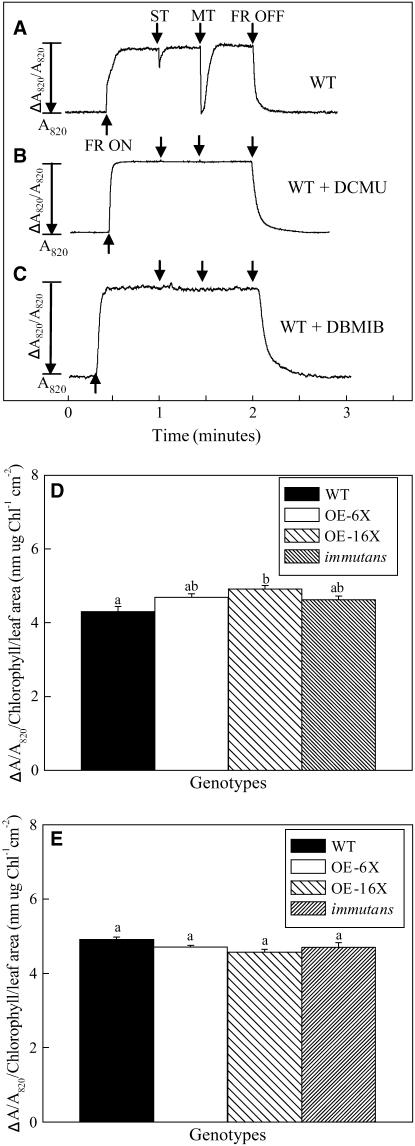
In vivo measurements of the relative redox state of P700. Detached plant leaves from wild type both untreated (A) and treated with the inhibitor DCMU (B) and treated with the inhibitor DBMIB (C) in Arabidopsis were dark adapted for 20 min prior to the measurement of the oxidation of P700. The steady-state oxidation of P700A820/A820) was estimated for plants grown at 25°C (D) and 5°C (E) after the FR light was turned on (FR ON) and the P700 transients were followed after application of the ST and MT flashes of white light. Letters represent statistically significant differences between means at the 95% confidence interval.
Figure 5.
Figure 5.
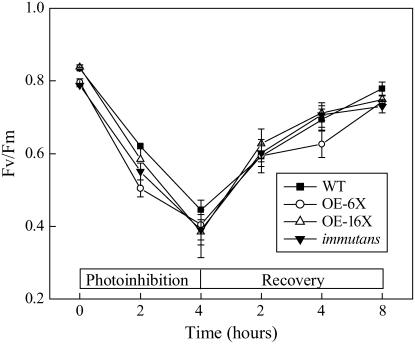
Fv/Fm of all plant genotypes of Arabidopsis exposed to high light (1,200 μmol photons m−2 s−1) at 5°C and allowed to recover at 25°C with an irradiance of 20 μmol photons m−2 s−1 for up to 8 h. Fv/Fm was measured in detached plant leaves.
Figure 6.
Figure 6.
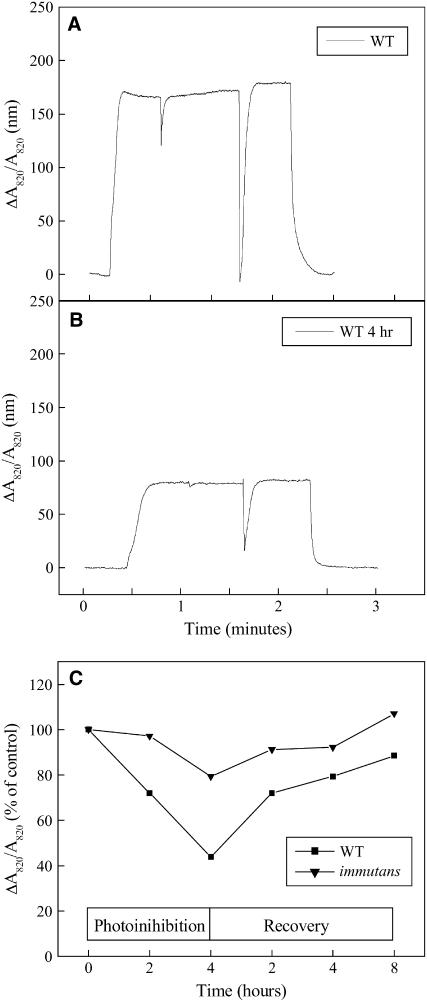
Photoinhibition of PSI. Photooxidation of P700 measured as ΔA820/A820 from detached plant leaves from wild-type control plants grown at 25/150 (A) and after 4 h of photoinhibition at 5°C with PPFD of 1,200 μmol photons m−2 s−1 (B). The steady-state oxidation of P700 was measured as ΔA820/A820 and normalized as a percentage of control. All genotypes of Arabidopsis were exposed to high light (1,200 μmol photons m−2 s−1) at 5°C and allowed to recover at 25°C with an irradiance of 20 μmol photons m−2 s−1 (C). P700 was measured in detached plant leaves. Data presented are of one experimental treatment with three replicate measurements.
Figure 7.
Figure 7.
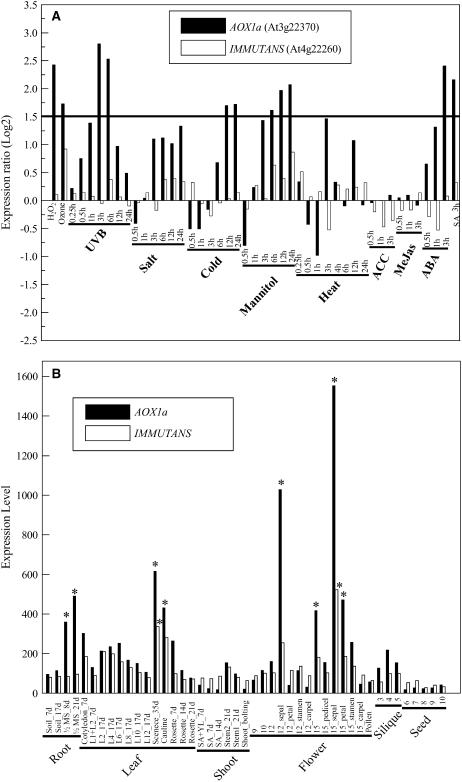
A, Expression ratio of AOX1a (At3g22370) and IM (At4g22260) transcripts (log base 2) under different abiotic stresses and hormone treatments. H2O2, 100 mm hydrogen peroxide for 3 h; ozone, 200 ppb of ozone for 1 h; UVB, 15-min damaging UVB irradiation; salt, 150 mm NaCl; cold, 4°C shift from room temperature; mannitol, 300 μm mannitol; heat, 38°C shift from room temperature (0.25–3 h) and recovery after 3 h (4–24 h); ACC, 10 μm 1-aminocyclopropane-1-carboxylic acid (ethylene precursor); MeJas, 10 μm methyl jasmonate; ABA, 10 μm abscisic acid; SA, 10 μm salicylic acid. Times indicate hours after treatment initiation. Note significant up-regulation (1.5-fold stringent cutoff) of AOX1a in H2O2, ozone, 3- and 6-h UVB treatments, 12- and 24-h cold treatments, 6-, 12-, and 24-h mannitol treatments, and 3-h treatments in ABA and SA. IM showed no significant up-regulation or down-regulation. B, Differential expression of AOX1a and IM transcripts in different tissues. Expression level based on MAS 5.0 scaling by NASC (see “Materials and Methods”) to give relative expression level (100 units = genomic average). Roots, leaves, shoot apices and stems, flowers, siliques, and seeds in different developmental stages according to Boyes et al. (2001) and Schmid et al. (2005). L, Leaf number (L1 = first appearing leaf); d, days after germination; SA, shoot apex; YL, young leaves; *, significant tissue-specific expression especially in senescing and cauline leaves (AOX1a) and sepals (IM and AOX1a) with more than 2-fold increase in average. Expression was not significantly above background in seeds for IM (stages 8–10) and AOX1a (stages 6–10), and in shoot apices (AOX1a). Roots were collected from soil-grown (Soil) and one-half-strength Murashige and Skoog agar media (MS); note significant increase in AOX1a expression on MS media.

References

    1. Aluru MR, Bae H, Wu D, Rodermel SR (2001) The Arabidopsis immutans mutation affects plastid differentiation and the morphogenesis of white and green sectors in variegated plants. Plant Physiol 127: 67–77 - PMC - PubMed
    1. Aluru MR, Rodermel SR (2004) Control of chloroplast redox by the IMMUTANS terminal oxidase. Physiol Plant 120: 4–11 - PubMed
    1. Aluru MR, Yu F, Fu A, Rodermel SR (2006) Arabidopsis variegation mutants: new insights into chloroplast biogenesis. J Exp Bot 57: 1871-1881 - PubMed
    1. Asada K, Heber U, Schreiber U (1993) Electron flow to the intersystem chain from stromal components and cyclic electron flow in maize chloroplasts, as detected in intact leaves by monitoring redox change of P700 and chlorophyll fluorescence. Plant Cell Physiol 34: 39–50
    1. Baerr JN, Thomas JD, Taylor BG, Rodermel SR, Gray GR (2005) Differential photosynthetic compensatory mechanisms exist in the immutans mutant of Arabidopsis thaliana. Physiol Plant 124: 390–402

Publication types

Associated data

LinkOut - more resources