. 2006 Oct;142(2):775-87.
doi: 10.1104/pp.106.085506. Epub 2006 Aug 4.

Dehydroascorbate reductase affects leaf growth, development, and function

Affiliations

Dehydroascorbate reductase affects leaf growth, development, and function

Zhong Chen et al. Plant Physiol. 2006 Oct.

Abstract

Ascorbic acid (Asc) is a major antioxidant in plants that detoxifies reactive oxygen species (ROS) and maintains photosynthetic function. Expression of dehydroascorbate reductase (DHAR), responsible for regenerating Asc from an oxidized state, regulates the cellular Asc redox state, which in turn affects cell responsiveness and tolerance to environmental ROS. Because of its role in Asc recycling, we examined whether DHAR is important for plant growth. Suppression of DHAR expression resulted in a preferential loss of chlorophyll a, a lower steady state of Rubisco as measured by the amount of the large subunit of Rubisco (RbcL), and a lower rate of CO(2) assimilation. As a consequence, a slower rate of leaf expansion and reduced foliar dry weight were observed. In addition, an accelerated rate of loss of chlorophyll, RbcL, light-harvesting complex II, and photosynthetic functioning was observed in mature leaves, resulting in premature leaf aging. Reduced growth rate as measured by plant height and leaf number was consistent with the DHAR-mediated reduction of photosynthetic function. Increasing DHAR expression maintained higher levels of chlorophyll, RbcL, light-harvesting complex II, and photosynthetic functioning, resulting in delayed leaf aging. The effect of DHAR expression on leaf aging inversely correlated with the level of lipid peroxidation, indicating that DHAR functions to protect against ROS-mediated damage. These observations support the conclusion that through its Asc recycling function, DHAR affects the level of foliar ROS and photosynthetic activity during leaf development and as a consequence, influences the rate of plant growth and leaf aging.


Figures

Figure 1.
Figure 1.
DHAR activity, chlorophyll pool size, and rate of CO2 assimilation during leaf development. A, DHAR activity was measured from every second leaf of adult tobacco just prior to flowering. DHAR protein levels were measured by western analysis. B, Chlorophyll a (♦) and b (○) levels and rate of CO2 assimilation (C) were determined from every second leaf of adult tobacco. Leaf 2 was the youngest leaf and leaf 20 the oldest leaf tested.
Figure 2.
Figure 2.
DHAR activity correlates with ROS-mediated damage and the level of RbcL and LHCII. A, The level of DHAR activity, lipid peroxidation (as measured by the TBARS assay), and total APX was measured in expanding, mature, and presenescent leaves of control (C), DOX, and DKD tobacco. The average and sd from three replicates are reported. B, The level of DHAR (DHARNt, DHARTa), RbcL, and LHCII were measured by western analysis. C, RT-PCR analysis of CP1 expression (top) in mature leaves, presenescent leaves, senescent stage 1 leaves (approximately 2 weeks older than presenescent leaves), and senescent stage 2 leaves (approximately 4 weeks older than presenescent leaves) of control, DOX, and DKD plants. RT-PCR analysis of actin expression (bottom) was also performed as a control using the same leaf samples.
Figure 3.
Figure 3.
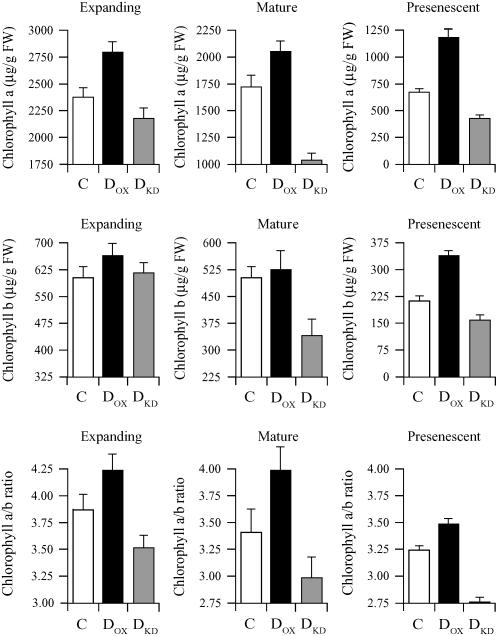
DHAR activity correlates with the chlorophyll pool size and chlorophyll a/b ratio. Chlorophyll a, chlorophyll b, and the chlorophyll a/b ratio were measured in expanding, mature, and presenescent leaves of control (C), DOX, and DKD tobacco. The average and sd from four replicates are reported.
Figure 4.
Figure 4.
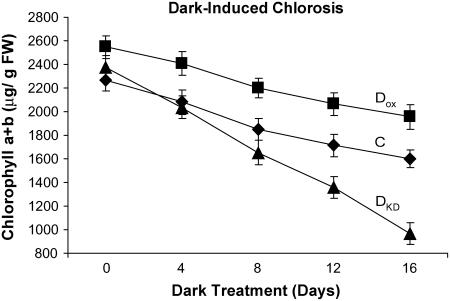
Suppression of DHAR expression accelerates loss of chlorophyll. Chlorophyll (a + b) was measured every 4 d from dark-treated leaves of control (C, ♦), DOX (▪), and DKD tobacco (▴). The average and sd from three replicates are reported.
Figure 5.
Figure 5.
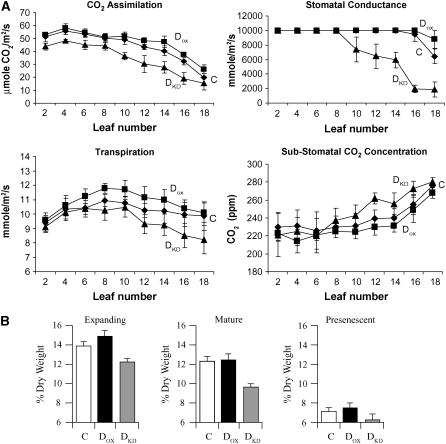
DHAR activity affects the efficiency of CO2 assimilation and leaf dry weight. A, The rates of CO2 assimilation, transpiration, and stomatal conductance, and the substomatal CO2 concentration were measured from every second leaf of control (C, ♦), DOX (▪), and DKD tobacco (▴). Leaf 2 was the youngest leaf and leaf 18 the oldest leaf tested. Expanding leaves include leaves 2 to 4, mature leaves include leaves 6 to 8, and presenescent leaves include leaves 16 to 18. B, The dry weight as measured as percent of fresh weight was determined for expanding, mature, and presenescent leaves. The average and sd from three replicates are reported.
Figure 6.
Figure 6.
The level of DHAR activity affects the rate of plant growth. Plant height and leaf number were measured in control (C, ♦), DOX (▪), and DKD tobacco (▴) beginning at 4 weeks after germination until the appearance of the inflorescence. Leaf area was measured following the vegetative to floral transition when all leaves had reached their final size. Leaf 1 was the youngest leaf and leaf 9 was the oldest leaf measured. The average and sd from eight replicates are reported.
Figure 7.
Figure 7.
The level of DHAR activity correlates with the foliar Asc redox state and level of RbcL and LHCII during leaf expansion. A, The level of DHAR activity, Asc (black bars), DHA (white bars), and the Asc redox state (Asc/DHA) were measured in the sixth true leaf during its growth from 8%, 50%, and 100% of fully expanded size of control (C), DOX, and DKD tobacco. The average and sd from three replicates are reported. B, The level of DHAR, RbcL, and LHCII were measured in the same leaves as in A by western analysis.
Figure 8.
Figure 8.
The level of DHAR activity correlates with the chlorophyll a pool size, the chlorophyll a/b ratio, and leaf dry weight during leaf expansion. A, Chlorophyll a, chlorophyll b, and the chlorophyll a/b ratio were measured in the sixth true leaf during its growth from 8%, 50%, and 100% of fully expanded size of control (C), DOX, and DKD tobacco. B, The dry weight as measured as the percent of fresh weight was determined at the same stages of leaf growth as in A. The average and sd from four replicates are reported.
Figure 9.
Figure 9.
The level of DHAR activity affects the efficiency of CO2 assimilation during leaf expansion. The rates of CO2 assimilation, transpiration, and stomatal conductance, and the substomatal CO2 concentration were measured in the sixth true leaf during its growth from control (C, ♦), DOX (▪), and DKD tobacco (▴). Measurements were taken every third day, starting when the leaves were 8% of fully expanded size until the leaves were 100% of fully expanded size (approximately day 9) and continued for an additional 9 d. The average and sd from three replicates are reported.
Figure 10.
Figure 10.
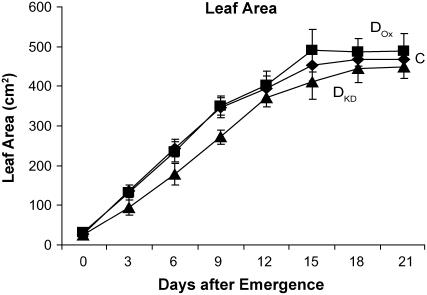
The level of DHAR activity affects the rate of leaf growth. Leaf area was measured for the sixth true leaf during its growth in control (C, ♦), DOX (▪), and DKD tobacco (▴) every 3 d beginning at leaf emergence. The average and sd from eight replicates are reported.

References

    1. Arrigoni O (1994) Ascorbate system in plant development. J Bioenerg Biomembr 26: 407–419 - PubMed
    1. Arrigoni O, De Tullio MC (2000) The role of ascorbic acid in cell metabolism: between gene-directed functions and unpredictable chemical reactions. J Plant Physiol 157: 481–488
    1. Arrigoni O, De Tullio MC (2002) Ascorbic acid: much more than just an antioxidant. Biochim Biophys Acta 1569: 1–9 - PubMed
    1. Asada K (1994) Mechanisms for scavenging reactive molecules generated in chloroplasts under light stress. In NR Baker, JR Bowyer, eds, Photoinhibition of Photosynthesis. From Molecular Mechanisms to the Field. Bios Scientific Publishers, Oxford, pp 129–142
    1. Asada K (1999) The water-water cycle in chloroplasts: scavenging of active oxygens and dissipation of excess photons. Annu Rev Plant Physiol Plant Mol Biol 50: 601–639 - PubMed

Publication types

MeSH terms

Associated data