


Hepatitis C virus infection among injecting drug users in Scotland: a review of prevalence and incidence data and the methods used to generate them
- PMID: 16893486
- PMCID: PMC2870592
- DOI: 10.1017/S0950268806007035
Hepatitis C virus infection among injecting drug users in Scotland: a review of prevalence and incidence data and the methods used to generate them
Abstract
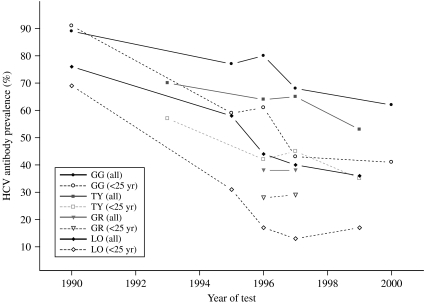
It is estimated that of 50,000 persons in Scotland (1% of the county's population), infected with the hepatitis C virus (HCV), around 90% injected drugs. This paper reviews data on the prevalence and incidence of HCV, and the methods used to generate such information, among injecting drug users (IDUs), in Scotland. The prevalence estimate for HCV among IDUs in Scotland as a whole (44% in 2000), is comparable with those observed in many European countries. Incidence rates ranged from 11.9 to 28.4/100 person-years. The data have shaped policy to prevent infection among IDUs and have informed predictions of the number of HCV-infected IDUs who will likely progress to, and require treatment and care for, severe HCV-related liver disease. Although harm reduction interventions, in particular needle and syringe exchanges and methadone maintenance therapy, reduced the transmission of HCV among IDUs during the early to mid-1990s, incidence in many parts of the country remains high. The prevention of HCV among IDUs continues to be one of Scotland's major public health challenges.
Figures

References
-
- Hutchinson SJ, Bird SM, Goldberg DJ. Modelling the current and future disease burden of hepatitis C among injecting drug users in Scotland. Hepatology. 2005;42:711–723. - PubMed
-
- Shaw L et al. Establishment of a database of diagnosed HCV-infected persons in Scotland. Communicable Disease & Public Health. 2003;6:305–310. - PubMed
-
- Anon. Diagnosis of hepatitis C virus in Scotland: data to December 2003. SCIEH Weekly Report. 2004;38:150–155.
-
- Hutchinson SJ et al. Hepatitis C virus infection in Scotland: epidemiological review and public health challenges. Scottish Medical Journal. 2006;51:8–15. - PubMed
-
- Nicoll A et al. The public health applications of unlinked anonymous seroprevalence monitoring for HIV in the United Kingdom. International Journal of Epidemiology. 2000;29:1–10. - PubMed
MeSH terms
LinkOut - more resources
Full Text Sources
Medical
