. 2006 Aug 15;103(33):12341-6.
doi: 10.1073/pnas.0601635103. Epub 2006 Aug 7.

Molecular and functional analysis of nicotinate catabolism in Eubacterium barkeri

Affiliations

Molecular and functional analysis of nicotinate catabolism in Eubacterium barkeri

Ashraf Alhapel et al. Proc Natl Acad Sci U S A. .

Abstract

The anaerobic soil bacterium Eubacterium barkeri catabolizes nicotinate to pyruvate and propionate via a unique fermentation. A full molecular characterization of nicotinate fermentation in this organism was accomplished by the following results: (i) A 23.2-kb DNA segment with a gene cluster encoding all nine enzymes was cloned and sequenced, (ii) two chiral intermediates were discovered, and (iii) three enzymes were found, completing the hitherto unknown part of the pathway. Nicotinate dehydrogenase, a (nonselenocysteine) selenium-containing four-subunit enzyme, is encoded by ndhF (FAD subunit), ndhS (2 x [2Fe-2S] subunit), and by the ndhL/ndhM genes. In contrast to all enzymes of the xanthine dehydrogenase family, the latter two encode a two-subunit molybdopterin protein. The 6-hydroxynicotinate reductase, catalyzing reduction of 6-hydroxynicotinate to 1,4,5,6-tetrahydro-6-oxonicotinate, was purified and shown to contain a covalently bound flavin cofactor, one [2Fe-2S](2+/1+) and two [4Fe-4S](2+/1+) clusters. Enamidase, a bifunctional Fe-Zn enzyme belonging to the amidohydrolase family, mediates hydrolysis of 1,4,5,6-tetrahydro-6-oxonicotinate to ammonia and (S)-2-formylglutarate. NADH-dependent reduction of the latter to (S)-2-(hydroxymethyl)glutarate is catalyzed by a member of the 3-hydroxyisobutyrate/phosphogluconate dehydrogenase family. A [4Fe-4S]-containing serine dehydratase-like enzyme is predicted to form 2-methyleneglutarate. After the action of the coenzyme B(12)-dependent 2-methyleneglutarate mutase and 3-methylitaconate isomerase, an aconitase and isocitrate lyase family pair of enzymes, (2R,3S)-dimethylmalate dehydratase and lyase, completes the pathway. Genes corresponding to the first three enzymes of the E. barkeri nicotinate catabolism were identified in nine Proteobacteria.


Conflict of interest statement

Conflict of interest statement: No conflicts declared.

Figures
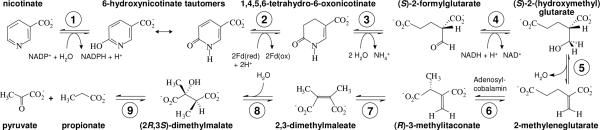
Fig. 1.
Fig. 1.
Nicotinate fermentation in E. barkeri. ➀, nicotinate dehydrogenase; ➁, 6-hydroxynicotinate reductase; ➂, enamidase; ➃, 2-(hydroxymethyl)glutarate dehydrogenase; ➄, 2-(hydroxymethyl)glutarate dehydratase; ➅, 2-methyleneglutarate mutase; ➆, (R)-3-methylitaconate isomerase; ➇, (2R,3S)-dimethylmalate dehydratase; ➈, (2R,3S)-dimethylmalate lyase.
Fig. 2.
Fig. 2.
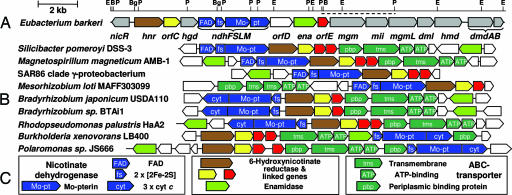
Nicotinate catabolism gene clusters. (A) The nicotinate fermentation gene cluster of E. barkeri with the PstI fragment (24), indicated by a dashed line and BamHI, BglII, EcoRI, and PstI restriction sites (B, Bg, E, and P), is shown. Genes associated with conversion of 2-formylglutarate to propionate and pyruvate are in gray. (B) Gene clusters associated with nicotinate catabolism via THON (descriptions and accession codes in Supporting Text). (C) Key: Genes with unclear association to nicotinate catabolism are colorless.
Fig. 3.
Fig. 3.
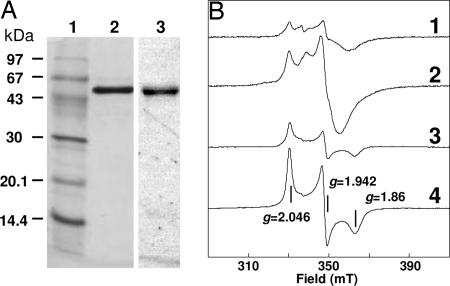
The enzyme 6-hydroxynicotinate reductase from E. barkeri. (A) SDS/PAGE. Lanes: 1, protein marker; 2 and 3, purified enzyme (2 μg) (1 and 2, Coomassie staining; 3, covalently bound flavin by UV-induced visible fluorescence). (B) EPR spectra of 36 μM purified enzyme in 20 mM KPi, pH 7.4. Spectra: 1, reduced with 10 mM THON, recorded at 10 K and 0.5 mW microwave power; 2, as 1, but reduced with 2 mM sodium dithionite; 3, as 1, but recorded at 40 K and 127 mW microwave power; 4, as 3, but reduced with 2 mM sodium dithionite. EPR conditions: modulation frequency, 100 kHz; microwave frequency, 9.460 GHz; modulation amplitude, 1.25 mT. Amplitudes of spectra 3 and 4 have been enlarged 4-fold.
Fig. 4.
Fig. 4.
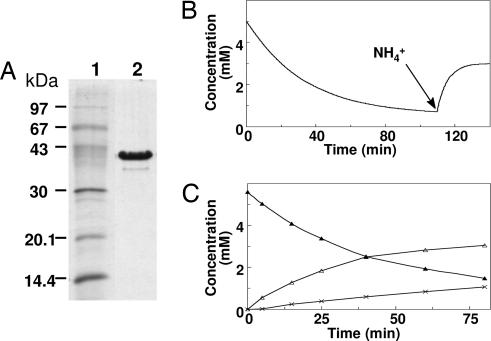
Enamidase from E. barkeri. (A) SDS/PAGE. Lanes: 1, protein marker; 2, 2 μg of purified enamidase. (B) Hydrolysis of 5 mM THON in 50 mM KPi, pH 7.4, at 23°C by 10 μg of enamidase and catalysis of the reverse reaction after addition of 200 mM (NH4)2SO4 (1-mm cuvette; THON concentration calculated with ε307 nm = 1.1 mM−1cm−1). (C) Hydrolysis of THON by enamidase and formation of (S)-2-formylglutarate. THON (1 ml, 5.6 mM) was incubated as in B, but with 5 μg of enzyme. Aliquots of 10 μl were diluted with 1 ml of 50 mM KPi, pH 7.4. THON (from a 272–nm absorbance; filled triangles) and (S)-2-formylglutarate concentrations (from NADH consumption 15 s after the addition of 10 units 2-(hydroxymethyl)glutarate dehydrogenase; open triangles) were measured. The lowest trace shows the calculated difference between THON hydrolyzed and (S)-2-formylglutarate (crosses).
Fig. 5.
Fig. 5.
Proposed intermediates of the enamidase catalyzed THON hydrolysis.
Fig. 6.
Fig. 6.
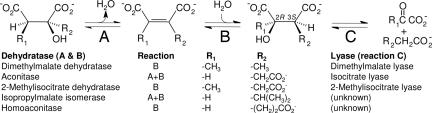
Dehydratase and lyase pairs acting on the (2R,3S)-3-substituted malate moiety.

References

    1. London J., Knight M. J. Gen. Microbiol. 1966;44:241–254. - PubMed
    1. Kaiser J.-P., Feng Y., Bollag J.-M. Microbiol. Rev. 1996;60:483–498. - PMC - PubMed
    1. Andreesen J. R., Fetzner S. Met. Ions Biol. Syst. 2002;39:405–430. - PubMed
    1. Nakano H., Wieser M., Hurh B., Kawai T., Yoshida T., Yamane T., Nagasawa T. Eur. J. Biochem. 1999;260:120–126. - PubMed
    1. Nagel M., Andreesen J. R. Arch. Microbiol. 1990;154:605–613.

Publication types

Associated data