


Enhancing patient safety through organizational learning: Are patient safety indicators a step in the right direction?
- PMID: 16898983
- PMCID: PMC1955346
- DOI: 10.1111/j.1475-6773.2006.00569.x
Enhancing patient safety through organizational learning: Are patient safety indicators a step in the right direction?
Abstract
Objective: To assess the potential contribution of the Agency for Healthcare Research and Quality Patient Safety Indicators (PSIs) to organizational learning for patient safety improvement.
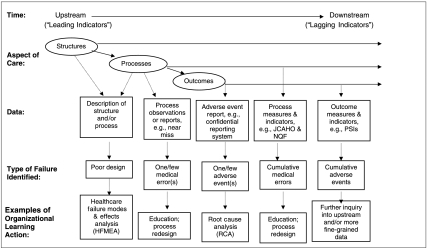
Principal findings: Patient safety improvement requires organizational learning at the system level, which entails changes in organizational routines that cut across divisions, professions, and levels of hierarchy. This learning depends on data that are varied along a number of dimensions, including structure-process-outcome and from granular to high-level; and it depends on integration of those varied data. PSIs are inexpensive, easy to use, less subject to bias than some other sources of patient safety data, and they provide reliable estimates of rates of preventable adverse events.
Conclusions: From an organizational learning perspective, PSIs have both limitations and potential contributions as sources of patient safety data. While they are not detailed or timely enough when used alone, their simplicity and reliability make them valuable as a higher-level safety performance measure. They offer one means for coordination and integration of patient safety data and activity within and across organizations.
Figures
References
-
- AHRQ (Agency for Healthcare Research and Quality) National Healthcare Disparities Report Publication # 05-0014. Rockville, MD: Department of Health and Human Services and the Agency for Healthcare Research and Quality; 2004a.
-
- AHRQ (Agency for Healthcare Research and Quality) National Healthcare Quality Report AHRQ Publication # 05-0013. Rockville, MD: Department of Health and Human Services and the Agency for Healthcare Research and Quality; 2004b.
-
- AHRQ (Agency for Healthcare Research and Quality) Guide to Patient Safety Indicators, Version 2.1, Revised January 3, 2005. 2005. [May 10, 2005]. Available at http://www.qualityindicators.ahrq.gov/psi_download.htm.
-
- Amalberti R, Auroy Y, Berwick D, Barach P. Five Barriers to Achieving Ultrasafe Health Care. Annals of Internal Medicine. 2005;142:756–64. - PubMed
-
- Bent PD, Bolosin SN, Creati BJ, Patrick AJ, Colson ME. Professional Monitoring and Critical Incident Reporting Using Personal Digital Assistants. Medical Journal of Australia. 2002;177(9):496–99. - PubMed
Publication types
MeSH terms
LinkOut - more resources
Full Text Sources
