. 2007 Jun;6(4):329-38.
doi: 10.1111/j.1601-183X.2006.00261.x. Epub 2006 Aug 7.

Increased response to morphine in mice lacking protein kinase C epsilon

Affiliations

Increased response to morphine in mice lacking protein kinase C epsilon

P M Newton et al. Genes Brain Behav. 2007 Jun.

Abstract

The protein kinase C (PKC) family of serine-threonine kinases has been implicated in behavioral responses to opiates, but little is known about the individual PKC isozymes involved. Here, we show that mice lacking PKCepsilon have increased sensitivity to the rewarding effects of morphine, revealed as the expression of place preference and intravenous self-administration at very low doses of morphine that do not evoke place preference or self-administration in wild-type mice. The PKCepsilon null mice also show prolonged maintenance of morphine place preference in response to repeated testing when compared with wild-type mice. The supraspinal analgesic effects of morphine are enhanced in PKCepsilon null mice, and the development of tolerance to the spinal analgesic effects of morphine is delayed. The density of mu-opioid receptors and their coupling to G-proteins are normal. These studies identify PKCepsilon as a key regulator of opiate sensitivity in mice.


Figures
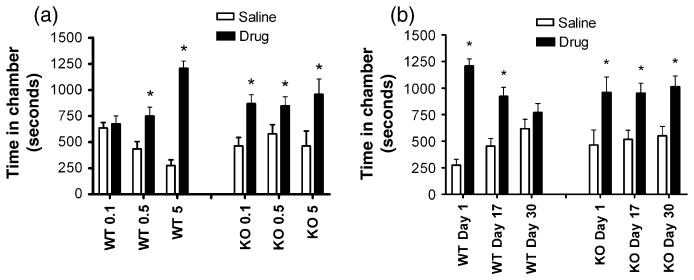
Figure 1
Figure 1. Morphine conditioned place preference is enhanced in PKCε null mice
(a) PKCε null mice developed conditioned place preference to a sub-threshold dose of morphine (0.1 mg/kg i.p.) that did not cause place preference in wild-type mice. Both genotypes developed preference to 0.5 and 5 mg/kg morphine. (b) Place preference to 5 mg morphine is maintained for a 30-day period in PKCε null mice but extinguishes in wild-type mice. Results are mean ± standard error of the mean values from 10 to 11 mice of each genotype. * P < 0.05 compared with the saline-paired side by Wilcoxon signed rank test.
Figure 2
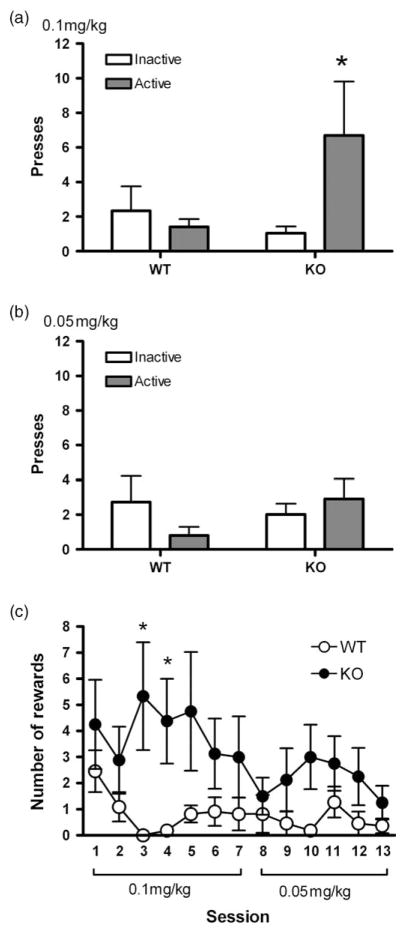
Figure 2. Morphine self-administration is enhanced in PKCε null mice
Mice were implanted with intravenous catheters delivering morphine on an FR 1 schedule for thirteen 60-min sessions (0.1 mg/kg per infusion for seven sessions, 0.05 mg/kg for six sessions). PKCε null mice showed significantly more responding on the active vs. the inactive lever for 0.1 mg/kg infusions, whereas wild-type mice did not show preferential responding on either lever (a). This preference for the active lever was abolished when the infusion dose was reduced to 0.05 mg/kg (b). In addition, the total number of rewards earned by PKCε null mice was greater than that earned by wild-type mice (c). *P < 0.05 compared with wild-type mice at that dose by post hoc Bonferroni tests.
Figure 3
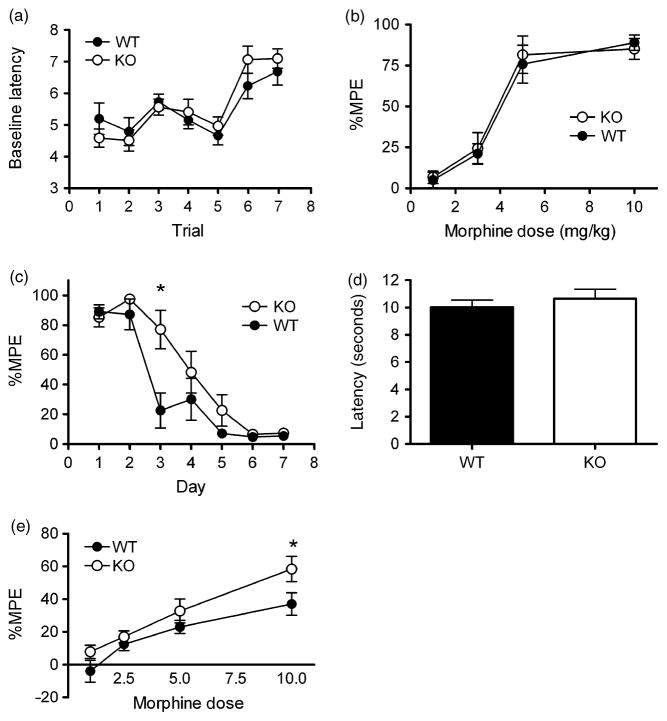
Figure 3. Acute supraspinal opioid analgesia is enhanced in PKCε null mice, whereas acute spinal analgesia is normal but the development of chronic tolerance is delayed
Morphine (1–10 mg/kg i.p.) effects on spinal nociception were quantified 30 min after injection by measuring the tail-flick latency using a 56°C water bath. (a) There was no genotypic difference in baseline latency (trial 1) or in the latencies measured before each injection of 10 mg/kg morphine during the tolerance experiment (trials 2–7) increased similarly over time in both genotypes. (b) There was also no genotypic difference in morphine dose response in naive non-tolerant mice. (c) The development of analgesic tolerance was assessed by repeated daily testing 30 min after a 10-mg/kg dose of morphine. PKCε null mice showed delayed development of tolerance compared with wild-type mice. *P < 0.05 compared with wild-type mice on day 3 by post hoc Bonferroni tests. Morphine effects on supraspinal nociception were quantified by measuring paw withdrawal latency in mice 30 min after morphine (1–10 mg/kg i.p.) injection using a hotplate set at 52°C. (d) There was no difference in baseline latency. (e) PKCε null mice showed significantly greater withdrawal latency after morphine. *P < 0.05 compared with wild-type mice at 10 mg/kg morphine by post hoc Bonferroni tests.
Figure 4
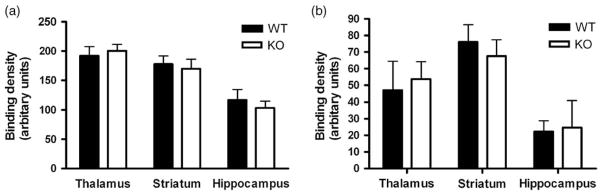
Figure 4. μ-Opioid receptor density and activation are unchanged in PKCε null mice
(a) μ-Opioid receptor density measured by [3H]DAMGO autoradiography was unchanged in PKCε null mice when compared with wild-type mice (P > 0.05, two-tailed t-test). (b) μ-Opioid receptor activation, measured by [35S]GTP-γS autoradiography after DAMGO stimulation, was unchanged in PKCε null mice compared with wild-type mice (P > 0.05, two-tailed t-test).

References

    1. Alessi DR. The protein kinase C inhibitors Ro 318220 and GF 109203X are equally potent inhibitors of MAPKAP kinase-1β (Rsk-2) and p70 S6 kinase. FEBS Lett. 1997;402:121–123. - PubMed
    1. Aley KO, Messing RO, Mochly-Rosen D, Levine JD. Chronic hypersensitivity for inflammatory nociceptor sensitization mediated by the epsilon isozyme of protein kinase C. J Neurosci. 2000;20:4680–4685. - PMC - PubMed
    1. Bailey CP, Connor M. Opioids: cellular mechanisms of tolerance and physical dependence. Curr Opin Pharmacol. 2005;5:60–68. - PubMed
    1. Bailey CP, Kelly E, Henderson G. Protein kinase C activation enhances morphine-induced rapid desensitization of mu-opioid receptors in mature rat locus ceruleus neurons. Mol Pharmacol. 2004;66:1592–1598. - PubMed
    1. Balmberg AB, Bannon AW. Models of nociception: hotplate, tail-flick, and formalin tests in rodents. In: Taylor GP, editor. Current Protocols in Neuroscience. Vol. 2. John Wiley and Sons; Hoboken, NJ: 1999. pp. 8.9.1–8.9.15. - PubMed

Publication types