Common inheritance of chromosome Ia associated with clonal expansion of Toxoplasma gondii
- PMID: 16902086
- PMCID: PMC1557770
- DOI: 10.1101/gr.5318106
Common inheritance of chromosome Ia associated with clonal expansion of Toxoplasma gondii
Abstract
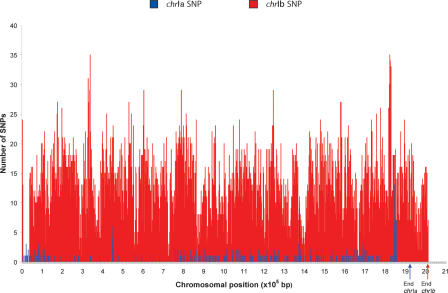
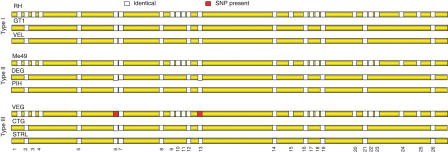
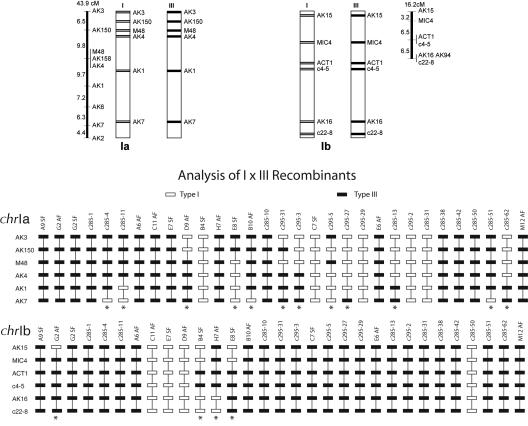
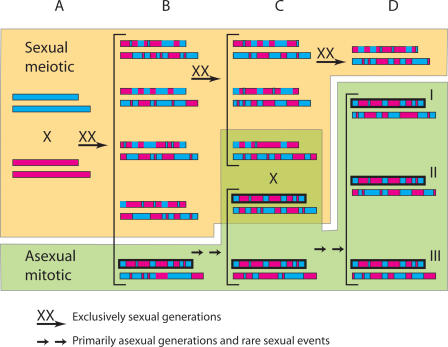
Toxoplasma gondii is a globally distributed protozoan parasite that can infect virtually all warm-blooded animals and humans. Despite the existence of a sexual phase in the life cycle, T. gondii has an unusual population structure dominated by three clonal lineages that predominate in North America and Europe, (Types I, II, and III). These lineages were founded by common ancestors approximately10,000 yr ago. The recent origin and widespread distribution of the clonal lineages is attributed to the circumvention of the sexual cycle by a new mode of transmission-asexual transmission between intermediate hosts. Asexual transmission appears to be multigenic and although the specific genes mediating this trait are unknown, it is predicted that all members of the clonal lineages should share the same alleles. Genetic mapping studies suggested that chromosome Ia was unusually monomorphic compared with the rest of the genome. To investigate this further, we sequenced chromosome Ia and chromosome Ib in the Type I strain, RH, and the Type II strain, ME49. Comparative genome analyses of the two chromosomal sequences revealed that the same copy of chromosome Ia was inherited in each lineage, whereas chromosome Ib maintained the same high frequency of between-strain polymorphism as the rest of the genome. Sampling of chromosome Ia sequence in seven additional representative strains from the three clonal lineages supports a monomorphic inheritance, which is unique within the genome. Taken together, our observations implicate a specific combination of alleles on chromosome Ia in the recent origin and widespread success of the clonal lineages of T. gondii.
Figures
References
-
- Ajioka J.W., Boothroyd J.C., Brunk B.P., Hehl A., Hillier L., Manger I.D., Marra M., Overton G.C., Roos D.S., Wan K.L., Boothroyd J.C., Brunk B.P., Hehl A., Hillier L., Manger I.D., Marra M., Overton G.C., Roos D.S., Wan K.L., Brunk B.P., Hehl A., Hillier L., Manger I.D., Marra M., Overton G.C., Roos D.S., Wan K.L., Hehl A., Hillier L., Manger I.D., Marra M., Overton G.C., Roos D.S., Wan K.L., Hillier L., Manger I.D., Marra M., Overton G.C., Roos D.S., Wan K.L., Manger I.D., Marra M., Overton G.C., Roos D.S., Wan K.L., Marra M., Overton G.C., Roos D.S., Wan K.L., Overton G.C., Roos D.S., Wan K.L., Roos D.S., Wan K.L., Wan K.L., et al. Gene discovery by EST sequencing in Toxoplasma gondii reveals sequences restricted to the Apicomplexa. Genome Res. 1998;8:18–28. - PubMed
-
- Ajzenberg D., Banuls A.L., Su C., Dumetre A., Demar M., Carme B., Darde M.L., Banuls A.L., Su C., Dumetre A., Demar M., Carme B., Darde M.L., Su C., Dumetre A., Demar M., Carme B., Darde M.L., Dumetre A., Demar M., Carme B., Darde M.L., Demar M., Carme B., Darde M.L., Carme B., Darde M.L., Darde M.L. Genetic diversity, clonality and sexuality in Toxoplasma gondii . Int. J. Parasitol. 2004;34:1185–1196. - PubMed
-
- Bartolome C., Maside X., Maside X. The lack of recombination drives the fixation of transposable elements on the fourth chromosome of Drosophila melanogaster . Genet. Res. 2004;83:91–100. - PubMed
-
- Boyle J.P., Rajasekar B., Saeij J.P., Ajioka J.W., Berriman M., Paulsen I., Roos D.S., Sibley L.D., White M.W., Boothroyd J.C., Rajasekar B., Saeij J.P., Ajioka J.W., Berriman M., Paulsen I., Roos D.S., Sibley L.D., White M.W., Boothroyd J.C., Saeij J.P., Ajioka J.W., Berriman M., Paulsen I., Roos D.S., Sibley L.D., White M.W., Boothroyd J.C., Ajioka J.W., Berriman M., Paulsen I., Roos D.S., Sibley L.D., White M.W., Boothroyd J.C., Berriman M., Paulsen I., Roos D.S., Sibley L.D., White M.W., Boothroyd J.C., Paulsen I., Roos D.S., Sibley L.D., White M.W., Boothroyd J.C., Roos D.S., Sibley L.D., White M.W., Boothroyd J.C., Sibley L.D., White M.W., Boothroyd J.C., White M.W., Boothroyd J.C., Boothroyd J.C. Just one cross appears capable of dramatically altering the population biology of an eukaryotic pathogen like Taxoplasma gondii . Proc. Natl. Acad. Sci. 2006;103:10514–10519. - PMC - PubMed
Publication types
MeSH terms
Associated data
- Actions
- Actions
- Actions
- Actions
- Actions
- Actions
- Actions
- Actions
- Actions
- Actions
- Actions
- Actions
- Actions
- Actions
- Actions
- Actions
- Actions
- Actions
- Actions
- Actions
- Actions
- Actions
- Actions
- Actions
- Actions
- Actions
- Actions
- Actions
- Actions
- Actions
- Actions
- Actions
- Actions
- Actions
- Actions
- Actions
- Actions
- Actions
- Actions
- Actions
- Actions
- Actions
- Actions
- Actions
- Actions
- Actions
- Actions
- Actions
- Actions
- Actions
- Actions
- Actions
- Actions
- Actions
- Actions
- Actions
- Actions
- Actions
- Actions
- Actions
- Actions
- Actions
- Actions
- Actions
- Actions
- Actions
- Actions
- Actions
- Actions
- Actions
- Actions
- Actions
- Actions
- Actions
- Actions
- Actions
- Actions
- Actions
- Actions
- Actions
- Actions
- Actions
- Actions
- Actions
- Actions
- Actions
- Actions
- Actions
- Actions
- Actions
- Actions
- Actions
- Actions
- Actions
- Actions
- Actions
- Actions
- Actions
- Actions
- Actions
- Actions
- Actions
- Actions
- Actions
- Actions
- Actions
- Actions
- Actions
- Actions
- Actions
- Actions
- Actions
- Actions
- Actions
- Actions
- Actions
- Actions
- Actions
- Actions
- Actions
- Actions
- Actions
- Actions
- Actions
- Actions
- Actions
- Actions
- Actions
- Actions
- Actions
- Actions
- Actions
- Actions
- Actions
- Actions
- Actions
- Actions
- Actions
- Actions
- Actions
Grants and funding
LinkOut - more resources
Full Text Sources
Other Literature Sources