


doi: 10.1126/science.1130105.
Single-molecule, motion-based DNA sequencing using RNA polymerase
Affiliations
- PMID: 16902131
- PMCID: PMC1865524
- DOI: 10.1126/science.1130105
Item in Clipboard
Single-molecule, motion-based DNA sequencing using RNA polymerase
Science.
.
Abstract
We present a method for sequencing DNA that relies on the motion of single RNA polymerase molecules. When a given nucleotide species limits the rate of transcription, polymerase molecules pause at positions corresponding to the rare base. An ultrastable optical trapping apparatus capable of base pair resolution was used to monitor transcription under limiting amounts of each of the four nucleotide species. From the aligned patterns of pauses recorded from as few as four molecules, we determined the DNA sequence. This proof of principle demonstrates that the motion of a processive nucleic acid enzyme may be used to extract sequence information directly from DNA.
Figures
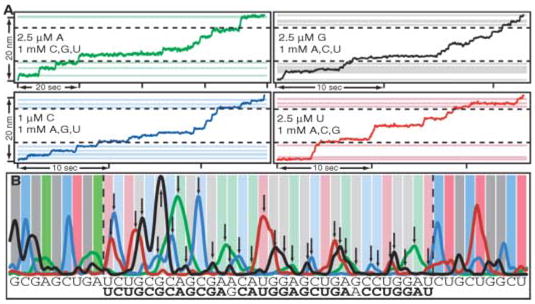
Motion-based DNA sequencing. (A) Aligned records of transcriptional position versus time for a single molecule of RNAP under the four different limiting nucleotide conditions (ATP, green; CTP, blue; GTP, black; and UTP, red). Positions of expected pauses used for record alignment (solid horizontal lines) flank the region to be sequenced (dotted horizontal lines). (B) Position histograms for the data in (A), normalized and smoothed. Flanking positions used for alignment (dark vertical bars) and unknown bases to be called (light vertical bars) are shown; base calls are indicated (arrows). The true sequence of the template is shown above the inferred sequence, with 30 of 32 correct bases (boldface type).
References
Publication types
MeSH terms
Substances
Grants and funding
LinkOut - more resources
Full Text Sources
Other Literature Sources
