


The Comparative Toxicogenomics Database (CTD): a resource for comparative toxicological studies
- PMID: 16902965
- PMCID: PMC1586110
- DOI: 10.1002/jez.a.307
The Comparative Toxicogenomics Database (CTD): a resource for comparative toxicological studies
Abstract
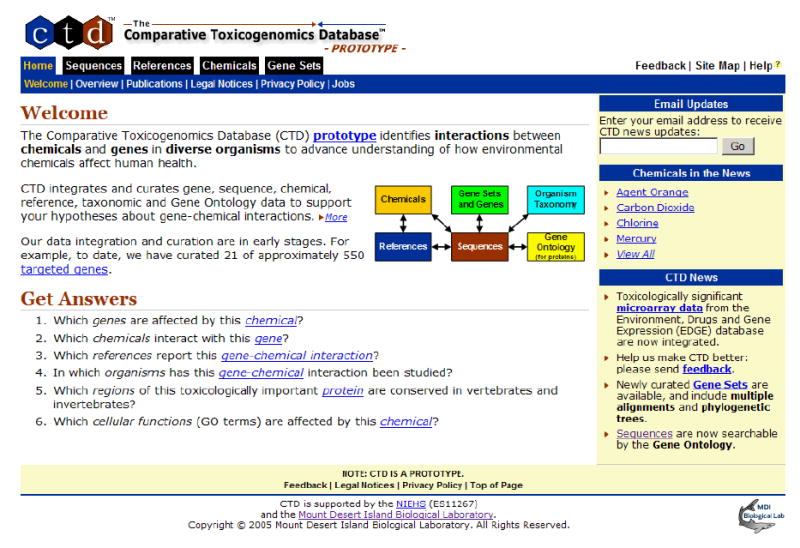
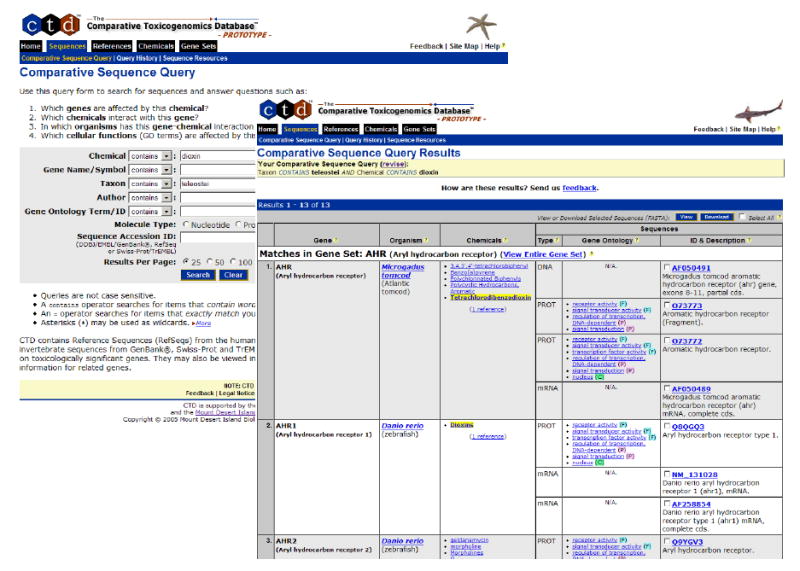
The etiology of most chronic diseases involves interactions between environmental factors and genes that modulate important biological processes (Olden and Wilson, 2000. Nat Rev Genet 1(2):149-153). We are developing the publicly available Comparative Toxicogenomics Database (CTD) to promote understanding about the effects of environmental chemicals on human health. CTD identifies interactions between chemicals and genes and facilitates cross-species comparative studies of these genes. The use of diverse animal models and cross-species comparative sequence studies has been critical for understanding basic physiological mechanisms and gene and protein functions. Similarly, these approaches will be valuable for exploring the molecular mechanisms of action of environmental chemicals and the genetic basis of differential susceptibility.
(c) 2006 Wiley-Liss, Inc.
Figures
References
-
- Harris MA, Clark J, Ireland A, Lomax J, Ashburner M, Foulger R, Eilbeck K, Lewis S, Marshall B, Mungall C, Richter J, Rubin GM, Blake JA, Bult C, Dolan M, Drabkin H, Eppig JT, Hill DP, Ni L, Ringwald M, Balakrishnan R, Cherry JM, Christie KR, Costanzo MC, Dwight SS, Engel S, Fisk DG, Hirschman JE, Hong EL, Nash RS, Sethuraman A, Theesfeld CL, Botstein D, Dolinski K, Feierbach B, Berardini T, Mundodi S, Rhee SY, Apweiler R, Barrell D, Camon E, Dimmer E, Lee V, Chisholm R, Gaudet P, Kibbe W, Kishore R, Schwarz EM, Sternberg P, Gwinn M, Hannick L, Wortman J, Berriman M, Wood V, de la Cruz N, Tonellato P, Jaiswal P, Seigfried T, White R. The Gene Ontology (GO) database and informatics resource. Nucleic Acids Res. 2004;32(Database issue):D258–261. - PMC - PubMed
-
- Mattingly CJ, Colby GT, Rosenstein MC, Forrest JN, Jr, Boyer JL. Promoting comparative molecular studies in environmental health research: an overview of the comparative toxicogenomics database (CTD) Pharmacogenomics J. 2004;4(1):5–8. - PubMed
-
- Olden K, Wilson S. Environmental health and genomics: visions and implications. Nat Rev Genet. 2000;1(2):149–153. - PubMed
Publication types
MeSH terms
Substances
Grants and funding
LinkOut - more resources
Full Text Sources
