Arteriographic demonstration of slow antegrade opacification distal to a cerebrovascular thromboembolic occlusion site as a favorable indicator for intra-arterial thrombolysis
- PMID: 16908573
- PMCID: PMC7977550
Arteriographic demonstration of slow antegrade opacification distal to a cerebrovascular thromboembolic occlusion site as a favorable indicator for intra-arterial thrombolysis
Abstract
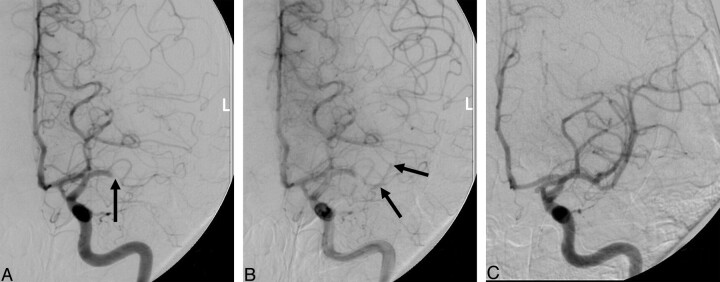
Purpose: This study sought to determine whether the angiographic demonstration of slow antegrade contrast opacification of an occluded cerebral artery distal to the thrombus (clot outline sign) on cerebral arteriograms performed immediately before thrombolytic treatment is associated with higher recanalization rates relative to patients without antegrade contrast opacification distal to the occlusion site.
Methods: The angiographic images of 100 consecutive arteriograms performed before thrombolysis in patients eligible for intra-arterial thrombolysis from May 1995 to February 2005 were reviewed. A modified Thrombolysis in Myocardial Infarction flow grade (mTIMI) was adapted to grade recanalization after cerebral thrombolysis. Clot outline sign was defined as slow antegrade contrast opacification distal to the thrombus on the delayed images of the presenting arteriogram. Logistic regression analysis for mTIMI grade included the following potential predictors: presence of outline sign, age, time to treatment, sex, site of occlusion, presenting National Institutes of Health Stroke Scale (NIHSS) score, presenting platelets, presenting systolic blood pressure, presence of pial collaterals, and admitting glucose value.
Results: Eighty-seven arteriograms were reviewed. Of these, 19 (22%) displayed the clot outline sign. Thirteen (69%) of 19 had clot outline sign, and 16 of 68 (29%) were not completely recanalized (mTIMI = 3); 95% with clot outline sign and 54% without were associated with either mTIMI 2 or 3 (P = .0055, Pearson correlation). Logistic regression analysis for recanalization relative to other predictors indicates that only the clot outline sign could act as a statistically significant predictor for recanalization (P = .0007).
Conclusion: Prethrombolysis cerebral arteriograms demonstrating delayed antegrade contrast opacification distal to the occlusion site are associated with higher recanalization rates.
Figures
References
-
- Del Zoppo G, Higashida R, Furlan A, et al. PROACT: A Phase II randomized trial of recombinant pro-urokinase by direct arterial delivery in acute middle cerebral artery stroke. Stroke 1998;29:4–11 - PubMed
-
- Furlan A, Higashida R, Weschler L, et al. Intra-arterial prourokinase for acute ischemic stroke: the PROACT II study. JAMA 1999;282:2003–11 - PubMed
-
- Zeumer H, Freitag HJ, Zanella F, et al. Local intra-arterial fibrinolytic therapy in patients with stroke: urokinase versus recombinant tissue plasminogen activator (r-TPA). Neuroradiology 1993;35:159–62 - PubMed
-
- Suarez J, Sunshine J, Tarr R, et al. Predictors of clinical improvement, angiographic recanalization, and intracranial hemorrhage after intra-arterial thrombolysis for acute ischemic stroke. Stroke 1999;30:2094–100 - PubMed
MeSH terms
Substances
LinkOut - more resources
Full Text Sources