


X chromosome-inactivation patterns of 1,005 phenotypically unaffected females
- PMID: 16909387
- PMCID: PMC1559535
- DOI: 10.1086/507565
X chromosome-inactivation patterns of 1,005 phenotypically unaffected females
Abstract
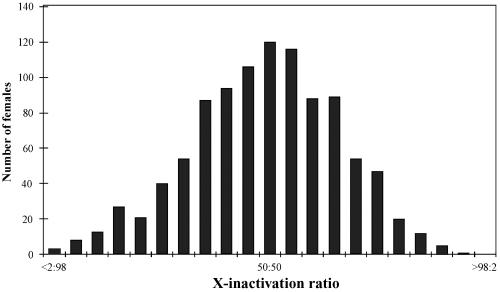
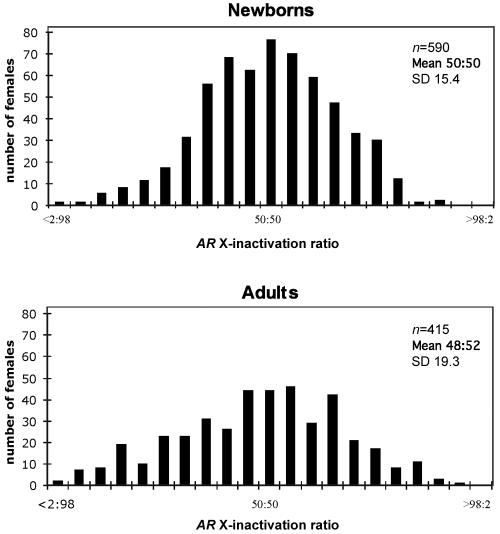
X-chromosome inactivation is widely believed to be random in early female development and to result in a mosaic distribution of cells, approximately half with the paternally derived X chromosome inactive and half with the maternally derived X chromosome inactive. Significant departures from such a random pattern are hallmarks of a variety of clinical states, including being carriers for severe X-linked diseases or X-chromosome cytogenetic abnormalities. To evaluate the significance of skewed patterns of X inactivation, we examined patterns of X inactivation in a population of >1,000 phenotypically unaffected females. The data demonstrate that only a very small proportion of unaffected females show significantly skewed inactivation, especially during the neonatal period. By comparison with this data set, the degree of skewed inactivation in a given individual can now be quantified and evaluated for its potential clinical significance.
Figures
References
Web Resource
-
- Online Mendelian Inheritance in Man (OMIM), http://www.ncbi.nlm.nih.gov/Omim/ (for Duchenne muscular dystrophy)
References
-
- Nance WE (1964) Genetic tests with a sex-linked marker: glucose-6-phosphate dehydrogenase. Cold Spring Harbor Symp Quant Biol 29:415–425 - PubMed
-
- Willard HF (2000) The sex chromosomes and X chromosome inactivation. In: Scriver CR, Beaudet AL, Sly WS, Valle D, Childs B, Vogelstein B (eds) The metabolic and molecular bases of inherited disease, 8th ed. McGraw-Hill, New York, pp 1191–1221
Publication types
MeSH terms
Grants and funding
LinkOut - more resources
Full Text Sources
Other Literature Sources
