


Clinical implications of FLT3 mutations in pediatric AML
- PMID: 16912228
- PMCID: PMC1895470
- DOI: 10.1182/blood-2006-03-009233
Clinical implications of FLT3 mutations in pediatric AML
Abstract
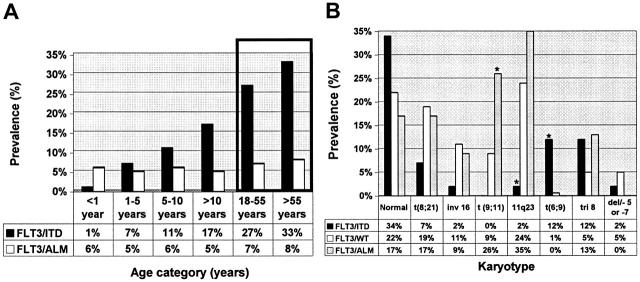
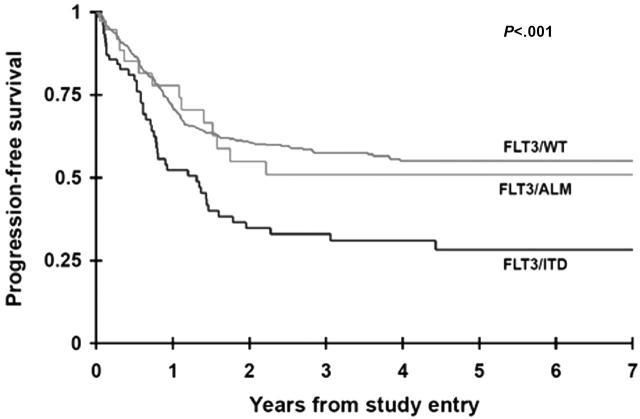
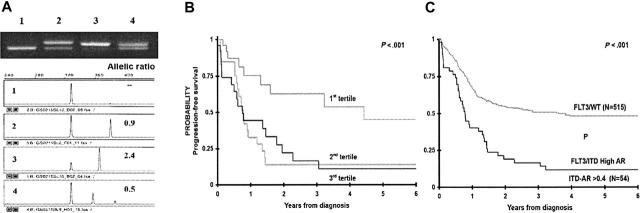
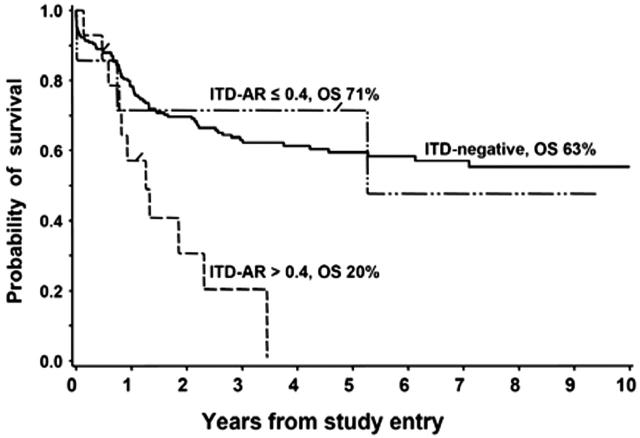
Activating mutations of the FLT3 gene occur because of an internal tandem duplication of the juxta-membrane domain (FLT3/ITD) or point mutation of the activation loop domain (FLT3/ALM). The presence of FLT3 mutations as well as the allelic ratio of FLT3/ITD (ITD-AR, mutant-wild type ratio) may have prognostic significance. FLT3 mutation status of 630 children with de novo acute myeloid leukemia (AML) treated on CCG-2941 and -2961 was determined, and ITD-AR was calculated for patients with FLT3/ITD. Clinical characteristics and outcomes for patients with FLT3/ALM and FLT3/ITD at varying ITD-ARs was determined and compared with those without FLT3 mutations (FLT3/WT). FLT3/ITD and FLT3/ALM were detected in 77 (12%) and 42 (6.7%) of the patients. Progression-free survival (PFS) was similar in patients with FLT3/ALM and FLT3/WT (51% versus 55%, P = .862). In contrast, PFS at 4 years from study entry for patients with FLT3/ITD was inferior to that of patients with FLT3/WT (31% versus 55%, P < .001). PFS decreased with increasing FLT3/ITD-AR (P < .001), and those with ITD-AR greater than 0.4 had a significantly worse PFS than those with lower ITD-AR (16% versus 72%, P = .001) or with FLT3/WT (55%, P < .001). ITD-AR defines the prognostic significance in FLT3/ITD-positive AML, and ITD-AR greater than 0.4 is a significant and independent prognostic factor for relapse in pediatric AML.
Figures
References
-
- Tse KF, Novelli E, Civin CI, Bohmer FD, Small D. Inhibition of FLT3-mediated transformation by use of a tyrosine kinase inhibitor. Leukemia. 2001;15: 1001-1010. - PubMed
-
- Abu-Duhier FM, Goodeve AC, Wilson GA, Care RS, Peake IR, Reilly JT. Identification of novel FLT-3 Asp835 mutations in adult acute myeloid leukaemia. Br J Haematol. 2001;113: 983-988. - PubMed
-
- Abu-Duhier FM, Goodeve AC, Wilson GA, et al. FLT3 internal tandem duplication mutations in adult acute myeloid leukaemia define a high-risk group. Br J Haematol. 2000;111: 190-195. - PubMed
-
- Kiyoi H, Naoe T, Yokota S, et al. Internal tandem duplication of FLT3 associated with leukocytosis in acute promyelocytic leukemia. Leukemia Study Group of the Ministry of Health and Welfare (Kohseisho). Leukemia. 1997;11: 1447-1452. - PubMed
-
- Stirewalt DL, Kopecky KJ, Meshinchi S, et al. FLT3, RAS, and TP53 mutations in elderly patients with acute myeloid leukemia. Blood. 2001; 97: 3589-3595. - PubMed
Publication types
MeSH terms
Substances
Grants and funding
LinkOut - more resources
Full Text Sources
Other Literature Sources
Medical
Research Materials
Miscellaneous
