. 2006 Aug 16:6:62.
doi: 10.1186/1471-2148-6-62.

Retrotranspositions in orthologous regions of closely related grass species

Affiliations

Retrotranspositions in orthologous regions of closely related grass species

Chunguang Du et al. BMC Evol Biol. .

Abstract

Background: Retrotransposons are commonly occurring eukaryotic transposable elements (TEs). Among these, long terminal repeat (LTR) retrotransposons are the most abundant TEs and can comprise 50-90% of the genome in higher plants. By comparing the orthologous chromosomal regions of closely related species, the effects of TEs on the evolution of plant genomes can be studied in detail.

Results: Here, we compared the composition and organization of TEs within five orthologous chromosomal regions among three grass species: maize, sorghum, and rice. We identified a total of 132 full or fragmented LTR retrotransposons in these regions. As a percentage of the total cumulative sequence in each species, LTR retrotransposons occupy 45.1% of the maize, 21.1% of the rice, and 3.7% of the sorghum regions. The most common elements in the maize retrotransposon-rich regions are the copia-like retrotransposons with 39% and the gypsy-like retrotransposons with 37%. Using the contiguous sequence of the orthologous regions, we detected 108 retrotransposons with intact target duplication sites and both LTR termini. Here, we show that 74% of these elements inserted into their host genome less than 1 million years ago and that many retroelements expanded in size by the insertion of other sequences. These inserts were predominantly other retroelements, however, several of them were also fragmented genes. Unforeseen was the finding of intact genes embedded within LTR retrotransposons.

Conclusion: Although the abundance of retroelements between maize and rice is consistent with their different genome sizes of 2,364 and 389 Mb respectively, the content of retrotransposons in sorghum (790 Mb) is surprisingly low. In all three species, retrotransposition is a very recent activity relative to their speciation. While it was known that genes re-insert into non-orthologous positions of plant genomes, they appear to re-insert also within retrotransposons, potentially providing an important role for retrotransposons in the evolution of gene function.


Figures
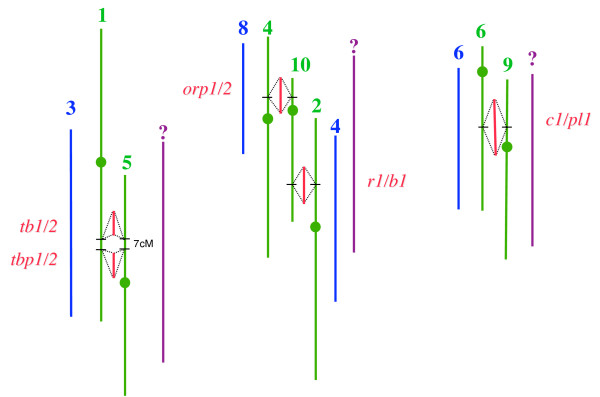
Figure 1
Figure 1
Five orthologous regions analyzed. Each maize region is represented by two homoeologous sequences depicting the whole-genome duplication event. Both rice and sorghum have one chromosomal sequence aligned. Each number on top of the line is the chromosome number. However, the chromosome number for sorghum is unknown. Blue, green, and purple lines represent rice, maize, and sorghum, respectively. A more detailed annotation of these regions with sequence coordinates have been published previously [31].
Figure 2
Figure 2
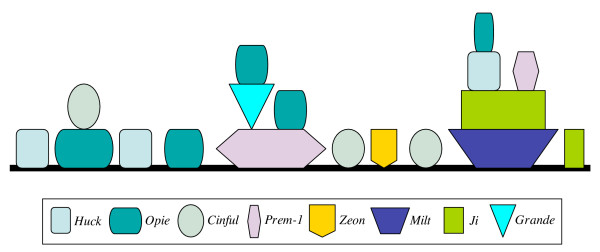
Organization of LTR-retrotransposons at the orp1 locus. The maize orp1 region on maize chromosome 4S has three-layer nested LTR retrotransposons. This region also contains the highest number of LTR retrotransposons. A color code for the various retrotransposon families has been added.
Figure 3
Figure 3
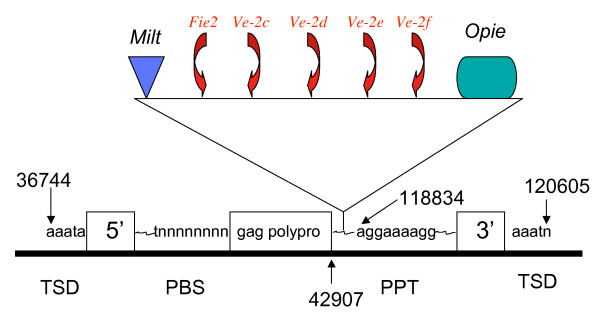
Genes nested in LTR retrotransposons at the orp2 locus on maize chromosome 10S. Some of the screened contigs permitted the analysis of more complex retrotransposon blocks like the region around orange pericarp 2 (orp2) locus on maize chromosome 10S. This region contains nested as well as non-nested LTR retrotransposons. Five genes are nested within Ji-3 retrotransposon of the orp2 region. Arrows provide the polarity of genes. Genes and elements are directly labeled in the figure. Position of insertions and truncations are given in nucleotide positions as they relate to the entire BAC sequence.
Figure 4
Figure 4
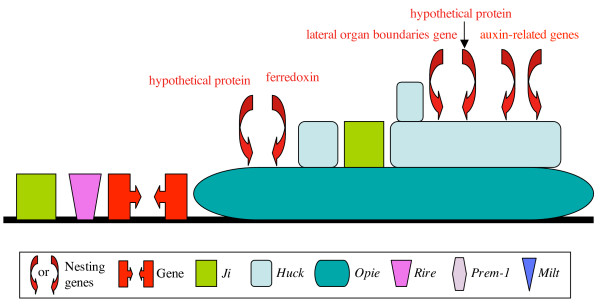
Genes nested in LTR retrotransposons at the tbp1 locus on maize chromosome 1L. The region around TATA-binding protein 1 (tbp1) on maize chromosome 1L contains nested as well as non-nested LTR retrotransposons. Four genes are nested within the Huck element and two within the Opie element of the tbp1 region. Genes are directly labeled in the figure. A color code for the TEs has been added.

References

    1. Casacuberta JM, Santiago N. Plant LTR-retrotransposons and MITEs: control of transposition and impact on the evolution of plant genes and genomes. Gene. 2003;311:1–11. doi: 10.1016/S0378-1119(03)00557-2. - DOI - PubMed
    1. International-Human-Genome-Sequencing-Consortium Finishing the euchromatic sequence of the human genome. Nature. 2004;431:931–945. doi: 10.1038/nature03001. - DOI - PubMed
    1. Messing J, Bharti AK, Karlowski WM, Gundlach H, Kim HR, Yu Y, Wei F, Fuks G, Soderlund CA, Mayer KF, Wing RA. Sequence composition and genome organization of maize. Proc Natl Acad Sci U S A. 2004;101:14349–14354. doi: 10.1073/pnas.0406163101. - DOI - PMC - PubMed
    1. Ma J, Bennetzen JL. Rapid recent growth and divergence of rice nuclear genomes. Proc Natl Acad Sci U S A. 2004;101:12404–12410. doi: 10.1073/pnas.0403715101. - DOI - PMC - PubMed
    1. Kumar A, Bennetzen JL. Plant retrotransposons. Annu Rev Genet. 1999;33:479–532. doi: 10.1146/annurev.genet.33.1.479. - DOI - PubMed

Publication types