. 2006;34(14):4036-45.
doi: 10.1093/nar/gkl559. Epub 2006 Aug 16.

Elongation complexes of Thermus thermophilus RNA polymerase that possess distinct translocation conformations

Affiliations

Elongation complexes of Thermus thermophilus RNA polymerase that possess distinct translocation conformations

Ekaterina Kashkina et al. Nucleic Acids Res. 2006.

Abstract

We have characterized elongation complexes (ECs) of RNA polymerase from the extremely thermophilic bacterium, Thermus thermophilus. We found that complexes assembled on nucleic acid scaffolds are transcriptionally competent at high temperature (50-80 degrees C) and, depending upon the organization of the scaffold, possess distinct translocation conformations. ECs assembled on scaffolds with a 9 bp RNA:DNA hybrid are highly stable, resistant to pyrophosphorolysis, and are in the posttranslocated state. ECs with an RNA:DNA hybrid longer or shorter than 9 bp appear to be in a pretranslocated state, as evidenced by their sensitivity to pyrophosphorolysis, GreA-induced cleavage, and exonuclease footprinting. Both pretranslocated (8 bp RNA:DNA hybrid) and posttranslocated (9 bp RNA:DNA hybrid) complexes were crystallized in distinct crystal forms, supporting the homogeneity of the conformational states in these complexes. Crystals of a posttranslocated complex were used to collect diffraction data at atomic resolution.


Figures
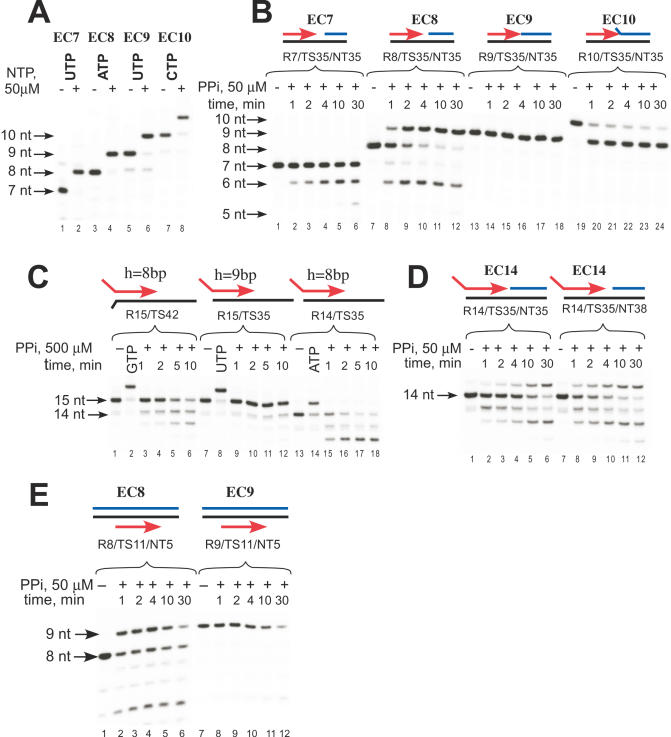
Figure 1
Figure 1
Sensitivity of different Tth RNAP ECs to pyrophosphorolysis. (A) Tth RNAP ECs (EC7, EC8, EC9, EC10, R7–10/TS35/NT35) were incubated with the substrate NTP (50 μM) for 5 min at RT as described in Materials and Methods. (B–D) Effect of the length of the RNA:DNA hybrid (B) and scaffold topology (C and D) on sensitivity to pyrophosphorolysis. Scaffold ECs were obtained as noted and then incubated with 50 (B, D and E) or 500 μM (C) PPi at 60°C for the times indicated. (E) Pyrophosphorolysis in complexes having fully complementary NT strand. EC9 was obtained by incubation of EC8 (R8/TS11/NT05b) with GTP for 2 min at 60°C followed by the removal of the NTP by washing with transcription buffer. The complexes were then incubated with 50 μM PPi at 60°C for the times indicated. Note that in EC8 (B and E) and EC14 (D) the RNA primer is extended by incorporation of substrate NTP released during pyrophosphorolysis. Color scheme: RNA-red, DNA T strand-black and DNA NT strand-blue.
Figure 2
Figure 2
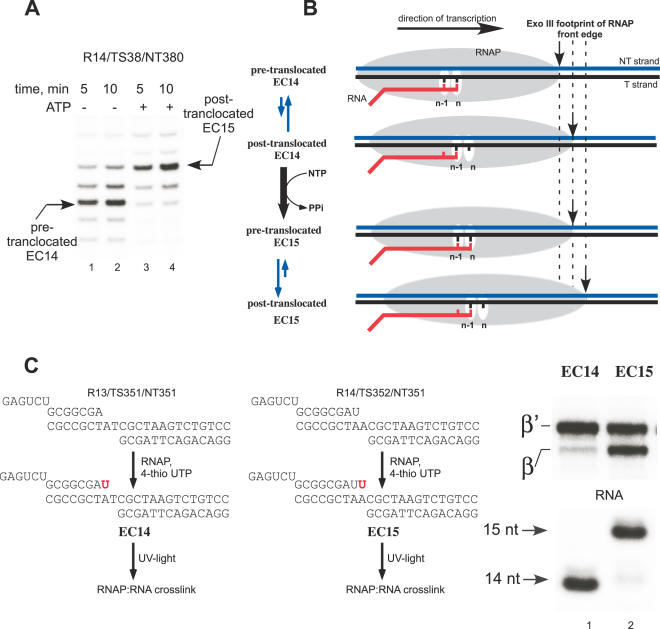
Probing of the EC translocation conformations. (A) Exo III footprints of EC14 and EC15. Tth EC14 (lanes 1 and 2) was assembled as described in Materials and Methods. EC15 (lanes 3 and 4) was obtained by incubation of EC14 with substrate ATP for 2 min at 60°C. Exo III (0.02 U/μl) was added for 5 (lanes 1 and 3) or 10 (lanes 2 and 4) min at 37°C. (B) Schematics of RNAP front edge oscillations in EC14 and EC15. (C) Photo cross-linking patterns of Tth EC14 and EC15, EC14 and EC15 containing 5′ 32P-labeled RNA primers were prepared as illustrated (left). The photo cross-linking analog 4-thio UTP (50 μM) was incorporated into the transcript for 2 min at 60°C followed UV light irradiation for 5 min at RT. The cross-linked species were separated using gel electrophoresis (right).
Figure 3
Figure 3
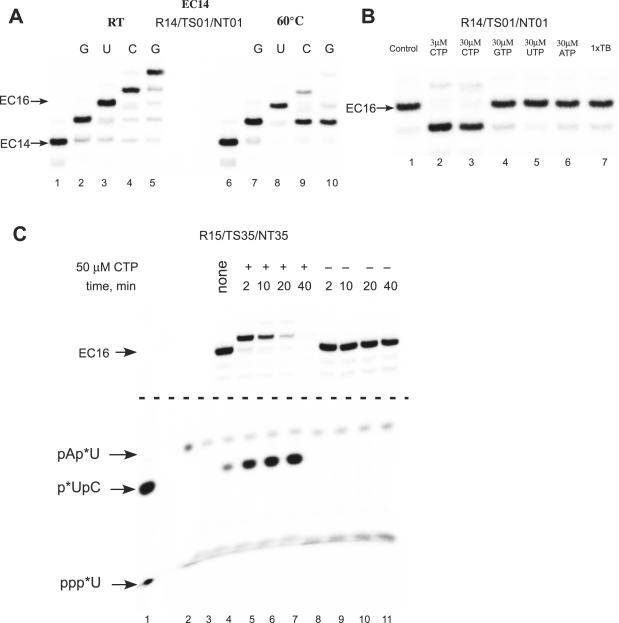
Intrinsic endonuclease activity in Tth RNAP EC. (A) Walking of Tth RNAP on an immobilized DNA template. EC14, formed using biotinylated NT DNA strand (NT01) and a 5′ 32P-labeled RNA primer was immobilized on streptavidin agarose beads, and the RNA primer was extended by several subsequent steps of NTP incorporation and washing at RT (lanes 1–5) and 60°C (lanes 6–10). (B) Nucleolytic activity in Tth RNAP EC16. Tth EC16 was obtained by extension of the RNA primer in EC14 using the walking technique at 60°C (lane 1) and incubated with the CTP (lanes 2 and 3), non-cognate NTPs (lanes 4–6) or without substrates (lane 7) for 5 min at 60°C. (C) EC16 (lane 3) was obtained by extension of the RNA primer in R15/TS35/NT35 by incorporation of [α-32P]UTP at the 3′ end of the RNA. The complex was then incubated in the presence (lanes 4–7) or absence (lanes 8–11) of 50 μM CTP for 2–40 min at 60°C, and the products of the reaction were analyzed by 23% PAGE electrophoresis. The central portion of the gel was removed for clarity. The position of 32P-labeled markers—pUpC (lane 1) and pApU (lane 2) are indicated by arrows; * denotes position of the labeled phosphate.
Figure 4
Figure 4
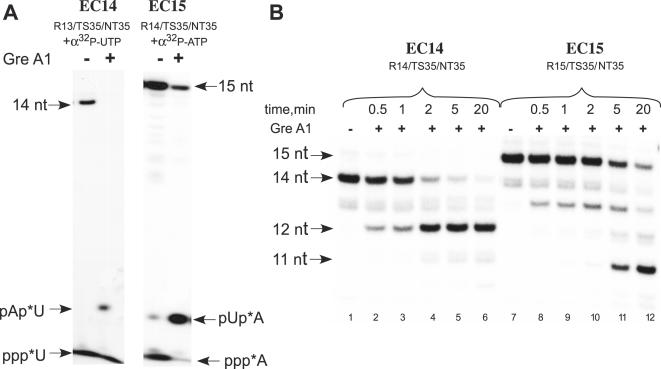
Sensitivity of Tth RNAP ECs to GreA stimulated nucleolytic activity. (A) Complexes R13/TS35/NT35 and R14/TS35/NT35 were labeled by incorporation of [α-32P]UTP and ATP, respectively, and incubated with an equimolar amount of Tth GreA (1 μM) for 10 min at 60°C. The products of the reaction were resolved in 23% PAGE. (B) EC14 and EC15, containing 5′ 32P-labeled RNA primers were incubated with equimolar amount of Tth GreA at 60°C for the times indicated.
Figure 5
Figure 5
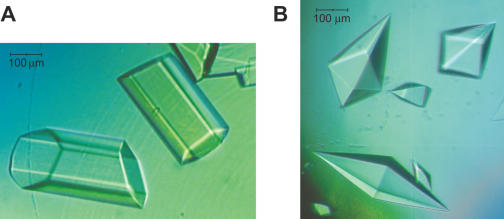
Crystals of Tth RNAP ECs. (A) Hexagonal crystals of pretranslocated Tth RNAP EC14 (B) Bi-pyramidal crystals of posttranslocated Tth RNAP EC15.

References

    1. Vassylyev D.G., Svetlov V., Vassylyeva M.N., Perederina A., Igarashi N., Matsugaki N., Wakatsuki S., Artsimovitch I. Structural basis for transcription inhibition by tagetitoxin. Nature Struct. Mol. Biol. 2005;12:1086–1093. - PMC - PubMed
    1. Campbell E.A., Korzheva N., Mustaev A., Murakami K., Nair S., Goldfarb A., Darst S.A. Structural mechanism for rifampicin inhibition of bacterial RNA polymerase. Cell. 2001;104:901–912. - PubMed
    1. Murakami K.S., Masuda S., Darst S.A. Structural basis of transcription initiation: RNA polymerase holoenzyme at 4 A resolution. Science. 2002;296:1280–1284. - PubMed
    1. Zhang G., Campbell E.A., Minakhin L., Richter C., Severinov K., Darst S.A. Crystal structure of Thermus aquaticus core RNA polymerase at 3.3 A resolution. Cell. 1999;98:811–824. - PubMed
    1. Artsimovitch I., Patlan V., Sekine S., Vassylyeva M.N., Hosaka T., Ochi K., Yokoyama S., Vassylyev D.G. Structural basis for transcription regulation by alarmone ppGpp. Cell. 2004;117:299–310. - PubMed

Publication types

MeSH terms