


Epithelial organic cation transporters ensure pH-dependent drug absorption in the airway
- PMID: 16917073
- PMCID: PMC1899308
- DOI: 10.1165/rcmb.2006-0230OC
Epithelial organic cation transporters ensure pH-dependent drug absorption in the airway
Abstract
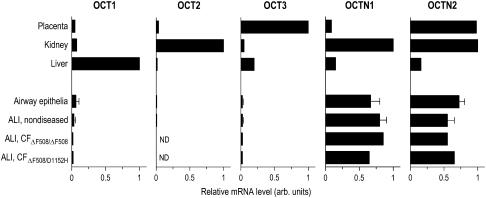
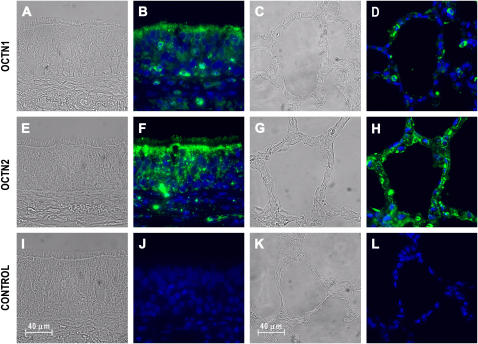
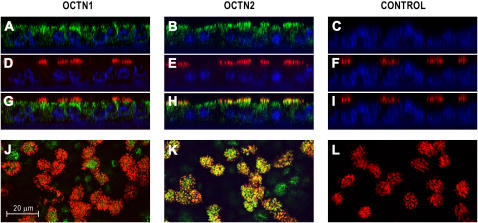
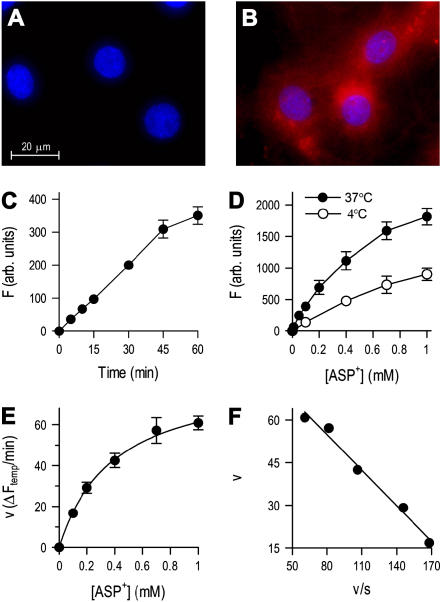
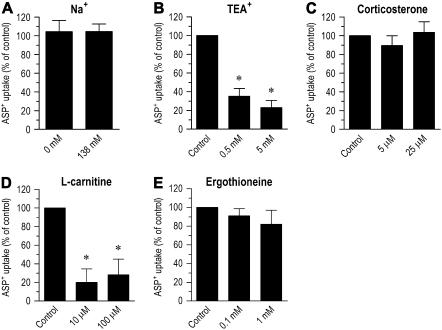
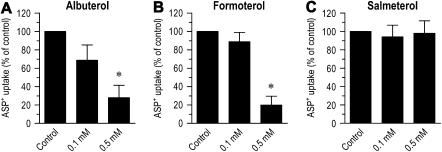
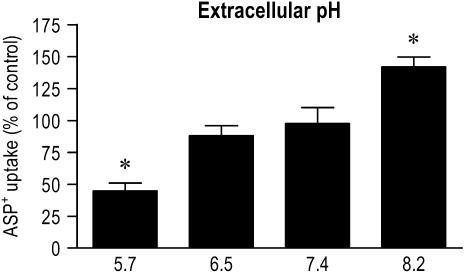
Most inhaled beta(2)-adrenergic agonist and anticholinergic bronchodilators have low lipid solubility because of their transient or permanent positive net charge at physiologic pH. Airway absorption of these cationic drugs is incompletely understood. We examined carrier-mediated mechanisms of cationic drug uptake by human airway epithelia. Airway tissues and epithelial cells, obtained from lung donors without preexisting lung disease, were evaluated for organic cation transporter expression by quantitative RT-PCR and immunofluorescence. For in vitro functional studies on primary airway epithelial cells, uptake of the cationic fluorophore 4-[4-(dimethylamino)-styryl]-N-methylpyridinium (ASP+) was characterized. Quantitative RT-PCR analysis demonstrated high mRNA levels for two polyspecific organic cation/carnitine transporters, OCTN1 and OCTN2, in human airway epithelia. Immunofluorescence of human airway sections confirmed OCTN1/2 protein expression, with a predominant localization to the apical portion of epithelial cells. Primary airway epithelial cells showed a carrier-mediated, temperature-sensitive and saturable uptake of ASP(+). Seventy-five to eighty percent of ASP(+) uptake was inhibited by L-carnitine, an OCTN2-carried zwitterion. The uptake was pH dependent, with approximately 3-fold lower rates at acidic (pH 5.7) than at alkaline (pH 8.2) extracellular pH. Albuterol and formoterol inhibited ASP(+) uptake, suggesting that all these molecules are carried by the same transport mechanism. These findings demonstrate the existence and functional role of a pH-dependent organic cation uptake machinery, namely OCTN1 and OCTN2, in human airway epithelia. We suggest that epithelial OCTN1/2 are involved in the delivery of inhaled cationic bronchodilators to the airway tissue.
Figures
References
-
- Patton JS, Fishburn CS, Weers JG. The lungs as a portal of entry for systemic drug delivery. Proc Am Thorac Soc 2004;1:338–344. - PubMed
-
- Johnson M. Molecular mechanisms of beta(2)-adrenergic receptor function, response, and regulation. J Allergy Clin Immunol 2006;117:18–24. - PubMed
-
- Gross NJ. Anticholinergic agents in asthma and COPD. Eur J Pharmacol 2006;533:36–39. - PubMed
-
- Kerb R. Implications of genetic polymorphisms in drug transporters for pharmacotherapy. Cancer Lett 2006;234:4–33. - PubMed
-
- Koepsell H. Polyspecific organic cation transporters: their functions and interactions with drugs. Trends Pharmacol Sci 2004;25:375–381. - PubMed
Publication types
MeSH terms
Substances
Grants and funding
LinkOut - more resources
Full Text Sources
Other Literature Sources
Medical
