


Prevention of mental health problems: rationale for a universal approach
- PMID: 16920756
- PMCID: PMC2083132
- DOI: 10.1136/adc.2006.100776
Prevention of mental health problems: rationale for a universal approach
Abstract
Background and objective: Mental health problems are a public health issue affecting as many as 20% of children in modern communities. Risk factors for externalising and internalising problems can occur in infancy. Infants at high risk live in stressed families with parent mental health problems, substance misuse, relationship conflict, social isolation, financial problems or infant temperamental difficulty. Although current prevention programmes target services to high-risk groups, targeting can stigmatise families and miss many children in need. The addition of universal prevention programmes for all families could address these concerns. This survey assessed the prevalence of infants at risk attending a primary care service as a delivery point for universal prevention.
Design: Survey of mothers of 6-month-old infants attending well-child clinics across six government areas of Melbourne, Victoria, Australia, between August and September 2004. A brief survey measured sociodemographic characteristics and the following family risks: maternal depression, anxiety, stress, substance misuse, violence at home, social isolation and infant temperamental difficulty.
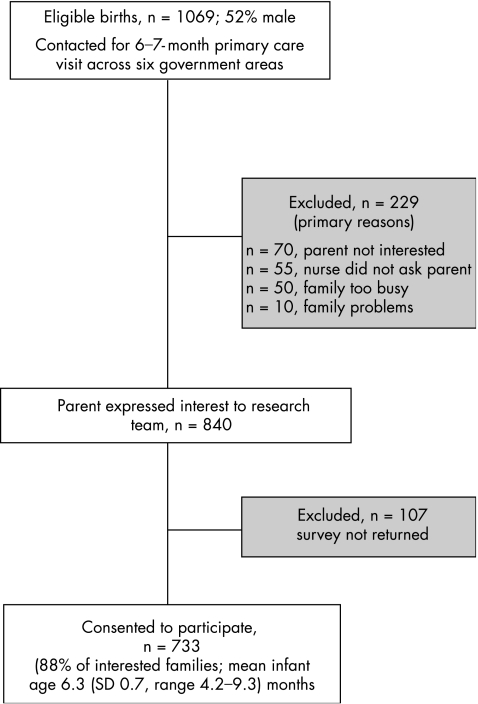
Results: The survey was completed by 733 mothers, representing 69% of infant births presented to the primary care service. Of these, 39% of infants were classified as at risk for developing mental health problems. The percentage of infants classified as at risk was not markedly dissimilar across socioeconomic levels (low, 42%; middle, 40%; high, 35%).
Conclusions: A substantial number of infants attending routine universal primary care are at risk of developing mental health problems. This primary care setting could provide an ideal platform for preventing early externalising and internalising problems via a universally offered, evidence-based parenting programme.
Conflict of interest statement
Competing interests: None.
References
-
- Anderson J C. Epidemiological issues. In: Ollendick TH, King NJ, Yule W, eds. International handbook of phobic and anxiety disorders in children and adolescents. New York: Plenum Press, 199443–65.
-
- Sawyer M G, Arney F M, Baghurst P A.et alThe mental health of young people in Australia. Australia: Mental Health and Special Programs Branch, Commonwealth Department of Health and Aged Care, 2000
-
- McConaughy S H, Achenbach T M. Comorbidity of empirically based syndromes in matched general population and clinical samples. J Child Psychol Psychiatr 1994351141–1157. - PubMed
-
- Barlow J, Stewart‐Brown S. Review article: behaviour problems and parent training programs. J Dev Behav Pediatr 200021356–370. - PubMed
-
- Bor W, Najman J M, O'Callaghan G M.et al Aggression and the development of delinquent behaviour in children. Trends and issues in crime and criminal justice. Series No: 201, Canberra: Australian Institute of Criminology 2001. http://www.aic.gov.au
Publication types
MeSH terms
LinkOut - more resources
Full Text Sources
Medical
